
Train for the Half Marathon Course You’re Racing
You can follow a very good half marathon training programme and still arrive on race day underprepared for your particular race.
Why?
Because 21.1 kilometres doesn’t always mean the same thing.
A flat, fast road half marathon is a very different challenge from a course containing repeated climbs. A race with a long downhill section asks different questions of your legs again. A trail half marathon may introduce uneven surfaces, tight corners and significant elevation changes.
Then there are environmental factors.
Wind.
Heat.
Cold.
Exposed sections.
And even something as simple as a sharp climb at kilometre 18 can completely change how you should prepare.
Your training therefore shouldn’t only prepare you to run 21.1 kilometres.
It should prepare you to run the 21.1 kilometres you’re actually racing.
Know Your Course Before You Start Training for It
One of the first things I recommend doing once you’ve chosen your goal half marathon is looking properly at the course.
Don’t wait until race week.
Find the course map.
Look at the elevation profile.
Read the race information.
If previous participants have uploaded their races to Strava or similar platforms, their data can provide another useful indication of what the course actually looks like.
You’re trying to answer questions such as:
- Is the course predominantly flat, rolling or hilly?
- How much total climbing is there?
- Where are the major climbs?
- How long are they?
- Are there substantial descents?
- What surface will you be running on?
- Are there exposed sections where wind could matter?
- Are there frequent corners or changes of direction?
- Where are the aid stations?
- What does the final 5K look like?
That final question is particularly important.
A hill at kilometre three and the same hill at kilometre 18 are not the same challenge.
You need to understand not only what the course contains, but when you’ll encounter it.
Specificity Matters
As you progress through your half marathon preparation, your training should become increasingly specific to the demands of your goal event.
That doesn’t mean every training run needs to replicate the race course.
Far from it.
Your easy running still needs to be easy.
Your aerobic development still matters.
Your threshold fitness still matters.
Your long runs still matter.
But as race day approaches, there should be fewer surprises between what you’ve experienced in training and what you’ll experience on race day.
If your race is hilly, include hills.
If it’s flat and fast, spend time developing your ability to maintain rhythm on flatter terrain.
If there’s a long descent, prepare your legs for downhill running.
If you’re racing on trails, don’t complete every important run on smooth asphalt.
Train for the demands of the event you’re entering.
Racing a Hilly Half Marathon? Train on Hills
This seems obvious, yet runners regularly enter hilly events after doing most of their training on flat terrain.
If your half marathon contains significant climbing, hills need to feature in your preparation.
That doesn’t mean every run needs to be hilly.
It means your training should develop the strength, aerobic power, technique and pacing skills required to handle climbing efficiently.
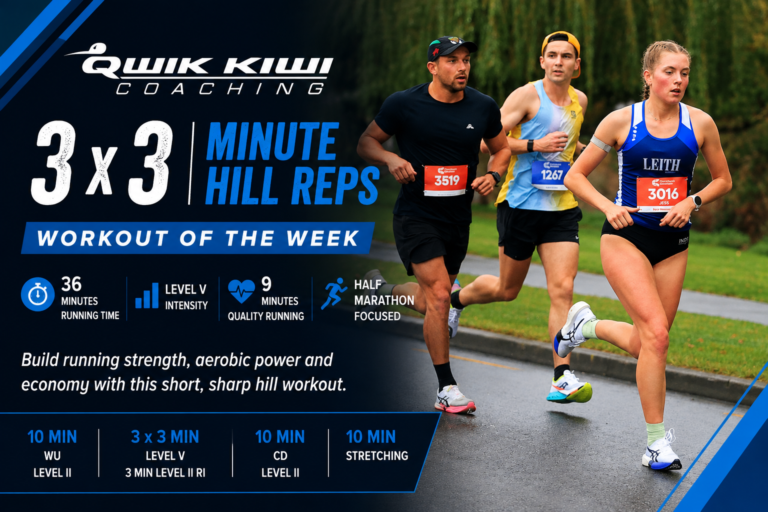
Hill repetitions can be particularly useful earlier in the quality phases of your preparation. For example, I use workouts such as 10x 1-minute Level V hill repetitions during the Early Quality (EQ) Phase to develop aerobic power, running strength and economy.
But structured hill repetitions aren’t the only answer.
Your aerobic runs and long runs can also incorporate terrain similar to what you’ll face on race day.
If your goal event repeatedly rolls up and down, completing all your long runs on dead-flat roads won’t provide the same muscular demands.
Don’t Just Train the Uphills
When runners look at a hilly race profile, their attention naturally goes to the climbs.
But the downhills deserve respect too.
Running downhill isn’t simply free speed.
Repeated or prolonged descending creates substantial eccentric loading as your muscles work to control your body with each landing.
If you’re not accustomed to it, your quadriceps can become increasingly fatigued as the race progresses.
That matters enormously if the course asks you to descend significantly and then continue running strongly afterwards.
So if your goal race contains substantial downhill running, include appropriate descents in training.
Don’t suddenly smash downhill repetitions as fast as possible.
Introduce the demand progressively.
Develop your technique.
Learn to remain relaxed.
And give your legs time to adapt.
Learn to Pace by Effort on Hills
One of the biggest mistakes you can make on a hilly half marathon is trying to force your flat-road goal pace up every climb.
The hill doesn’t care what pace is written on your race plan.
As the gradient increases, the physiological cost of maintaining the same speed increases too.
Your pace should therefore respond to the terrain.
On an uphill section, you may run considerably slower while maintaining an appropriate effort.
On a descent, you may naturally run faster.
This is why understanding intensity and perceived effort becomes so valuable.
Rather than panicking because your watch says you’re 20 seconds per kilometre slower on a climb, ask:
Am I running at the appropriate effort for this part of the race?
Your overall pacing strategy should account for the course profile rather than pretending every kilometre is identical.
I’ve previously discussed this principle in my broader half marathon pacing strategy: pacing needs to respond intelligently to course profile and conditions rather than being dictated blindly by instantaneous GPS pace.
Flat Courses Require Specific Preparation Too
Course-specific training isn’t only for hilly races.
A very flat half marathon presents its own challenge.
There may be little variation in your stride.
Very few natural changes in pace.
No descents providing a temporary change in muscular demand.
You’re simply required to settle into your rhythm and keep producing it.
Kilometre after kilometre.
If you’re targeting a flat, fast race, include appropriate training where you practise maintaining a consistent rhythm on relatively flat terrain.
Race-pace workouts become particularly valuable.
You want your intended half marathon pace to feel familiar.
You should know what the rhythm feels like.
What your breathing feels like.
What your cadence feels like.
And what happens to your perceived effort as fatigue accumulates.
Match the Surface
Terrain isn’t only about elevation.
Think about the surface you’re going to race on.
A road half marathon primarily rewards road-running fitness.
A gravel course may change your footing and pace.
A trail event could include roots, rocks, mud, narrow sections and uneven surfaces.
Training exclusively on smooth roads and then racing 21.1km on technical trails creates an obvious specificity problem.
The reverse can also apply.
If you’re preparing for a fast road half marathon but almost all of your running is on slow, technical trails, you may be developing excellent general fitness without spending enough time practising the rhythm required for sustained road running.
You don’t need to abandon the surfaces you enjoy.
Just make sure some of your training reflects the demands of your goal race.
Train for the Final 5K
Don’t simply look at the average characteristics of the course.
Look at what happens late in the race.
Suppose your half marathon contains a significant climb at kilometre 17.
That’s important information.
You don’t just need to be capable of running uphill.
You need to be capable of running uphill after approximately 17 kilometres of running.
That can influence how you structure selected race-specific long runs.
You might deliberately include climbing later in a run rather than always doing the hilly section while your legs are fresh.
Or perhaps your race has a long descent late in the course followed by several flat kilometres to the finish.
You could practise transitioning from downhill running back onto flat terrain and finding your rhythm again.
You’re not trying to reproduce the entire race every weekend.
You’re identifying the moments most likely to challenge you and preparing for them.
Use Your Long Runs to Rehearse the Course
Your long run is one of the best places to introduce course specificity.
As you move towards the more race-specific stages of your programme, selected long runs can begin resembling aspects of your goal event.
If the race has approximately 150 metres of climbing, for example, you might choose long-run routes that provide a broadly similar amount or pattern of elevation.
If the race starts flat before becoming hilly, occasionally structure a long run in a similar way.
If the difficult terrain arrives late, place some of your climbing later.
Again, you don’t need a perfect replica.
The goal is simply to make race day feel familiar rather than surprising.
Don’t Forget Your Quality Sessions
Course specificity can influence your quality training too.
A Level III tempo session on flat terrain provides a particular stimulus.
The same intensity over rolling terrain adds another layer.
Threshold running on hills can help prepare you for sustained climbing.
Race-pace sessions on terrain similar to your goal event can teach you how your pace needs to change while your effort remains appropriate.
The workout still needs a clear purpose.
Don’t add hills simply because your race has hills if doing so undermines the intended training stimulus.
But where the terrain complements the objective of the workout, it can make your preparation increasingly specific.
What If You Live Somewhere Flat?
Not everybody has access to terrain that resembles their race course.
If you live somewhere flat and you’ve entered a hilly half marathon, you need to become creative.
A treadmill can be extremely useful because you can control the gradient precisely. Treadmills are particularly useful for controlled hill training when suitable outdoor terrain isn’t available. Runner’s World
You can also use:
- bridges;
- overpasses;
- short hills repeated several times;
- stairs where appropriate for supplementary conditioning; and
- strength training to support the muscular demands of climbing.
None perfectly recreates a long outdoor climb, but they’re better than ignoring the course completely.
Likewise, if you live somewhere hilly but you’re racing a flat course, seek out flatter roads or paths for some of your race-specific sessions.
You don’t need perfect terrain.
You need the best approximation available.
Wind Can Be Part of the Course
Elevation profiles get plenty of attention.
Wind often doesn’t.
Yet an exposed coastal half marathon on a windy day can feel dramatically different from a sheltered event.
You can’t control the weather on race day.
But you can become comfortable running in less-than-perfect conditions.
Don’t automatically cancel every outdoor session because it’s windy.
Learn what running into a headwind feels like.
Learn not to panic when your pace slows despite maintaining the correct effort.
Learn to relax with a tailwind rather than suddenly surging.
And if you’re racing somewhere notoriously exposed, consider that when planning your training routes.
Prepare for Heat and Cold
The same principle applies to temperature.
If you’re travelling to an event where the likely conditions differ significantly from where you train, think about how you can prepare.
Heat acclimation is a specific topic in itself, and you shouldn’t deliberately create unsafe training conditions.
But knowing the likely race-day environment allows you to make sensible decisions about training times, clothing, hydration and expectations.
Cold-weather events bring different practical challenges.
The broader lesson remains:
Research the conditions you’re likely to face rather than assuming race day will conveniently match your favourite training weather.
Practise Your Fuelling Where It Matters
Course-specific preparation isn’t purely about your legs.
Look at the aid stations.
Where are they?
What do they provide?
How does their placement fit with your intended fuelling strategy?
If you expect to take a gel around a particular point but that coincides with the steepest climb of the race, is that really when you want to be opening a packet and trying to swallow it?
Perhaps taking it slightly earlier makes more sense.
If you’re relying on the event’s sports drink, practise with that product beforehand where possible.
Your fuelling strategy should fit the actual course, not an imaginary perfectly flat 21.1km route with aid stations appearing exactly when you want them.
Your Race-Pace Training May Need to Become Effort-Based
One of the interesting consequences of course-specific training is that your race-pace sessions don’t always have to be obsessed with pace.
Suppose you’re targeting 5:00/km on average.
On a flat section, that might be straightforward.
On a significant climb, 5:00/km might be completely inappropriate.
Course-specific training can teach you how to maintain the correct intensity while allowing pace to fluctuate.
That’s particularly valuable if you’re racing a hilly event.
Your GPS watch gives you information.
It doesn’t understand the course as well as you should.
Don’t Try to Recreate the Entire Race Every Weekend
Specificity can be taken too far.
You don’t need to find a 21.1km route identical to your race and repeatedly run it at race intensity.
That’s not preparation.
That’s racing in training.
Your programme still needs progression, recovery and variety.
Different phases of training have different objectives. My broader half marathon framework moves from Foundation & Injury Prevention (FI), through Early Quality (EQ) and Transition Quality (TQ), before becoming increasingly race-specific during Final Quality (FQ).
Early in the programme, you may be developing general aerobic fitness, resilience and running strength.
As race day approaches, specificity becomes increasingly important.
You don’t need to train like it’s race day from week one.
Study the Course Again Before Race Day
As your event approaches, return to the course map.
You’ll now be looking at it with considerably more fitness and experience than when you first entered.
Identify your key sections.
Where do you need to remain patient?
Where are the climbs?
Where can you settle into rhythm?
Where will you fuel?
What does the final 5K contain?
Where might you begin increasing your effort if you’re feeling good?
For example, the Auckland Half Marathon combines a varied profile with meaningful elevation, so preparing for it requires more than simply practising a flat-road goal pace.
Knowing those details before the gun goes removes uncertainty.
You’re not discovering the course.
You’re executing a plan.
Course-Specific Training Builds Confidence
There’s also an important psychological benefit.
Imagine reaching a significant climb late in your half marathon and thinking:
I’ve done this before.
You’ve practised climbing on tired legs.
You know how to shorten your stride.
You know your pace will slow.
You know what effort you should maintain.
And you know there’s no reason to panic when the watch shows a slower kilometre.
That’s a very different experience from arriving at the bottom of the hill and suddenly discovering that your flat-road training hasn’t prepared you for what comes next.
Specific training builds physical capacity.
It also builds familiarity.
And familiarity builds confidence.
Train for the Course You’re Racing
Your half marathon isn’t simply 21.1 kilometres.
It’s 21.1 kilometres of a particular course.
With particular hills.
Particular descents.
Particular surfaces.
Particular weather possibilities.
And particular challenges arriving at particular points in the race.
So don’t prepare for a generic half marathon.
Research your event.
Study the elevation profile.
Understand the surface.
Look at where the difficult sections occur.
Then gradually introduce those demands into your training.
You don’t need to perfectly replicate the course.
But when race day arrives, very little about it should surprise you.
Train for the course you’re racing—not the course you wish you were racing.
Want Help Preparing for Your Half Marathon Course?
If you’ve entered a half marathon and you’re unsure how to adapt your training to its hills, terrain, race profile or specific demands, I can help.
Book a free, no-obligation 40-minute coaching consultation with me and we can discuss your target event, current training and how to make your preparation more specific to the course you’ll actually race.
Book your free 40-minute coaching consultation
For more half marathon training, pacing, workouts and race-day preparation, visit www.HalfMarathonTraining.co.nz.
Train smart. Race strong.



One Comment
Comments are closed.