Half Marathon Hub Weekly: Island Racing, Smarter Long Runs & Training for Your Course | 5 October 2026
Another weekend of half marathon racing is behind us, and this week the New Zealand half marathon scene took us from Aotea / Great Barrier Island to Bottle Lake Forest in Christchurch.
Wharf to Wharf offered two very different ways of tackling the half marathon distance, with separate Road and Track events, while Christchurch’s 4 Paws Half Marathon paired runners with their four-legged training partners.
We also have three new training articles on www.HalfMarathonTraining.co.nz this week, covering a substantial Final Quality tempo workout, one of the most common questions I get about long-run duration, and why your training needs to prepare you for the specific half marathon course you’re actually going to race.
And looking ahead, it’s a busy weekend: six events around the country fall within our half-marathon or approximately half-marathon-distance window.
🏃 Weekend Half Marathon Results
Wharf to Wharf – Great Barrier Island
Saturday’s Wharf to Wharf on Aotea / Great Barrier Island provided runners with an unusual choice: a Half Marathon Road and a Half Marathon Track.
The event showcases the island’s roads, native forest and coastal environment, with around 180 competitors taking part across all distances this year.
Wharf to Wharf – Half Marathon Road
Men
🥇 Elliot Forrest — 1:46:25
🥈 Nathan Millar — 1:49:54
🥉 Ryan Attwood — 1:59:34
Aotea local Elliot Forrest took the win, finishing 3 minutes 29 seconds clear of Nathan Millar.
There’s a little more to Forrest’s victory than the finishing time. He had undergone surgery after dislocating his shoulder only seven weeks earlier. Winning his home event made for quite a comeback.
Women
🥇 Hannah Jensen — 2:08:48
🥈 Suzanne Jeffels — 2:12:51
🥉 Kimberley Hitchcox — 2:24:17
Jensen was also eighth overall in the Road Half Marathon.
Wharf to Wharf – Half Marathon Track
The Track Half Marathon offered a quite different challenge, and the finishing times reflect that.
Men
🥇 Karl Scholtens — 2:04:21
🥈 Gary Wilton — 2:13:59
🥉 Sam Jaffe — 2:16:09
Women
🥇 Bethany Kitcher — 2:22:18
🥈 Tina Price — 2:43:48
🥉 Lyrik Murray — 2:56:44
Kitcher finished sixth overall in the Track event.
Having Road and Track half marathons at the same event is also a timely reminder of something we’ll come back to in this week’s training section: 21.1 kilometres doesn’t always represent the same challenge.
🐕 4 Paws Half Marathon – Christchurch
Sunday’s 4 Paws Marathon took place at Bottle Lake Forest in Christchurch.
This is a completely off-road event, using the forest and coastal environment, with distances ranging from 2.5km through to the full marathon. The Half Marathon is 21.1km.
And because this is 4 Paws, we’ll give the complete athlete pairings their deserved recognition.
Men
🥇 Corban Blair Harding & Stevie Harding — 1:24:48
🥈 Rory Kirkwood & Fern — 1:27:35
🥉 Peter Matheson & Mack — 1:27:52
There was just 17 seconds between second and third.
Women
🥇 Julia Grant & Winston — 1:32:05
🥈 Sarah Gilbert & Maggie Scott — 1:40:32
🥉 Sara Vermeulen & Kōwhai — 1:45:13
Congratulations to all the runners — and their canine teammates — who took on Bottle Lake.
⏳ Still Waiting on Sri Chinmoy Results
We haven’t forgotten about the Sri Chinmoy events.
We’re still unable to find published results for the Sri Chinmoy Spring Half Marathon in Christchurch from 27 September, and results from yesterday’s Sri Chinmoy Auckland Series Race 8 are also not yet available.
Rather than filling the gaps with incomplete information, we’ll continue checking and include the results in a future Hub when they’re published.
🏃 This Week on www.HalfMarathonTraining.co.nz
This week’s three training articles actually fit together particularly well.
One looks at developing sustained race-specific endurance. Another asks how much endurance training you really need. The third reminds us that even when two races are both 21.1km, they may require very different preparation.
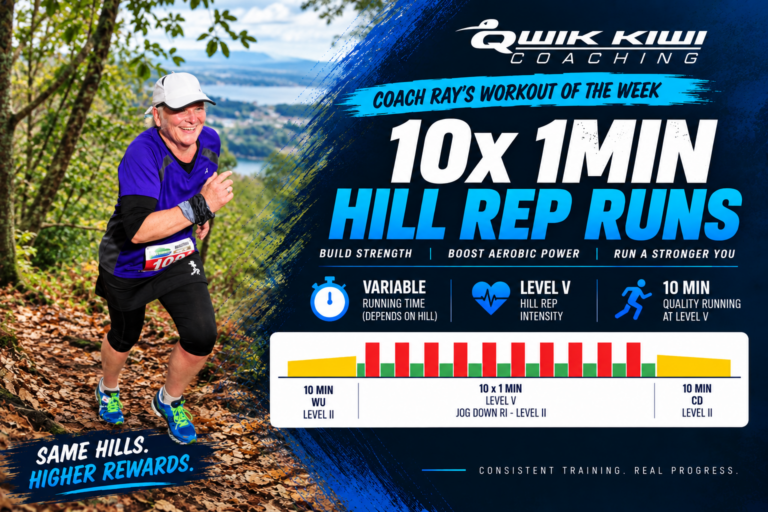
Workout of the Week: 20/15/10/5min Tempo Runs
This is a substantial Final Quality (FQ) Phase workout designed for runners who have already developed their underlying fitness and are now making their training increasingly specific to half marathon performance.
After a 10-minute Level II warm-up, you complete:
20min Level III → 2:30min Level II → 15min Level III → 2:30min Level II → 10min Level III → 2:30min Level II → 5min Level III
Finish with 10 minutes at Level II.
That’s 1:17:30 of running, including a substantial 50 minutes at Level III.
The key isn’t to see how fast you can run each repetition. The challenge is to accumulate all 50 minutes at the correct Level III intensity.
The descending structure helps. When you’ve completed the opening 20 minutes, the next target is only 15. Then 10. Then five.
But don’t mistake shorter for easier.
By the time you begin that final five-minute effort, you’ve already accumulated 45 minutes at Level III. The repetitions become shorter as your accumulated fatigue becomes greater.
That’s exactly where pace discipline matters.
If you attack the first 20-minute repetition too aggressively and turn Level III into Level IV, you’ve changed the purpose of the workout. This session is about developing the ability to remain strong, controlled and efficient for an extended period.
For a half marathon runner approaching race day, that’s an extremely useful capability.
How Long Should Your Long Run Be for a Half Marathon?
Do you need to run 21.1km before race day?
For most runners, my answer is no.
I prefer to prescribe the long run primarily according to duration rather than distance.
For most half marathon runners, I’ll progressively build towards a maximum of approximately two hours. A faster runner might comfortably cover more than 21.1km within those two hours. A recreational runner might cover only 16km.
Neither athlete has automatically completed the better long run.
The purpose isn’t to prove you can cover the race distance. We’re trying to create the aerobic adaptations and endurance required for the half marathon without generating so much fatigue that the session compromises the rest of your training.
For most runners, the overwhelming majority of the long run should remain at Level II — Endurance/Conversational intensity.
Once an athlete is comfortably running beyond approximately an hour, I generally introduce 4 × 20-second Level V stride-outs towards the end, spaced five minutes apart, with the final stride completed with approximately 10 minutes of Level II running remaining.
Another important point is progression.
Your first long run should reflect what you’ve actually been doing recently — not an arbitrary number printed in Week One of a generic programme. From there, build gradually.
And your long run doesn’t need to get longer every single week. Recovery weeks, training history, the rest of your programme and eventually your taper all matter.
The question isn’t:
“What’s the furthest I can run this weekend?”
A better question is:
“What long run gives me the endurance stimulus I need while still allowing me to complete the rest of my training properly?”
That’s a very different way of approaching half marathon preparation.
Train for the Half Marathon Course You’re Racing
This weekend’s Wharf to Wharf results illustrate the point beautifully.
A road half marathon and a track/trail half marathon may both cover approximately the same distance, but they aren’t necessarily asking the same questions of the athlete.
A flat road race isn’t the same as a hilly road race.
A hilly road race isn’t the same as a technical trail event.
And a race containing a long descent can challenge your legs very differently again.
Before beginning specific preparation for your goal race, study the course. Look at its elevation profile, surface, major climbs, descents, exposed sections, corners, aid stations and particularly what happens during the final 5km.
That last point matters.
A steep climb at kilometre three isn’t the same challenge as a steep climb at kilometre 18.
As race day approaches, there should gradually be fewer surprises between what you’ve experienced in training and what you’ll encounter during the race.
If your race is hilly, include appropriate hills.
If it’s flat and fast, practise maintaining rhythm on flatter terrain.
If it contains substantial descending, progressively prepare your legs for the eccentric loading of running downhill.
If it’s a trail race, don’t complete every important training session on smooth asphalt.
Your programme needs to prepare you not simply to run a half marathon.
It needs to prepare you for your half marathon.
📅 Training Plans Starting Monday 12 October
Two new structured training builds begin next Monday for runners targeting events early in 2027.
🔥 Feel The Burn Trail Run — 16 Weeks
Our 16-week Feel The Burn Trail Run training plans begin on Monday.
Feel The Burn is scheduled for Saturday 30 January 2027 at Flock Hill Station in the Craigieburn Basin, Canterbury. The event offers approximately 5km, 10km, 20km and 30km options through spectacular high-country terrain.
With a trail event like this, simply becoming fitter isn’t enough. Terrain, climbing, descending and running strength all become important parts of the preparation.
Starting now gives you the full 16-week progression rather than trying to squeeze trail-specific fitness into the final few weeks.
🛣️ Christchurch Motorway Half Marathon — 20 Weeks
Our 20-week Christchurch Motorway Half Marathon training plans also begin Monday.
The race is scheduled for Sunday 28 February 2027, starting and finishing at Canterbury Agricultural Park. It’s a traffic-free course designed to cater for everyone from recreational runners through to athletes chasing a PB.
Twenty weeks gives us plenty of time to progressively develop the runner before making the training increasingly specific as race day approaches.
👉 NZ Half Marathon Hub+ gives you access to the structured training plans and the training progression to take the guesswork out of what to do each week.
🗓️ Coming Up This Weekend
It’s a particularly busy weekend for half-marathon and near-half-marathon-distance racing around New Zealand.
Saturday 10 October
Jackson Holmes Salmon Run — Rakaia, Canterbury
The Salmon Run includes a 21km Half Marathon Trail Run around the Rakaia area alongside its multisport and duathlon events. Salmon Run
Orokonui Challenge — Waitati, Dunedin
Not quite an official half marathon at 21.8km, but certainly close enough to belong in our weekend round-up. The mixed-terrain course includes around 600m of elevation change, taking runners through coastal terrain and the Orokonui Ecosanctuary. Orokonui Ecosanctuary –
Sunday 11 October
Ahuriri Half Marathon — Napier
A 21.1km two-loop out-and-back course from the Ahuriri waterfront, described by the organisers as flat and fast. Ahuriri Half Marathon
Edridge Contracting Teetotal Traverse — St Arnaud
A challenging trail half marathon through the Teetotal Flats/Big Bush Conservation Area on the edge of Nelson Lakes National Park. Teetotal Traverse
Muriwai Half Marathon — Auckland
A west-coast trail event featuring forest roads, stream track, undulating terrain and beach views. The 2026 event has sold out. Predator Free Muriwai
Trail Trilogy — Waihi
The Half Marathon forms part of a much larger day of racing on the Hauraki Rail Trail, with distances of 9km, 21.1km, 42.2km, 55km and 100km. Trail Trilogy
That’s six very different challenges in one weekend — from flatter road running to demanding trails.
And once again, that’s a pretty good demonstration of why 21.1km doesn’t tell you everything you need to know about a race.
💡 This Week’s Takeaway
This week’s theme is specificity without losing sight of the fundamentals.
Build your endurance progressively.
Keep your long runs predominantly at Level II rather than racing them.
As your event approaches, use workouts such as the 20/15/10/5min Tempo Runs to develop sustained race-specific fitness.
And know what you’re actually preparing for.
A fast road half marathon, a rolling course and a challenging trail half marathon may all have approximately 21.1km written beside their names, but they can require very different strengths.
Build the runner first. Then prepare that runner for the race they’re actually going to run.
📬 Get the Half Marathon Hub Weekly
Want this round-up delivered directly to you each week?
The Half Marathon Hub Weekly brings together New Zealand half marathon results, upcoming races, practical training advice and the latest resources from www.HalfMarathonTraining.co.nz.
Join the FREE Half Marathon Hub Weekly
And if you’re ready for structured training rather than simply reading about it:
Coming Next Week
Next Monday we’ll be back with results from the Jackson Holmes Salmon Run, Orokonui Challenge, Ahuriri Half Marathon, Teetotal Traverse, Muriwai Half Marathon and Trail Trilogy.
We’ll also check again for those outstanding Sri Chinmoy Christchurch and Auckland results, along with the latest training articles and the next group of structured training plans.
Until then, train consistently, keep the purpose of each session clear, and good luck if you’re racing this weekend.
Coach Ray
Qwik Kiwi Coaching
www.HalfMarathonTraining.co.nz