
Can I Run a Half Marathon in 12 Weeks If I Can Only Run for 30 Minutes Now?
You’ve entered a half marathon. It’s 12 weeks away. But right now, the longest you can run continuously is 30 minutes. Is it really possible to prepare for 21.1 kilometres in just three months?
The short answer is yes.
The longer answer is that it’s going to take consistency, commitment, carefully structured training and a realistic understanding of what you’re asking your body to achieve.
If you can already run continuously for 30 minutes, you’ve established a useful starting point. You have some aerobic fitness, you’re capable of sustained running, and you’ve got something to build upon.
But there’s a substantial difference between running for 30 minutes and completing a half marathon.
Over the next 12 weeks, your challenge is to progressively reduce that difference.
You won’t necessarily arrive at the start line having completed the full half marathon distance in training. You might not even have managed a two-hour long run.
And that’s okay.
The goal is to develop enough endurance, running strength and aerobic efficiency to give yourself a realistic opportunity to complete the event.
I’ve been coaching endurance athletes since 2000, and one of the principles I’ve always followed is that training should minimise the amount of work required to achieve an athlete’s goal, rather than simply maximise the amount of training they complete.
That principle is especially important when you’re working with a relatively short preparation period.
Let’s look at how I’d approach the next 12 weeks.
Is 30 Minutes of Continuous Running Enough to Start Half Marathon Training?
Yes. In fact, being able to run comfortably and continuously for 30 minutes is one of my preferred starting benchmarks for structured half marathon preparation.
Notice that I’m not saying you need to run 5 km in 30 minutes.
I’m not saying you need to have completed a 10 km race.
And I’m certainly not suggesting you should already be capable of running 21.1 km.
What matters initially is your ability to run continuously for 30 minutes at a comfortable, conversational intensity.
That tells me you’ve already developed some basic running endurance.
Of course, someone who’s been running consistently for six months and can comfortably manage 30 minutes may be better prepared than someone who’s only just managed their first continuous 30-minute run.
Your training history matters.
But for the purposes of this article, we’re going to assume you can currently run for 30 minutes continuously and want to complete a half marathon in 12 weeks.
It’s an ambitious goal, but one we can work towards.
The Biggest Challenge: Developing Your Endurance in Just 12 Weeks
The biggest challenge isn’t necessarily your speed.
It’s your endurance.
A half marathon is 21.1 kilometres, and depending on your running pace, you could be on your feet for considerably longer than two hours.
Right now, your body is accustomed to running for approximately 30 minutes.
Over the next 12 weeks, we need to progressively develop your ability to sustain that activity for much longer.
That means improving your aerobic fitness, developing muscular endurance and increasing your tolerance for the repetitive loading associated with running.
Your cardiovascular system will adapt to consistent training, but so must your muscles, tendons, joints and other supporting tissues.
And those adaptations don’t all happen at the same rate.
This is why I wouldn’t recommend suddenly increasing your long run from 30 minutes to 60 or 90 minutes simply because you’ve entered a half marathon.
You might be able to push yourself through an excessively long run, but that doesn’t mean it’s a sensible training decision.
The resulting fatigue, muscle soreness or injury risk could compromise the training you need to complete over the following weeks.
Consistency over 12 weeks is far more valuable than one impressive training session followed by several days of recovery.
You’ll Need to Run at Least Three Times Per Week
If you’re currently capable of running continuously for 30 minutes and want to complete a half marathon in 12 weeks, I would generally recommend a minimum of three runs per week.
Those three sessions each have a purpose.
1. A Developing Quality Session
Early in the programme, this will simply be another comfortable aerobic run.
As your fitness develops, we’ll introduce carefully selected quality training.
Depending on the training phase, that might involve hill repetitions, threshold intervals or tempo running.
The purpose isn’t to exhaust you.
It’s to progressively improve the running fitness and efficiency you’ll need for your half marathon.
2. A Shorter, Steady Aerobic Run
Your second session is a shorter, steady run at Level II.
This is a comfortable, conversational intensity that helps develop aerobic endurance without placing excessive stress on your body.
It’s an important part of your weekly training.
Not every session needs to be challenging to be effective.
3. Your Weekly Long Run
Your third session is the cornerstone of your half marathon preparation.
This is where we progressively extend your ability to run continuously.
Initially, your long run might be just 30 minutes.
Over the following weeks, we’ll gradually increase that duration as your body adapts.
For someone with your current fitness and a half marathon only 12 weeks away, this progression will be particularly important.
The three sessions work together: one develops specific fitness, one reinforces your aerobic foundation, and one extends your endurance.
During the initial Foundation & Injury Prevention phase, all three runs remain at Level II.
Once you’ve established that routine, we’ll begin introducing additional intensity into just one session each week.
How Quickly Should You Increase Your Long Run?
This is where patience becomes essential.
If your current longest continuous run is 30 minutes, that’s where I’d begin.
I wouldn’t automatically prescribe an hour-long run just because your event is approaching.
Instead, we progressively extend the duration.
For example, an early progression might look something like this:
- One week: 30 minutes
- Following week: 35 minutes
- Next week: 40 minutes
- Following week: 45 minutes
- Next week: 50 minutes
These are illustrative durations, not a fixed prescription.
The actual increases will depend on how you’re adapting, how consistently you’re training and how well you’re recovering.
Some weeks, you may be ready to progress.
Other weeks, maintaining the same duration may be the better decision.
There may also be occasions when we need to reduce training to manage fatigue.
The objective isn’t to increase your long run every week regardless of how you’re feeling. It’s to progressively develop your endurance while keeping you healthy enough to continue training.
As your fitness improves, your long runs will become a greater part of your preparation.
For many half marathon runners, I like to develop long runs towards approximately two hours.
However, with only 12 weeks available and a starting point of 30 minutes, we may not get there.
And that’s an important expectation to establish early.
What If You Don’t Reach a Two-Hour Long Run?
It doesn’t automatically mean you can’t complete the half marathon.
The purpose of your training isn’t to prove you can run the entire event distance before event day.
It’s to develop as much appropriate endurance as possible within the time available.
You might arrive at your event having completed a longest run that is considerably shorter than the time you’ll need to finish 21.1 km.
That means event day will involve a substantial step beyond your training experience.
But compare that with where you started.
Twelve weeks earlier, you could run continuously for 30 minutes.
After 12 weeks of consistent training, you may have developed considerably greater endurance, improved aerobic fitness and increased your ability to sustain running.
The step from your longest training run to the half marathon may still be significant.
But it should be much smaller than the step you faced at the beginning of your programme.
That is the progress we’re trying to achieve.
Whether you’re ready to attempt the full distance will still depend on your actual training progression, recovery and health as event day approaches.
The Four Phases of Your 12-Week Half Marathon Training Programme
I use four phases of periodisation when developing half marathon training programmes.
With a full 24-week preparation, each phase generally lasts six weeks.
For a 12-week programme, we compress that structure into four three-week phases.
The challenge is to make each phase purposeful without trying to force six months of training adaptations into three months.
Throughout all four phases, your long run continues to develop progressively.
Weeks 1–3: Foundation & Injury Prevention (FI)
The first priority is consistency.
During these initial three weeks, I’d focus on establishing your running routine and developing your aerobic fitness.
All three weekly runs are completed at Level II, a comfortable conversational intensity.
There are no demanding threshold intervals or hard hill sessions at this stage.
Your body needs time to become accustomed to the frequency and duration of your training.
For someone currently running 30 minutes continuously, this phase is particularly important.
We’re preparing your cardiovascular system and musculoskeletal system for the training that follows.
Your long run begins at an appropriate duration and progresses gradually.
By the end of this phase, the objective is to have established a consistent routine that you can sustain.
It’s tempting to skip this phase because you’ve only got 12 weeks.
I wouldn’t.
Foundation & Injury Prevention provides the platform for everything that follows.
Weeks 4–6: Early Quality (EQ)
Once you’ve established some consistency, we can begin introducing a little more intensity.
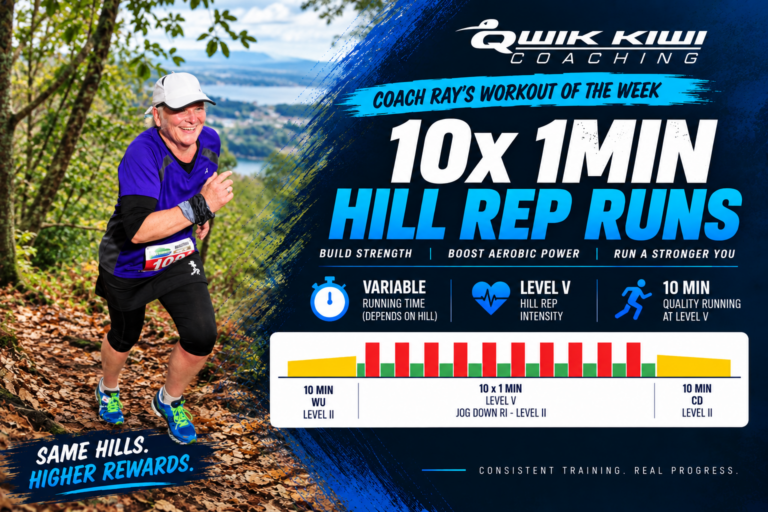
During Early Quality, I generally favour hill repetitions.
Hill running helps develop running strength, reinforces effective running mechanics and introduces a more demanding training stimulus.
But we don’t suddenly turn every run into a hard workout.
Your week still contains three runs.
One session introduces carefully controlled hill repetitions.
Your second session remains a shorter Level II aerobic run.
Your third session remains your progressively developing long run, also at Level II.
The aim is to add a useful training stimulus while preserving the consistency you’ve established.
And importantly, your long run continues to develop throughout this phase.
Weeks 7–9: Transition Quality (TQ)
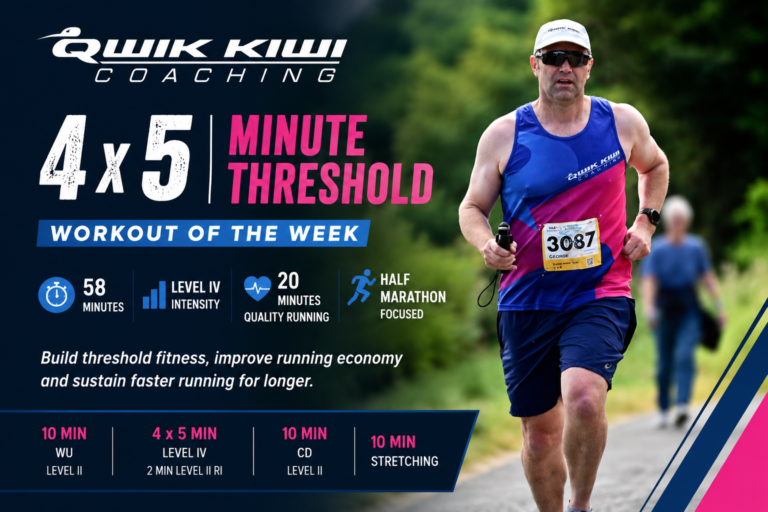
During Transition Quality, we begin introducing threshold running.
Threshold training involves running at a controlled but demanding intensity, typically Level IV.
It’s harder than your normal conversational running, but it isn’t an all-out effort.
The purpose is to improve your ability to sustain a higher aerobic workload and become more efficient at running.
You might wonder why we’d introduce threshold running when your half marathon goal is simply to complete the event.
After all, I’m not recommending that you run your half marathon at threshold intensity.
The reason is that improving your higher-end aerobic capability can make your easier running feel more manageable.
As your fitness improves, the effort required to maintain a comfortable running pace can become more sustainable.
That’s valuable when you’re preparing for an event that will take considerably longer than your current running experience.
Again, we’re introducing this training through one session per week.
The other two sessions remain focused on aerobic endurance, with the long run continuing to develop as appropriate.
Weeks 10–12: Final Quality (FQ)
The final phase brings your training closer to the demands of your half marathon.
Here, we’ll introduce tempo running at Level III.
Tempo running provides an opportunity to develop your ability to maintain a purposeful, controlled effort for sustained periods.
It also helps you become more familiar with managing your pace and effort.
However, your goal for this first half marathon isn’t to race aggressively.
It’s to complete the event with as much consistency and control as possible.
As event day approaches, we’ll also need to reduce training appropriately so that you’re not arriving at the start line carrying unnecessary fatigue.
That means we don’t simply keep increasing your long run until the day before the event.
Your final significant long run needs to be completed with enough time to recover before the half marathon.
In practice, that means your available endurance-building window is shorter than the full 12 weeks.
This is another reason why consistency from the beginning matters so much.
Most of Your Training Should Still Be Easy Running
One mistake runners often make when preparing for an event at short notice is assuming they need to train harder to compensate for having less time.
That’s not the approach I’d recommend.
You’re already asking your body to adapt to a significant increase in running endurance.
Adding excessive intensity on top of that creates unnecessary fatigue and increases the risk of interrupting your training.
Most of your running should remain at Level II.
That means running at a comfortable, conversational intensity where you can maintain control of your breathing and effort.
Your long run is primarily about developing endurance.
Your shorter aerobic run reinforces that endurance.
And your developing quality session introduces specific training adaptations at the appropriate stage.
The objective is to accumulate consistent, productive training rather than repeatedly testing your limits.
You don’t need to prove your fitness every week. You need to keep developing it.
What Should Your Goal Be on Half Marathon Day?
If you’ve progressed from 30 minutes of continuous running to your first half marathon in just 12 weeks, I’d strongly encourage you to focus on completing the event rather than chasing an ambitious finishing time.
That doesn’t mean the event isn’t challenging.
Quite the opposite.
Completing 21.1 km after such a relatively short preparation period is a significant achievement.
Your goal should be to run as consistently and efficiently as possible throughout the event.
Start at Level II
I’d recommend beginning at a comfortable Level II intensity.
Depending on how your fitness has developed, you may be able to maintain a pace towards the upper end of your Level II range.
However, I’d be cautious about starting too quickly.
The first few kilometres of a half marathon can feel deceptively easy.
You’re excited, surrounded by other runners and benefiting from the atmosphere of the event.
It’s tempting to run faster than you planned.
But remember, your challenge isn’t to run the first five kilometres quickly.
It’s to sustain your running for the full 21.1 kilometres.
Starting too hard could make the later stages considerably more difficult.
Focus on Consistency, Not Speed
Your pacing strategy should be built around maintaining a controlled, sustainable effort.
Avoid chasing other runners.
Don’t worry if people pass you early.
And resist the temptation to increase your pace simply because you’re feeling good after a few kilometres.
Your endurance will be tested as the event progresses.
By maintaining a consistent effort, you give yourself the best opportunity to manage that challenge.
Expect Some Difficult Moments
Even with a successful 12-week training programme, your first half marathon is likely to include some tough moments.
There may be stages where your legs become heavy.
Your muscles may begin to fatigue.
And mentally, you may find yourself questioning whether you can maintain your effort to the finish.
That’s understandable.
You’re attempting a duration and distance that may extend considerably beyond what you’ve experienced in training.
The key is to remain composed, manage your effort and focus on the next manageable section of the event.
Completing a half marathon isn’t just about your cardiovascular fitness.
It’s also about learning to manage the physical and mental demands of sustained endurance exercise.
Don’t Overlook Fuelling and Hydration
Although the primary focus of your 12-week preparation is developing endurance, you also need to think about how you’ll fuel your half marathon.
If your event is likely to take more than two hours, relying entirely on the energy you had available at the start may not be appropriate.
As your long runs become longer, you’ll have opportunities to practise taking in carbohydrates and fluids while running.
That includes finding out what products you tolerate, how frequently you can comfortably consume them and how you’ll carry or access them during your event.
Don’t leave these decisions until event day.
You don’t want to combine the longest run of your life with a completely unfamiliar fuelling strategy.
Your training is an opportunity to develop those practical skills alongside your aerobic fitness.
Recovery Is Part of the Training Programme
With only 12 weeks available, it’s easy to become overly focused on completing every scheduled session.
But recovery is essential to making those sessions productive.
Your fitness develops through the combination of training stress and appropriate recovery.
If you continually add training without allowing your body to adapt, fatigue can accumulate faster than fitness.
That’s particularly important when you’re progressively increasing your long-run duration.
Pay attention to persistent muscle soreness, unusual fatigue, deteriorating running technique or discomfort that changes how you run.
These can be signs that your body isn’t coping with the current training load.
A sensible adjustment to your programme is far better than pushing through a problem and losing several weeks to injury.
You also need to be realistic about your wider commitments.
Work, family responsibilities, sleep and general life stress all influence your ability to recover.
Three consistent weekly runs, appropriately prescribed and supported by good recovery, can be more productive than attempting five or six runs that your body isn’t ready to absorb.
What Happens After the Half Marathon?
If you’ve successfully completed your first half marathon after starting with just 30 minutes of continuous running 12 weeks earlier, you’ve achieved something substantial.
But you should also expect to be tired.
Potentially very tired.
Your legs may be sore, your muscles fatigued and your body may need considerably more recovery than it would after a normal training session.
That’s because event day has probably involved a substantial increase beyond the duration you’ve experienced during your training.
The day after your half marathon isn’t the time to test your fitness again.
Nor is it the time to immediately launch into another demanding training block.
Give yourself time to recover.
Prioritise sleep, adequate nutrition, hydration and gentle movement as tolerated.
Some muscle soreness and fatigue are to be expected, but severe pain, unusual swelling or symptoms that concern you shouldn’t simply be dismissed as normal post-event discomfort.
Once you’ve recovered appropriately, you can begin thinking about your next goal.
And this is where things get interesting.
You’re no longer the runner who could only manage 30 minutes continuously.
You’ve developed a much stronger aerobic foundation and gained valuable experience of structured training.
That gives you considerably more options for your next event.
You might decide to return to the half marathon distance with a longer preparation period.
You might focus on improving your 5 km or 10 km performance.
Or you might simply enjoy continuing to develop your endurance without an immediate race deadline.
Whatever you choose, the consistency you’ve developed over the previous 12 weeks provides a valuable starting point.
So, Can You Really Run a Half Marathon in 12 Weeks?
Yes, potentially — if you can currently run continuously for 30 minutes, commit to consistent training and adapt well to the progression.
But it’s important to understand what that means.
Twelve weeks isn’t a magic shortcut.
You can’t simply increase your running duration as quickly as possible and expect your body to cope.
You’ll need to establish a consistent routine of at least three runs per week.
You’ll need to progressively develop your long run.
You’ll need to introduce quality training at the appropriate time.
And you’ll need to manage recovery carefully throughout the process.
You may not reach a two-hour long run before your event.
You may arrive at the start line knowing that the final kilometres will take you beyond anything you’ve completed in training.
And you’ll need to approach the half marathon as an endurance challenge rather than an opportunity to race for an ambitious finishing time.
There are no guarantees that every runner starting at 30 minutes will be ready to complete 21.1 km after 12 weeks. Your progress and health must determine whether the event remains an appropriate goal.
But with the right approach, you can make substantial progress in three months.
The aim isn’t to turn a 30-minute runner into a fully developed half marathon racer in 12 weeks. It’s to develop enough fitness, endurance and confidence to give that runner a realistic opportunity to complete their first half marathon.
That’s an achievable goal worth working towards.
Ready to Train for Your Half Marathon in 12 Weeks?
If you can already run continuously for 30 minutes and have a half marathon coming up in 12 weeks, you don’t need to guess what training to do next.
The NZ Half Marathon Hub+ provides structured training programmes designed around your current running ability, available training time and half marathon goals.
You can choose from 12-week programmes with three, four or five runs per week, allowing you to follow a progressive training structure that fits your experience and commitments.
The programmes use the four-phase periodisation approach outlined in this article, developing your aerobic foundation, running strength, threshold fitness and event-specific preparation.
Rather than trying to cram as much training as possible into 12 weeks, you’ll have a structured approach to making the best use of the time available.
Start with the fitness you’ve got. Build progressively. Arrive at your half marathon as well prepared as possible.

👉 Explore the 12-Week Half Marathon Training Programmes in NZ Half Marathon Hub+
Coach Ray Boardman
Qwik Kiwi Coaching
Train smarter, not simply more.



One Comment
Comments are closed.