
How to Run a Half Marathon in Under 2 Hours: Your Complete Sub-2-Hour Training Guide 🏃
Want to run a half marathon in under two hours? Breaking the two-hour barrier is one of the most popular goals among recreational runners. It’s a significant achievement, but with the right preparation, consistent training and sensible race-day pacing, it’s an achievable target for many athletes.
To finish 21.1 km in under two hours, you’ll need to average approximately 5:41 minutes per kilometre for the entire race.
That might sound straightforward when you’re fresh and running your first few kilometres. The challenge is maintaining that pace after 15, 18 or even 20 kilometres, when fatigue begins to accumulate.
That’s why a successful sub-two-hour half marathon isn’t simply about running faster.
It’s about developing the endurance, running strength, threshold fitness and race-specific preparation that allow you to sustain your target pace for the entire distance.
In this guide, I’ll explain how I approach training athletes to break the two-hour barrier, including the four phases of training, individualised training intensities, long-run progression, quality workouts, strength training, race-day nutrition and pacing.
I’ll also introduce Project 2:00hr, my dedicated 20-week half marathon training programme, available through the NZ Half Marathon Hub+ membership.
What Pace Do You Need to Run a Half Marathon in Under Two Hours?
A half marathon is officially 21.0975 kilometres.
To finish in exactly two hours, you need to average approximately 5:41.3 min/km. However, if your goal is to break two hours, I’d recommend aiming for a small margin rather than targeting exactly 2:00:00.
A finish time of around 1:59:30 gives you a little breathing room.
Sub-2-Hour Half Marathon Pacing Chart
| Distance | Approximate elapsed time |
|---|---|
| 1 km | 5:40 |
| 5 km | 28:20 |
| 10 km | 56:40 |
| 15 km | 1:25:00 |
| 20 km | 1:53:20 |
| Finish (21.1 km) | 1:59:33 |
These checkpoints assume a consistent pace of 5:40 min/km. They’re a useful reference, but your actual race strategy may involve small variations in pace according to the course, conditions and how you’re feeling.
One of the biggest mistakes runners make is assuming they need to run significantly faster than goal pace during the opening kilometres to build a safety margin.
You don’t.
Starting too quickly can create problems that become increasingly difficult to overcome later in the race.
The aim is to reach the final kilometres with enough energy remaining to maintain your target pace.
Are You Ready to Train for a Sub-2-Hour Half Marathon?
Before beginning a dedicated training programme, it’s useful to establish whether your current fitness suggests that breaking two hours is a realistic goal.
For my Project 2:00hr programme, I use the following performances as indicators of readiness:
- 10 km: Under 56 minutes
- Half marathon: Approximately 2 hours 7 minutes or faster
- Marathon: Approximately 4 hours 20 minutes or faster
You don’t need to have achieved all three performances.
Each is a useful guide to your existing fitness and the likelihood of successfully preparing for a sub-two-hour half marathon.
Importantly, these aren’t strict entry requirements or guarantees of success.
A 55-minute 10 km completed last month provides more useful evidence of current readiness than the same performance achieved several years ago.
The more recent your performance, the more confidently we can use it to assess your current fitness.
We also need to consider your training consistency, running experience, injury history and how much time you have available to prepare.
Someone who has been running consistently four times per week for several months may be in a better position to begin structured half marathon training than someone who has achieved a faster race time but hasn’t trained regularly since.
Consistency matters.
If your current performances are some distance away from these benchmarks, that doesn’t mean a sub-two-hour half marathon is out of reach. It may simply mean you need more time developing your fitness before beginning a goal-specific programme.
Understanding Your Training Intensities: Why One Pace Doesn’t Fit Everyone
One of the most important principles of effective half marathon training is understanding that your training intensities should reflect your current fitness, not simply your target finishing time.
Two runners might both be aiming to break two hours for the half marathon, but that doesn’t mean they should complete their training sessions at identical speeds.
One athlete might begin the programme with a recent 10 km performance of 55 minutes, while another has a personal best of 57 minutes but is returning to consistent training.
Their starting fitness, training history and ability to tolerate different intensities may be quite different.
Prescribing exactly the same training paces to both athletes simply because they share the same race goal would ignore those differences.
My five training intensity levels
I use five training intensity levels to structure running workouts:
| Level | Training intensity | Primary purpose |
|---|---|---|
| Level I | Easy / Recovery | Recovery and very low-intensity running |
| Level II | Endurance / Conversational | Aerobic development and long runs |
| Level III | Tempo | Sustained, controlled running |
| Level IV | Threshold | Developing the ability to sustain demanding efforts |
| Level V | VO₂ | Higher-intensity aerobic development |
Each level has a particular purpose within the training programme.
However, the pace associated with each level is individual to the athlete and changes as their fitness develops.
Establishing your training intensities
At the beginning of Project 2:00hr, we establish appropriate training intensities using the athlete’s current performance metrics.
These might include recent race performances, appropriate fitness assessments and other relevant training data.
From this information, we can establish training targets that reflect the athlete’s present capabilities.
The aim is to ensure that easy running is genuinely easy, threshold training provides the appropriate stimulus and tempo sessions are completed at the intended intensity.
Your training paces aren’t selected simply because you’re aiming for a two-hour half marathon.
They’re selected because they represent the appropriate training intensities for you at that point in your preparation.
Your training intensities should change as you improve
This is particularly important over a 20-week training programme.
If your training is effective, we would expect your fitness to improve as you progress through the different phases.
A pace that initially feels demanding may become considerably more manageable after several months of consistent training.
For this reason, Project 2:00hr includes opportunities to reassess and adjust training intensities at the beginning of the programme and at the transition between each training phase.
Rather than using one set of pace targets for the entire 20 weeks, we adapt the training prescription to reflect your developing fitness.
This allows the programme to remain appropriately challenging without becoming unnecessarily demanding.
The goal: Make sub-two-hour race pace a sustainable Level III effort
For a sub-two-hour half marathon, the target pace is approximately 5:41 min/km.
But that doesn’t mean this pace will initially fall within the athlete’s Level III training intensity.
At the beginning of the programme, goal race pace may represent a considerably more demanding effort.
As the athlete develops aerobic endurance, running strength and threshold fitness, we want that same pace to become progressively more sustainable.
Ideally, by race day, 5:41 min/km will sit comfortably within the athlete’s updated Level III intensity range.
That’s an important distinction.
We’re not simply teaching an athlete to tolerate a demanding pace for longer.
We’re developing their fitness so that the required race pace represents a more manageable physiological demand.
This is one of the key reasons I use a progressive, periodised training approach.
For a more detailed explanation of the five intensity levels, see my guide to Half Marathon Training Intensity Levels.
How Long Should You Train for a Sub-2-Hour Half Marathon?
The ideal preparation period depends on your starting fitness, training experience and how consistently you’ve been running.
For Project 2:00hr, I’ve chosen a 20-week training programme.
Twenty weeks gives us time to develop the different components of half marathon fitness progressively rather than rushing into demanding workouts.
The programme follows my four-phase training model:
| Training phase | Duration | Primary emphasis |
|---|---|---|
| Foundation & Injury Prevention (FI) | 4 weeks | Aerobic consistency and durability |
| Early Quality (EQ) | 6 weeks | Running strength and hill repetitions |
| Transition Quality (TQ) | 6 weeks | Threshold fitness |
| Final Quality (FQ) | 4 weeks | Tempo running, race preparation and tapering |
| Total | 20 weeks | Progressive half marathon preparation |
Each phase builds on the work completed in the previous phase.
Rather than jumping immediately into demanding race-specific workouts, we progressively develop the physical qualities needed to run well over 21.1 km.
Importantly, the transition between phases also provides an opportunity to reassess the athlete’s current fitness and update their training intensities.
This means the workouts remain appropriate as fitness improves.
For a more detailed explanation of this approach, read my guide to Half Marathon Training Phases.
Phase 1: Foundation & Injury Prevention — Weeks 1–4
The first four weeks focus on establishing consistent aerobic running and preparing your body for the more demanding training ahead.
One of the most common mistakes recreational runners make is introducing hard workouts before they’ve developed sufficient consistency.
They might complete a demanding interval session on Tuesday, another hard run on Thursday and then attempt their longest run of the week on Saturday.
The individual workouts might look impressive, but the combined training stress can be excessive.
During Foundation & Injury Prevention, the emphasis is on controlled aerobic running, with steady running and stride-outs introduced as appropriate.
The objective is to develop your ability to complete regular training without accumulating unnecessary fatigue.
Why easy running matters
Easy running helps develop your aerobic endurance while keeping the training stress manageable.
It also provides an opportunity to develop the muscular and connective-tissue tolerance needed for longer runs and more demanding sessions later in the programme.
For Project 2:00hr, the majority of this running is completed at Level II — Endurance intensity.
Level II is a conversational effort.
You should generally be able to speak comfortably while running, rather than struggling to complete a sentence.
The actual pace will depend on your current fitness.
For some athletes, this may initially feel considerably slower than their target half marathon race pace.
That’s deliberate.
You don’t need to run every training session at race pace to become capable of racing at that speed.
In fact, regularly turning easy runs into hard efforts can compromise recovery and reduce the quality of the sessions where higher intensity is actually required.
During these early weeks, focus on consistency, good running technique and finishing your sessions feeling that you could have continued if necessary.
Reassessing your fitness after Foundation & Injury Prevention
At the conclusion of this phase, we have an opportunity to review your progress.
If your aerobic fitness has improved, your training intensity targets may need adjusting before you begin the next phase.
This ensures that the hill sessions and supporting endurance runs are appropriate for your current capabilities rather than simply reflecting where you started four weeks earlier.
Phase 2: Early Quality — Weeks 5–10
Once we’ve established a consistent aerobic foundation, we begin introducing more demanding training.
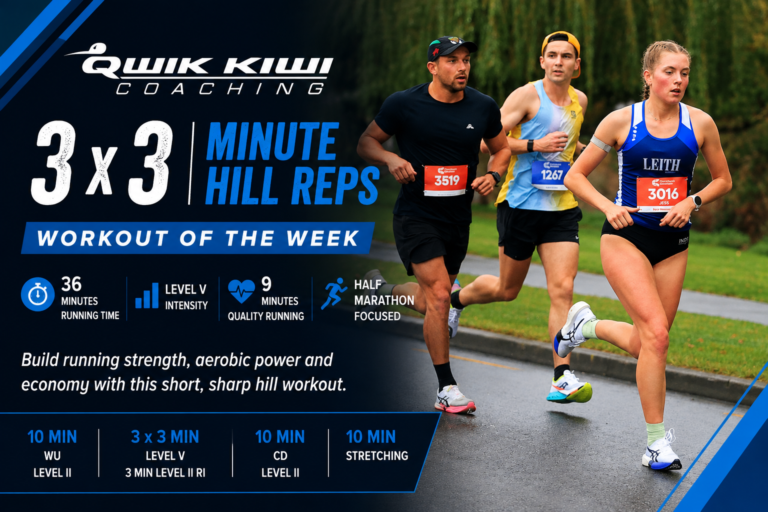
During the six-week Early Quality phase, the emphasis shifts towards developing running strength through hill repetitions.
Hill running can be a particularly useful training tool because it encourages forceful, purposeful running while providing an opportunity to develop coordination and technique.
The aim isn’t simply to sprint up hills until you’re exhausted.
The repetitions should be structured according to the athlete’s current fitness and the intended training stimulus.
What are the benefits of hill repetitions?
Hill training can help develop:
- Running-specific muscular strength.
- Coordination and effective running mechanics.
- The ability to produce force during each stride.
- Confidence when running on undulating terrain.
- Preparation for the more demanding threshold sessions that follow.
The quality of each repetition matters more than simply completing as many repetitions as possible.
Recovery between efforts should be sufficient to maintain the intended running technique and workout quality.
Your easy running and long-run progression continue throughout this phase.
The hill sessions provide a specific training stimulus, but they don’t replace the aerobic work that remains essential for half marathon performance.
Adjusting training intensities as running strength develops
By the end of Early Quality, you’ve completed another six weeks of structured training.
Your aerobic fitness, running economy and ability to tolerate demanding efforts may have improved.
Before progressing into Transition Quality, we reassess your current performance metrics and adjust your training targets as appropriate.
This is particularly important because the next phase introduces sustained Level IV threshold efforts.
We want those sessions prescribed according to your current fitness, not the fitness you had at the beginning of the programme.
Phase 3: Transition Quality — Weeks 11–16
During Transition Quality, the emphasis moves towards developing threshold fitness.
This is a particularly important component of preparing for a sub-two-hour half marathon.
At this stage, we’re trying to improve your ability to sustain a demanding running effort without accumulating fatigue too quickly.
Level IV threshold training
Threshold training involves controlled periods of demanding running, generally separated by recovery intervals.
Depending on the athlete’s training progression, sessions might involve repeated efforts of several minutes rather than one continuous hard run.
The objective is to accumulate useful training time at the prescribed intensity while maintaining good running technique and consistency.
Threshold running shouldn’t feel like an all-out sprint.
It should feel demanding but controlled.
If you start a workout too quickly and your pace deteriorates significantly across the repetitions, you’re probably not achieving the intended training stimulus.
Why threshold fitness matters for a two-hour half marathon
Your target race pace is approximately 5:41 min/km.
At the beginning of the programme, maintaining this pace might require an effort that is too demanding to sustain comfortably for the full half marathon distance.
Through progressive training, we’re working to improve your ability to maintain faster running speeds at a given physiological intensity.
As threshold fitness develops, the relationship between running pace and effort should improve.
A pace that previously required a demanding effort may become more sustainable.
This is particularly valuable when preparing for a half marathon, where the challenge isn’t simply producing speed but maintaining it for an extended period.
However, threshold sessions are only one component of the programme.
The aerobic endurance you’ve developed through easy running and progressively longer runs remains essential.
Reassessing fitness before Final Quality
At the conclusion of Transition Quality, we again review your current fitness.
By this point, you’ve completed 16 weeks of training.
Ideally, the improvements in aerobic endurance, running strength and threshold fitness will mean your training intensity ranges have shifted from their original values.
We can then establish appropriate targets for the final phase.
This is where the relationship between your developing Level III tempo intensity and your goal half marathon pace becomes particularly important.
Phase 4: Final Quality — Weeks 17–20
The final four weeks focus on converting your developing fitness into race-specific readiness.
During this phase, we introduce Level III tempo running, with the programme progressively reducing training stress as race day approaches.
Tempo training provides a controlled training stimulus that helps bridge the gap between easy endurance running and more demanding threshold efforts.
The emphasis isn’t on proving your fitness by running every session as quickly as possible.
It’s on arriving at race day fit, confident and sufficiently recovered to perform.
Bringing goal race pace into your Level III intensity
One of the objectives of the preceding 16 weeks has been to develop your fitness so that your target half marathon pace becomes increasingly sustainable.
Ideally, by this final phase, approximately 5:41 min/km will sit comfortably within your updated Level III tempo range.
This would indicate that your physiological capabilities have developed towards the demands of your goal event.
However, not every athlete will progress at exactly the same rate.
Some may reach this point earlier, while others may require additional training.
That’s why reassessing training intensities throughout the programme is so important.
Rather than forcing every athlete to follow identical pace targets, we use their developing performance metrics to guide the training prescription.
The importance of the taper
During the final two weeks, the training programme transitions towards race readiness.
We progressively reduce training volume while maintaining appropriate running frequency and enough intensity to preserve the fitness you’ve developed.
A taper isn’t an opportunity to squeeze in all the training you think you’ve missed.
By this point, most of the work has already been completed.
The objective is to allow fatigue to dissipate while maintaining your running rhythm.
You should arrive at the start line feeling fresh and ready to run, not exhausted from one final demanding training week.
Why Your Training Paces Shouldn’t Stay the Same for 20 Weeks
Let’s consider two athletes beginning Project 2:00hr.
Both have the same goal: breaking two hours for the half marathon.
However, their starting fitness and training histories are different.
The first athlete has been running consistently for several months and has a recent 10 km performance that suggests they’re approaching the fitness required for a sub-two-hour half marathon.
The second athlete has similar historical performances but has been training less consistently.
At the beginning of the programme, their prescribed training intensities may differ.
During Foundation & Injury Prevention, both athletes focus on aerobic consistency, but their actual Level II running speeds may be quite different.
As the programme progresses, each athlete’s fitness should improve according to their individual response to training.
At the end of each phase, we reassess their performance metrics.
If one athlete has improved more rapidly than the other, their updated training intensity targets may reflect that difference.
By the time they reach Final Quality, their Level III tempo ranges may have shifted considerably from where they started.
The important point is that training intensity is relative to the athlete’s current fitness, not simply the finishing time they’re hoping to achieve.
The target race pace remains the same.
But the physiological effort required to maintain that pace should become more manageable as fitness develops.
This is the difference between simply following a schedule and following a progressive training programme that responds to your developing capabilities.
How Many Times Per Week Should You Run?
You don’t necessarily need to run six or seven days per week to break two hours for the half marathon.
Project 2:00hr is structured around four runs per week.
This provides a balance between training frequency, recovery and the ability to complete the key sessions consistently.
A typical training week
| Day | Session |
|---|---|
| Monday | Recovery or supplementary strength work |
| Tuesday | Quality session appropriate to the training phase |
| Wednesday | Recovery or supplementary training |
| Thursday | Steady running or stride-outs, depending on the phase |
| Friday | Recovery or supplementary strength work |
| Saturday | Long run or easy run, depending on race-day scheduling |
| Sunday | Easy run or long run, depending on race-day scheduling |
The long run is scheduled on the same day of the week as your target half marathon.
If your race is on a Saturday, your long run takes place on Saturday, followed by an easy run on Sunday.
If your race is on a Sunday, your easy run is scheduled for Saturday and your long run for Sunday.
This helps you establish a consistent weekly routine that reflects your eventual race-day schedule.
Why four runs per week can work
A four-run structure allows us to include:
- A focused quality session.
- A supporting steady or stride-out session.
- A progressively longer endurance run.
- An additional easy run to support aerobic development.
The key is making each session purposeful.
More training isn’t automatically better.
The aim is to complete enough appropriate training to stimulate improvement while allowing sufficient recovery to adapt.
How Long Should Your Long Run Be?
Your long run is one of the most important sessions in preparing for a sub-two-hour half marathon.
It develops the endurance needed to maintain your running performance as fatigue accumulates over longer distances.
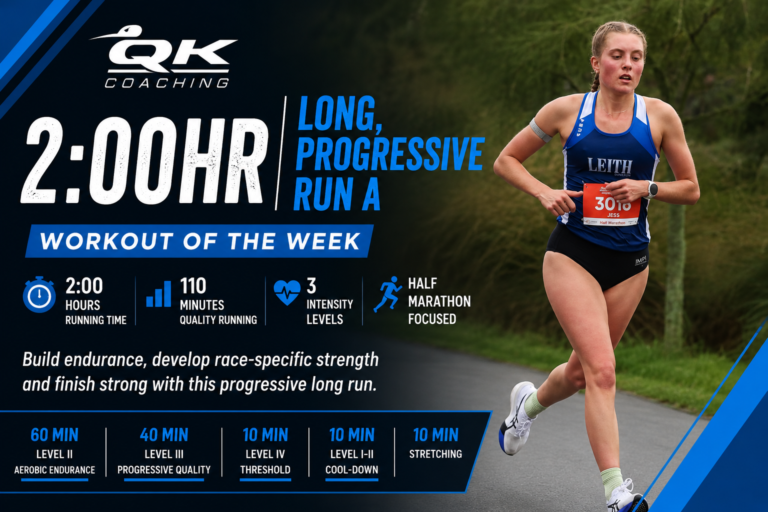
In Project 2:00hr, the long run begins at 60 minutes and progressively builds towards two hours.
This progression takes place across the training programme rather than through large, sudden increases in duration.
Why I prescribe long runs by time
Two athletes might complete the same 15 km route in very different amounts of time.
For one runner, that might be a relatively manageable session. For another, it could involve substantially more time on their feet and a greater training load.
Prescribing long runs by duration allows us to manage the training stimulus more appropriately.
During most of the programme, long runs are completed predominantly at Level II intensity.
The pace associated with Level II will be specific to your current fitness and may change as your training progresses.
Do you need to run 21.1 km before race day?
Not necessarily.
You don’t need to prove that you can complete the full half marathon distance in training to be ready for race day.
The goal is to develop sufficient endurance while managing fatigue and injury risk.
A well-structured long-run progression, supported by consistent weekly training, can prepare you for the race without requiring you to repeatedly cover 21.1 km beforehand.
Introducing Level III running into the long run
As the programme progresses, selected long runs include some time at Level III intensity.
This adds a more demanding training stimulus while retaining the overall endurance focus of the session.
However, it doesn’t mean every long run becomes a race simulation.
The harder running is introduced progressively and deliberately, before training stress is reduced during the taper.
As your fitness develops, your Level III training pace may also change.
The objective is to develop race readiness without carrying unnecessary fatigue into race day.
Strength Training for a Sub-2-Hour Half Marathon
Running fitness is important, but so is the ability of your muscles and connective tissues to tolerate the repeated loading involved in running.
Strength training can support your preparation by developing muscular capacity and improving your ability to cope with training demands.
For recreational half marathon runners, I particularly value exercises that develop the major muscle groups involved in running.
These include movements such as squats, split squats, step-ups, calf raises, hip-hinge exercises and appropriate trunk-strength exercises.
The exercises, loading and progression should reflect your experience and physical capabilities.
If you’re new to strength training, start conservatively.
The aim is to complement your running programme, not create so much muscle soreness that you struggle to complete your next quality session.
Where possible, organise your strength training so that it doesn’t compromise the quality of your key running workouts or your long run.
Nutrition and Hydration for a Sub-2-Hour Half Marathon
You can complete an excellent training programme and still compromise your race-day performance through poor fuelling.
For an event lasting close to two hours, carbohydrate availability and hydration deserve attention.
Everyday nutrition
Your everyday nutrition should provide sufficient energy to support your training and recovery.
That includes adequate carbohydrate to fuel running, protein to support muscle repair and adaptation, and a varied diet that provides the nutrients required for general health.
Avoid consistently under-fuelling your training.
Arriving at workouts with inadequate energy can reduce training quality and make recovery more difficult.
Practise fuelling during your long runs
Long runs provide an excellent opportunity to practise the nutrition strategy you intend to use on race day.
For an event of approximately two hours, a practical starting point is often around 30–60 g of carbohydrate per hour, depending on your tolerance, experience and the products you use.
Some athletes can tolerate and benefit from higher intakes, but this should be developed through practice rather than introduced for the first time on race day.
Sports drinks, gels and other easily digested carbohydrate sources can all be useful.
The important thing is finding a strategy that works for you.
Hydration
Your fluid requirements will vary according to temperature, humidity, sweat rate, body size and running intensity.
Rather than relying on one fixed drinking volume for every athlete, practise a sensible hydration strategy during training.
Avoid both excessive dehydration and drinking so much that you gain weight through fluid consumption during the event.
Carbohydrate loading
For a half marathon expected to take approximately two hours, increasing carbohydrate availability before race day can be beneficial.
A structured carbohydrate-loading approach during the final 24–48 hours may help ensure your muscle glycogen stores are well supplied.
The exact amount should reflect your body mass, dietary tolerance and overall nutrition strategy.
Don’t use the final days before your race to experiment with unfamiliar foods or unusually large meals.
Keep your approach practical and familiar.
How to Pace a Half Marathon Under Two Hours
Race-day pacing can make the difference between achieving your goal and watching the two-hour mark slip away during the final kilometres.
My preferred approach is to divide the half marathon into three sections.
Rather than thinking about the entire 21.1 km at once, focus on executing each third appropriately.
First third: 0–7 km — Stay controlled
The opening kilometres should feel manageable.
You’re fresh, the atmosphere is exciting and it can be tempting to run faster than planned.
Resist that temptation.
Settle into your target pace, establish a comfortable rhythm and avoid wasting energy weaving through other runners.
Don’t panic if your first kilometre is a few seconds slower than planned because of congestion.
You have plenty of running ahead of you.
Middle third: 7–14 km — Maintain your rhythm
By this stage, you should be settled into your race.
Focus on maintaining your planned effort, keeping your running technique relaxed and following your nutrition strategy.
This is where the consistency developed during your long runs and threshold sessions becomes particularly valuable.
Avoid unnecessary surges.
Your objective is to maintain an efficient, sustainable effort.
Final third: 14–21.1 km — Commit to the finish
The final third is where the half marathon becomes increasingly demanding.
By now, fatigue will be accumulating, and maintaining your target pace may require more concentration.
Break the remaining distance into manageable sections.
Focus on the next kilometre rather than the entire distance still ahead.
If you’ve paced the first two-thirds appropriately, you’ll give yourself the best opportunity to maintain your speed through the final kilometres.
If you’re feeling strong with a few kilometres remaining, you can begin to increase your effort.
However, don’t force a dramatic acceleration too early.
The goal is to finish under two hours, not to run your fastest first 10 km and then struggle through the remainder.
Your Final Two Weeks Before Race Day
The final fortnight should focus on maintaining fitness while allowing accumulated fatigue to decrease.
Continue following the planned training schedule, but avoid the temptation to add extra workouts because you’re nervous about your preparation.
Maintain your usual running frequency as prescribed, with progressively reduced training volume.
Pay attention to sleep, nutrition and recovery.
Check your race logistics in advance, including travel, parking, start time, course profile, weather forecast and access to aid stations.
Make sure your shoes, clothing and nutrition have already been tested during training.
The day before the race, a short easy run may be appropriate if that’s part of your normal routine and training plan.
Otherwise, rest and prepare for race day.
You won’t gain meaningful new fitness in the final few days, but you can certainly create unnecessary fatigue.
Eight Common Mistakes That Can Cost You a Sub-2-Hour Half Marathon
1. Running your easy sessions too quickly
If every run becomes moderately hard, you may accumulate unnecessary fatigue without improving the specific qualities each workout is intended to develop.
Keep your Level II runs at the appropriate intensity for your current fitness.
2. Using goal race pace to prescribe every training session
Your target finishing time doesn’t determine your current physiological capabilities.
Training intensities should reflect your present fitness and be adjusted as you improve.
3. Failing to update training intensities
The training targets that were appropriate at the beginning of a 20-week programme may no longer be appropriate after several months of consistent training.
Reassess your performance metrics at appropriate points throughout the programme.
4. Starting threshold sessions too aggressively
Threshold running is demanding but controlled.
Running the opening repetition too quickly can compromise the remaining workout.
5. Increasing your long run too quickly
Sudden increases in long-run duration can create excessive training stress.
Progress gradually and allow time to adapt.
6. Neglecting recovery
Training creates the stimulus for improvement, but recovery allows adaptation to occur.
More hard training isn’t always better.
7. Failing to practise race-day nutrition
Don’t wait until race morning to discover whether a particular gel or sports drink agrees with your stomach.
Practise during training.
8. Starting the race too fast
A few seconds per kilometre faster than planned might feel harmless early in the race.
Over 21.1 km, that extra effort can become costly.
Run with discipline during the opening kilometres so you have the best chance of finishing strongly.
Introducing Project 2:00hr — Your 20-Week Sub-2-Hour Half Marathon Training Programme
If you’re serious about breaking two hours for the half marathon, having a structured programme can remove much of the guesswork from your preparation.
That’s why I’ve developed Project 2:00hr, a dedicated 20-week programme designed to help recreational runners prepare for this milestone.
The programme is available through NZ Half Marathon Hub+, which combines structured training with coaching support and a community of runners working towards their own half marathon goals.
What makes Project 2:00hr different?
Rather than simply giving you a collection of workouts, the programme follows a deliberate progression through all four training phases.
You’ll begin by developing aerobic consistency, progress through hill repetitions and threshold training, and then focus on tempo running and race readiness as your target event approaches.
Importantly, your training intensities are established according to your current fitness and reassessed as you progress through the programme.
This means your training prescription can evolve as your capabilities improve, rather than relying on fixed training paces determined solely by your goal finishing time.
The programme includes:
- 20 weeks of structured half marathon training, following the FI, EQ, TQ and FQ phases.
- Four runs per week, with quality sessions, steady or stride-out runs, long runs and supporting easy runs.
- Individualised training intensity targets, established using your current performance metrics and reviewed at phase transitions.
- Long runs progressing from 60 minutes to two hours, including selected Level III work as race day approaches.
- Structured workouts delivered through TrainingPeaks, with downloadable workout files compatible with supported devices and training platforms, including Garmin and Zwift.
- Fortnightly group coaching calls, providing opportunities to learn, ask questions and develop your understanding of training.
- Regular coaching support and feedback to help you navigate your preparation.
- Access to the other benefits of NZ Half Marathon Hub+ membership.
Who is Project 2:00hr suitable for?
The programme is designed for runners who have an established level of fitness and want to train specifically towards breaking the two-hour barrier.
As a guide, recent performances around the following levels suggest you’re approaching the appropriate starting fitness:
- Under 56 minutes for 10 km.
- Around 2:07 or faster for a half marathon.
- Around 4:20 or faster for a marathon.
These performances aren’t compulsory requirements.
They’re indicators that help us assess whether a sub-two-hour half marathon is a realistic target for your next training cycle.
Join NZ Half Marathon Hub+
NZ Half Marathon Hub+ membership is NZ$19 per week.
Over the 20-week Project 2:00hr training period, that represents NZ$380 at the current ongoing membership rate.
Rather than simply receiving a training schedule, you’ll have access to the structured programme, fortnightly coaching calls, regular support and the wider Hub+ membership benefits.
If your goal is to break two hours, Project 2:00hr provides a structured pathway to help you prepare with purpose.
Frequently Asked Questions About Running a Sub-2-Hour Half Marathon
Is a sub-2-hour half marathon a good time?
Yes. Breaking two hours is a meaningful achievement for many recreational runners.
It requires maintaining approximately 5:41 min/km for the entire 21.1 km distance.
The significance of the achievement depends on your personal background and running experience, but it’s a worthwhile performance goal.
Can I run a sub-2-hour half marathon with four runs per week?
Yes, for appropriately prepared runners, four well-structured runs per week can provide an effective training programme.
Project 2:00hr uses four weekly runs, combining quality training, supporting runs and progressively longer endurance sessions.
The important factor is completing the appropriate training consistently.
What 10 km time suggests I can run a sub-2-hour half marathon?
A recent 10 km performance under approximately 56 minutes is one of the readiness indicators I use for Project 2:00hr.
However, your endurance, training consistency and ability to maintain pace over longer distances also matter.
A strong 10 km result doesn’t automatically guarantee a successful half marathon.
How fast should my easy runs be for a sub-2-hour half marathon?
Your easy runs should be completed at an appropriate Level II endurance intensity, based on your current fitness.
For most athletes, this means a comfortable, conversational effort.
The actual running pace will vary between athletes and may change as fitness improves.
Should my training paces change during a 20-week programme?
Yes, if your fitness improves sufficiently to justify an adjustment.
Project 2:00hr establishes training intensities using your current performance metrics and includes reassessment at the transition between training phases.
This allows the prescribed intensities to reflect your developing capabilities.
Should my goal half marathon pace be within Level III?
Ideally, by race day, your target half marathon pace will sit comfortably within your updated Level III tempo intensity range.
However, this may not be the case at the beginning of the programme.
The objective of the progressive training approach is to develop your fitness so that maintaining goal race pace becomes more sustainable.
Should I run at half marathon race pace during every long run?
No.
Most long-run training should be completed at an appropriate endurance intensity.
Project 2:00hr introduces selected Level III efforts within the long-run progression, but not every long run is intended to be a race simulation.
Do I need to complete 21.1 km before my half marathon?
No.
You can prepare successfully without covering the full race distance in training.
Project 2:00hr progresses long runs by duration, building from 60 minutes towards two hours.
Is 20 weeks enough to train for a sub-2-hour half marathon?
For an athlete who begins with suitable fitness and consistent running experience, 20 weeks can provide an effective preparation period.
If you’re starting from a lower fitness level, you may benefit from additional foundation training before beginning a dedicated sub-two-hour programme.
What should I do if I miss a training session?
Avoid automatically trying to make up every missed workout.
One missed session is unlikely to determine your race result.
Consider why the session was missed, how you’re recovering and what training is scheduled next.
Trying to squeeze multiple demanding sessions into a short period can create more problems than simply continuing with an appropriate schedule.
Final Thoughts: Train With Purpose, Not Just Intensity
Running a half marathon in under two hours requires more than being able to run one fast kilometre.
You need to develop the endurance to sustain your pace, the strength to tolerate regular training, the threshold fitness to manage demanding efforts and the discipline to execute your race-day strategy.
Most importantly, these qualities need to be developed progressively.
That’s the philosophy behind Project 2:00hr.
We begin with Foundation & Injury Prevention, introduce hill repetitions during Early Quality, develop threshold fitness during Transition Quality and then focus on tempo running and race readiness during Final Quality.
Throughout the entire programme, easy running and long runs continue building the aerobic endurance that underpins your half marathon performance.
As your fitness develops, your training intensities are reassessed and adjusted to reflect your current capabilities.
The goal is to make the pace required to break two hours progressively more sustainable, rather than simply forcing yourself to complete every training session at a predetermined speed.
You don’t need every workout to be hard. You need each workout to have a purpose.
If you’re ready to work towards breaking two hours, I’d love to help you prepare.
🏃 Ready to Break the Two-Hour Barrier?
Join NZ Half Marathon Hub+ and get access to Project 2:00hr, my structured 20-week training programme, along with coaching support, fortnightly group calls and the wider benefits of Hub+ membership.
Coach Ray
Qwik Kiwi Coaching




One Comment
Comments are closed.