
Coach Ray’s Workout of the Week: 10x 2min Hill Reps – Build Running Strength, Speed & Aerobic Power 🏃♂️⛰️
Hill repetitions are one of my favourite ways to develop running strength, aerobic power and running economy.
They challenge your cardiovascular system while encouraging you to develop the strength and technique needed to run efficiently.
For half marathon runners, this combination is particularly valuable.
You don’t need to be preparing for a hilly race to benefit from hill training. Even if your goal event is relatively flat, improving your ability to generate force, maintain good running mechanics and sustain a strong effort can contribute to better running performance.
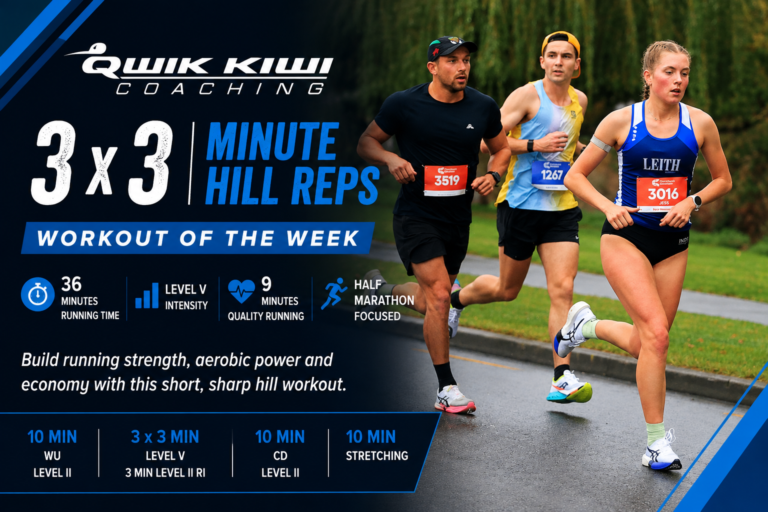
This week’s Coach Ray’s Workout of the Week is 10x 2min Hill Reps.
The workout consists of ten two-minute uphill efforts at Level V, with an easy Level II jog back downhill after each repetition.
With 20 minutes of quality uphill running, this is a demanding session that combines aerobic power development with running-specific muscular strength.
I primarily use workouts like this during the Early Quality (EQ) Phase of half marathon preparation, when we’re building the physical and physiological qualities that support more sustained threshold and race-specific training later in the programme.
The objective isn’t simply to run uphill as fast as possible.
It’s to produce ten strong, controlled uphill efforts while maintaining good running technique and consistent intensity from the first repetition to the last.
The Workout

Warm-Up
10 minutes at Level II
Begin with easy aerobic running to gradually increase your heart rate, breathing and muscle temperature.
If possible, finish your warm-up near the bottom of the hill you’ll be using for your repetitions.
Main Set
10x:
- 2 minutes uphill at Level V
- Jog back downhill at Level II for recovery
Repeat until you’ve completed ten uphill efforts.
After the final repetition, jog back down the hill before beginning your cool-down.
Cool-Down
10 minutes at Level II
Finish with easy aerobic running on flat or gently rolling terrain.
Stretching
10 minutes of stretching
Quality Running: 20 minutes at Level V
Running Duration: Approximately 50–65 minutes, depending on how long each downhill recovery takes.
For example, if your downhill jog takes two minutes, the session will total approximately 60 minutes:
10min warm-up + 10x (2min uphill + 2min downhill) + 10min cool-down = 60 minutes.
The actual running duration will vary according to the hill gradient, distance covered during each repetition and time required to jog back to your starting point.
Why This Workout Works
The 10x 2min Hill Reps workout combines two important training stimuli: sustained high-intensity running and the additional muscular demands of running uphill.
During each repetition, your cardiovascular system works hard to deliver oxygen to the working muscles, while your legs must produce sufficient force to propel you up the gradient.
Over ten repetitions, this creates a substantial training stimulus.
For half marathon runners, the key benefits include:
Aerobic Power: Level V efforts challenge your aerobic system and help develop your ability to work at high oxygen demands.
Running Strength: Uphill running increases the muscular demands on your calves, quadriceps, glutes and other muscles involved in propulsion.
Running Economy: Repeated uphill efforts provide an opportunity to practise effective posture, foot placement and force production.
Technique: Hills encourage purposeful running mechanics, particularly when you maintain good posture and avoid overstriding.
Fatigue Resistance: Completing ten repetitions challenges your ability to maintain running quality as fatigue accumulates.
Mental Resilience: Learning to remain composed during demanding uphill efforts can help develop confidence for challenging sections of a half marathon.
The objective isn’t simply to accumulate fatigue.
It’s to complete 20 minutes of high-quality Level V uphill running while maintaining consistent technique and effort.
Session Snapshot
| Goal | Develop aerobic power, running strength and running economy |
| Running Duration | Variable – approximately 55–65 minutes |
| Quality Running | 20 minutes |
| Intensity | Level V uphill |
| Recovery | Level II jog downhill |
| Training Phase | Early Quality (EQ) Phase |
| Best For | Half Marathon runners |
| Terrain | Moderate, consistent uphill gradient |
| Equipment | Running shoes and watch/timer |
| Difficulty | Intermediate to Advanced |
| Session Type | Hill Repetitions |
How Hard Should Level V Feel?
Level V is a hard, high-intensity effort designed to develop aerobic power.
Your breathing will become rapid and conversation will be extremely difficult.
However, there’s an important distinction between Level V and an all-out sprint.
You’re not attempting to run as fast as physically possible for two minutes.
You’re aiming to maintain a hard, controlled effort that you can reproduce across all ten repetitions.
Because you’re running uphill, your pace will be considerably slower than it would be on flat terrain at a similar physiological intensity.
That’s completely normal.
Don’t try to maintain your normal flat-ground Level V pace while climbing.
Instead, concentrate on your effort, breathing and running mechanics.
If you use a running power meter, it may provide additional information about your effort, although gradient and terrain can influence the relationship between power and perceived exertion.
Heart rate can also be useful, but remember that it takes time to respond to changes in intensity.
During a two-minute repetition, your heart rate may still be rising as you approach the finish.
For that reason, perceived effort is particularly important during this workout.
The goal is ten consistent Level V efforts—not ten maximal sprints.
Why Two-Minute Hill Repetitions?
Two minutes is long enough to create a substantial cardiovascular challenge while also providing a meaningful period of sustained uphill running.
Shorter hill repetitions often place greater emphasis on acceleration, explosive force production and running mechanics.
Longer hill repetitions can produce a more sustained aerobic challenge.
Two-minute repetitions sit between these approaches.
They’re long enough that you can’t rely on explosive power alone, but short enough that you can maintain a high intensity when the recovery is appropriate.
Across ten repetitions, you accumulate 20 minutes of uphill Level V running.
That’s a significant amount of quality work.
The challenge becomes maintaining consistent execution as the repetitions accumulate.
Choosing the Right Hill
Hill selection can make a substantial difference to the quality of this workout.
For two-minute repetitions, I recommend finding a hill with a relatively consistent, moderate gradient.
As a general guide, a gradient of approximately 4–8% can work well for many runners.
However, the exact gradient is less important than your ability to run continuously with good technique.
Ideally, your hill should have:
- A consistent gradient.
- A safe, even running surface.
- Minimal traffic or other interruptions.
- Enough length for two minutes of continuous uphill running.
- A safe route for jogging back downhill.
Avoid hills that are so steep that you’re forced to dramatically shorten your stride, lose your running rhythm or transition into walking.
The purpose is to develop running strength and aerobic power through quality uphill running.
You’re not trying to turn the workout into a climbing or hiking session.
Should You Use the Same Hill for Every Repetition?
Ideally, yes.
Using the same hill makes it easier to compare your repetitions and assess whether you’re maintaining consistent effort.
You can use landmarks or the distance covered during each two-minute effort as a rough indication of consistency.
However, don’t become obsessed with covering exactly the same distance every time.
Your priority is maintaining Level V intensity and good running technique.
The First Three Repetitions: Establish Your Effort
The opening repetitions are where you establish the intensity you want to maintain throughout the session.
You’ll be relatively fresh, and it may be tempting to attack the hill aggressively.
Resist that temptation.
Ten repetitions is a substantial workload.
Start the first effort at a controlled Level V intensity.
Concentrate on maintaining an efficient stride, good posture and consistent breathing.
The first repetition should feel hard, but you shouldn’t reach the top completely exhausted.
Use the second and third repetitions to settle into a sustainable rhythm.
By the end of the third repetition, you should have a good understanding of the effort required to complete the remaining seven.
The aim is consistency—not setting a personal best on the first climb.
Repetitions Four to Seven: Maintain Your Quality
The middle section is often where the real training benefit develops.
You’ve completed several hard efforts, and fatigue is beginning to accumulate.
Your legs may feel heavier.
Your breathing may take longer to settle during the downhill recoveries.
This is where maintaining good running technique becomes increasingly important.
Focus on:
- Keeping your posture tall.
- Maintaining a slight forward lean from the ankles.
- Avoiding excessive bending at the waist.
- Using your arms naturally to support your running rhythm.
- Maintaining a purposeful cadence.
- Avoiding exaggerated strides.
Don’t try to force your way uphill by dramatically increasing your stride length.
A slightly shorter, quicker stride is often more effective when climbing.
Remember that the objective is to maintain Level V intensity, not to chase a particular pace.
Repetitions Eight to Ten: Finish With Consistency
By the time you reach the final three repetitions, you’ve already accumulated 14 minutes of Level V uphill running.
The fatigue is real.
Your breathing will be elevated, and your legs may be feeling the cumulative demands of the workout.
This is where pacing discipline matters.
It can be tempting to approach the final repetition as an all-out race to the top.
But that’s not the purpose of the session.
Continue to run at Level V.
Maintain your technique.
Avoid allowing fatigue to cause excessive forward bending, overstriding or uncontrolled movements.
If you can complete the final repetition at approximately the same effort and with similar technique to the first, you’ve executed the workout well.
Finishing strongly means maintaining quality—not sprinting beyond the prescribed intensity.
Why Jogging Downhill Is Part of the Workout
The downhill recovery serves two purposes.
First, it provides an opportunity for your cardiovascular system to partially recover before the next high-intensity effort.
Second, it allows you to return to your starting point while continuing to run aerobically.
The prescribed intensity is Level II.
This should feel comfortable and controlled.
However, downhill running places different mechanical demands on your legs compared with running uphill.
In particular, the quadriceps must work eccentrically to help control your descent.
If you run downhill too aggressively, you may accumulate unnecessary muscular fatigue that compromises the quality of your later uphill repetitions.
That’s why I recommend jogging back down under control.
Avoid bounding downhill or attempting to recover as quickly as possible.
Use short, relaxed strides and maintain good balance.
If the hill is particularly steep or technical, slow down further for safety rather than forcing Level II pace.
The downhill recovery is there to support the next repetition.
Don’t turn the recovery into another hard effort.
Why Hill Repetitions Help on Flat Half Marathon Courses
A common misconception is that hill training is only valuable if you’re preparing for a hilly race.
That’s not the case.
Running uphill challenges your muscles to generate force against gravity.
It also creates an opportunity to practise purposeful running mechanics while your cardiovascular system is working hard.
The improvements you develop through hill training can contribute to your running performance on a variety of terrains.
For example, stronger and more efficient running mechanics may help you maintain your stride when fatigue develops during the later stages of a flat half marathon.
Similarly, developing aerobic power during the Early Quality Phase provides a useful foundation for the more sustained threshold and tempo training that follows.
Of course, hill repetitions don’t replace race-specific training.
As your half marathon approaches, your programme should increasingly reflect the demands of your event.
But earlier in your preparation, hill workouts can be an effective way to develop qualities that support that later training.
Running Technique: How to Run Uphill Efficiently
Good technique is particularly important during longer hill repetitions.
Maintain Good Posture
Keep your body relatively tall with a slight forward lean from the ankles.
Avoid bending excessively at the waist.
Shorten Your Stride Naturally
As the gradient increases, your stride will generally become shorter.
Allow this to happen naturally rather than trying to maintain your flat-ground stride length.
Maintain a Purposeful Cadence
Concentrate on keeping your feet moving rhythmically.
Avoid exaggerated, bounding movements that unnecessarily increase muscular fatigue.
Use Your Arms
Your arms can help support your running rhythm and balance.
Keep your shoulders relaxed and avoid excessive tension in your upper body.
Look Ahead
Keep your gaze directed up the hill rather than staring at your feet.
This can help maintain better posture and awareness of the terrain.
Run With Control
The aim is efficient, sustained Level V running.
If your technique deteriorates significantly, your effort may be too aggressive for the hill or your current fitness.
Coaching Tips
Warm Up Properly
Don’t begin the first Level V repetition immediately after arriving at the hill.
Complete your full Level II warm-up.
Start Conservatively
Ten repetitions is a substantial workload. Avoid attacking the first climb too aggressively.
Focus on Effort Rather Than Pace
Your pace will be affected by the gradient. Maintain the prescribed Level V intensity.
Use the Same Starting Point
Returning to the same point can help you maintain consistency between repetitions.
Jog Down Under Control
Use the downhill recovery to regroup rather than rushing back to the bottom.
Maintain Your Technique
Good posture, natural stride length and controlled arm movement matter throughout the workout.
Don’t Race the Final Repetition
Finish at Level V rather than turning the last climb into an all-out sprint.
Prioritise Recovery Afterwards
This is a demanding session. Ensure your subsequent training allows you to recover appropriately.
Common Mistakes
Choosing a Hill That’s Too Steep
An excessively steep gradient can compromise your running technique and change the nature of the session.
Running the First Repetition Too Fast
Starting too aggressively can make it difficult to maintain quality across all ten repetitions.
Chasing Flat-Ground Pace
Your pace will naturally decrease uphill. Use the prescribed intensity rather than trying to match your normal speed.
Sprinting Instead of Running at Level V
Two-minute Level V efforts should be hard and controlled, not maximal sprints.
Running Downhill Too Quickly
Aggressive downhill running can create unnecessary muscular fatigue and increase the risk of losing control.
Allowing Technique to Deteriorate
Poor posture, overstriding and excessive upper-body tension can reduce the quality of the workout.
Turning the Final Repetition Into a Race
The objective is ten consistent repetitions, not nine controlled efforts followed by one maximal sprint.
Adding Extra Repetitions
More isn’t automatically better.
Twenty minutes of quality Level V running is already a substantial training stimulus.
How This Workout Fits Into a Hill Repetition Progression
Hill repetitions can be progressively developed by increasing the duration or number of uphill efforts.
A possible progression could be:
| Workout | Level V Uphill Running | Number of Repetitions |
|---|---|---|
| 4x 2min Hill Reps | 8 minutes | 4 |
| 10x 1min Hill Reps | 10 minutes | 10 |
| 6x 2min Hill Reps | 12 minutes | 6 |
| 8x 2min Hill Reps | 16 minutes | 8 |
| 10x 2min Hill Reps | 20 minutes | 10 |
All variations can use a 10-minute Level II warm-up, Level II downhill recovery and a 10-minute Level II cool-down.
The total running duration will depend on the length of the downhill recoveries.
This is an illustration of possible workloads rather than a strict week-by-week progression. A runner might build from shorter repetitions towards longer ones, or increase the number of two-minute repetitions once they’re comfortable with the intensity.
The important principle is that the training load progresses appropriately.
Don’t increase the number of repetitions simply because you’re capable of completing more.
Your ability to maintain good running technique, consistent intensity and adequate recovery should guide progression.
For less experienced runners, 10x 2min Level V uphill may be too demanding initially.
Starting with fewer repetitions is often the better option.
When Should You Include This Workout?
I primarily use 10x 2min Hill Reps during the Early Quality (EQ) Phase of half marathon preparation.
My training approach progresses through four phases.
Foundation & Injury Prevention (FI) Phase
The emphasis is on establishing aerobic fitness, training consistency and the physical resilience required for the more demanding training ahead.
Most running is completed at easier intensities, with training volume developed progressively.
Early Quality (EQ) Phase
This is where structured quality training becomes an important component of the programme.
Workouts such as hill repetitions help develop running strength, aerobic power and running economy.
The objective is to develop the physical and physiological qualities that support the more sustained quality running introduced later.
10x 2min Hill Reps fits particularly well within this phase.
Transition Quality (TQ) Phase
Training increasingly focuses on the ability to sustain stronger running intensities.
Longer threshold repetitions and other structured workouts help bridge the gap between earlier aerobic power development and later race-specific preparation.
Final Quality (FQ) Phase
Training becomes increasingly specific to the demands of the half marathon.
Greater emphasis is placed on sustained Level III tempo running, race-specific pacing and developing the ability to maintain the required intensity over 21.1 kilometres.
The aerobic power and running strength developed during the Early Quality Phase help support this later training.
This is why hill repetitions are valuable even when your goal race is flat.
We’re developing qualities early in the programme that can contribute to stronger, more efficient running later.
Coach Ray’s Verdict
10x 2min Hill Reps is a challenging workout designed to develop aerobic power, running strength and running economy.
With 20 minutes of Level V uphill running, the session provides a substantial training stimulus during the Early Quality Phase of half marathon preparation.
The key is maintaining quality.
Choose a suitable hill.
Complete your warm-up.
Run each uphill repetition at a controlled Level V intensity.
Jog back downhill at Level II.
And aim to maintain consistent effort and good technique from the first repetition through to the tenth.
Don’t sprint the first climb.
Don’t race the downhill recoveries.
And don’t sacrifice your technique simply to complete another repetition.
Strong, controlled hill running today can help build the fitness and resilience you’ll rely on later in your half marathon preparation.
Ready to Put Workouts Like This Into a Complete Half Marathon Plan?
Individual workouts can be valuable, but their real benefit comes from completing the right session at the right point within an appropriately structured programme.
Inside the NZ Half Marathon Hub+, my training progresses through the Foundation & Injury Prevention (FI), Early Quality (EQ), Transition Quality (TQ) and Final Quality (FQ) phases, gradually moving from developing your aerobic foundation towards increasingly specific half marathon preparation.
Whether you’re preparing for your first half marathon or looking to improve your personal best, following a structured programme helps ensure your training progresses appropriately.

Explore the NZ Half Marathon Hub+ and find your next training programme.




One Comment
Comments are closed.