
Coach Ray’s Workout of the Week: 4x 8min Threshold Runs
Threshold running is one of the most valuable training tools for half marathon runners. It develops your ability to sustain a strong running intensity for longer periods, helping you become more efficient and maintain your pace as fatigue accumulates.
But effective threshold training isn’t about running as hard as possible. It’s about maintaining a controlled intensity for the prescribed duration.
This week’s Coach Ray’s Workout of the Week is 4x 8min Threshold Runs.
The session includes four eight-minute repetitions at Level IV, separated by two-minute Level I recovery intervals. With a 10-minute warm-up and 10-minute cool-down, you’ll complete 60 minutes of running, including 32 minutes of quality threshold work.
I primarily use this workout during the Transition Quality (TQ) Phase of half marathon preparation, when athletes are building their ability to sustain more demanding running intensities before progressing towards increasingly race-specific training.
The challenge isn’t simply completing the first eight-minute repetition.
It’s maintaining the correct Level IV intensity throughout all four repetitions, particularly as fatigue accumulates.
The Workout

Warm-Up
10 minutes at Level II
Begin with easy aerobic running, gradually preparing your cardiovascular system and muscles for the threshold efforts ahead.
Your breathing should remain comfortable, and you should finish the warm-up feeling ready to run harder.
Main Set
Complete:
4x 8 minutes at Level IV, with 2 minutes at Level I recovery after each repetition.
Each eight-minute repetition should be completed at a comfortably hard but controlled threshold intensity.
The two-minute Level I recovery allows you to reduce the intensity substantially before beginning the next repetition.
Avoid turning the recovery into a faster aerobic run. The purpose is to recover sufficiently to maintain the quality of the following effort.
Cool-Down
10 minutes at Level I–II
After the final recovery interval, continue with easy running to gradually reduce your effort.
Stretching
10 minutes stretching
Running Duration: 60 minutes
Quality Running: 32 minutes at Level IV
Why This Workout Works
The 4x 8min Threshold Runs workout provides a substantial amount of sustained Level IV running while dividing the workload into manageable repetitions.
Instead of attempting to complete 32 minutes continuously at threshold intensity, you accumulate that quality work across four eight-minute intervals.
The short recoveries help you maintain the intended intensity and good running technique throughout the session.
For half marathon runners, this develops several important qualities:
- Threshold Fitness: Improving your ability to sustain a strong running intensity before fatigue increases rapidly.
- Aerobic Endurance: Developing the capacity to continue running efficiently at demanding intensities.
- Running Economy: Practising efficient movement while running at a sustained, purposeful effort.
- Pacing Discipline: Learning to maintain consistent intensity rather than starting too fast.
- Fatigue Resistance: Developing your ability to sustain quality running as the session progresses.
- Mental Resilience: Building confidence in your ability to maintain controlled effort through longer repetitions.
The key benefit comes from accumulating 32 minutes at the correct Level IV intensity.
Running faster than prescribed doesn’t automatically produce a better workout.
Session Snapshot
| Goal | Improve threshold fitness, aerobic endurance and running economy |
| Running Duration | 60 minutes |
| Quality Running | 32 minutes |
| Intensity | Level IV |
| Recovery | 2 minutes at Level I |
| Training Phase | Transition Quality (TQ) Phase |
| Best For | Half Marathon runners |
| Terrain | Flat to gently rolling |
| Equipment | Running shoes and watch/timer |
| Difficulty | Intermediate–Advanced |
| Session Type | Threshold |
How Hard Should Level IV Feel?
Level IV is comfortably hard but controlled.
You’re running substantially harder than your normal Level II aerobic intensity and above the Level III tempo intensity used during more race-specific half marathon training.
Your breathing will be elevated, conversation will be difficult, and you’ll need to concentrate on maintaining your running rhythm.
However, you should remain in control.
Eight minutes is long enough that starting too aggressively will create problems before the repetition finishes.
The objective is to settle into Level IV and maintain it consistently.
If you’re struggling desperately after the opening three or four minutes, you’ve probably started too hard.
Similarly, if you finish the first repetition feeling as though you’ve completed a race effort, you’re unlikely to maintain the correct intensity throughout the session.
You should finish each repetition feeling that you’ve worked hard, but still have the capacity to complete the remaining repetitions at the prescribed intensity.
Why Eight-Minute Threshold Repetitions?
Eight-minute repetitions provide a useful balance between sustained threshold running and manageable recovery opportunities.
Shorter threshold intervals can be effective, but they don’t always require the same level of sustained concentration.
Longer intervals demand greater pacing discipline.
With eight minutes at Level IV, you have enough time to settle into a consistent rhythm and maintain a meaningful threshold effort.
Across four repetitions, that produces 32 minutes of quality running.
This is a substantial threshold workload for a half marathon runner.
The purpose isn’t to complete each repetition faster than the previous one.
It’s to reproduce the correct intensity four times.
Why the Level I Recovery Matters
This workout uses two-minute Level I recovery intervals.
That’s deliberately easier than the Level II recoveries used in some of my other threshold sessions.
Level I is a very easy recovery intensity.
During these two minutes, allow your breathing to settle and reduce the muscular and cardiovascular demands of running.
You should continue moving, but the effort should be genuinely easy.
The recovery isn’t an opportunity to demonstrate how quickly you can run between repetitions.
It’s an opportunity to prepare for the next eight-minute Level IV effort.
There are two common mistakes athletes make during these recovery intervals.
The first is running too fast.
If your recovery drifts into Level II or Level III, you’re adding unnecessary workload and potentially compromising the following repetition.
The second is stopping completely when the workout calls for Level I running.
Unless there’s a specific reason to stop, maintain gentle forward movement.
The recovery is part of the workout prescription, so complete it at the correct intensity.
The First Repetition: Establish Your Intensity
The opening eight-minute repetition is where you establish the rhythm you want to maintain throughout the workout.
You’re fresh from your warm-up and should feel ready to run.
That can make it tempting to start aggressively.
Resist that temptation.
Use the opening minute to settle smoothly into Level IV.
Focus on your breathing, posture and running rhythm.
By the end of the first eight minutes, you should feel that you’ve completed a solid threshold effort without exhausting yourself.
You still have another 24 minutes of Level IV running ahead.
The Second Repetition: Repeat the Quality
After two minutes at Level I, begin your second eight-minute repetition.
The objective is to reproduce the same controlled threshold intensity.
Don’t automatically accelerate because you feel recovered.
Equally, don’t assume you need to slow down simply because you’ve already completed one repetition.
Allow your effort to guide the pace.
The second repetition should feel challenging but manageable.
Concentrate on maintaining good running technique and avoiding unnecessary tension.
The Third Repetition: Maintain Discipline
By the third repetition, fatigue will have started to accumulate.
You’ve already completed 16 minutes of threshold running, and your body is beginning to feel the workload.
This is where pacing discipline becomes particularly important.
You may notice that maintaining Level IV requires greater concentration.
That’s expected.
However, your intensity should remain controlled.
Avoid allowing the effort to drift into Level V.
The objective isn’t to demonstrate how hard you can push.
It’s to maintain the intended training stimulus.
The Fourth Repetition: Finish With Quality
The final eight-minute repetition brings your total threshold running to 32 minutes.
This is where the workout comes together.
You’ve already completed three sustained Level IV efforts, and the accumulated fatigue will make the final repetition more demanding.
Your challenge is to maintain the same controlled intensity.
Don’t turn the final repetition into a race.
There’s no need to sprint through the final minute or push beyond Level IV simply because the workout is almost finished.
Finishing strongly means maintaining the correct intensity and good running technique—not running as fast as possible.
If you can complete the fourth repetition with the same quality as the first, you’ve executed the session well.
Don’t Turn Threshold Into VO₂ Max
One of the most common mistakes athletes make during threshold training is running too hard.
Level IV and Level V serve different purposes within your training programme.
Level IV develops your ability to sustain a strong, controlled running intensity.
Level V places a greater emphasis on very hard aerobic-power work.
Both have their place.
But they’re not interchangeable.
If you consistently push your threshold repetitions into Level V, you’re changing the training stimulus and increasing the fatigue cost.
That can affect your recovery and your ability to complete subsequent workouts.
For this session, 32 minutes at Level IV is the objective.
Don’t sacrifice that purpose by chasing faster times.
Choosing the Right Route
A flat to gently rolling route is ideal for this workout.
You want terrain that allows you to establish and maintain a consistent threshold intensity without frequent interruptions.
Suitable options include:
- Quiet roads with minimal traffic
- Cycle paths
- Flat park loops
- Waterfront or riverside routes
- A running track
- A treadmill when outdoor conditions are unsuitable
Avoid routes with frequent road crossings, traffic lights or steep hills.
If you’re running on rolling terrain, adjust your pace to maintain Level IV intensity.
Your speed will naturally vary with the gradient.
That’s acceptable.
The important thing is that the training intensity remains appropriate.
Run by Intensity, Not Just Pace
Threshold running is often associated with specific pace targets.
However, your pace on any particular day can be influenced by fatigue, temperature, wind, terrain and other factors.
That’s why I prescribe this workout using Level IV intensity.
Your objective is to maintain the correct physiological demand rather than blindly chasing a predetermined speed.
If you’re running into a strong headwind, your pace may slow.
If you’re running uphill, your pace will naturally decrease.
If you’re carrying fatigue from previous training, your usual threshold pace may feel harder than expected.
Use your perceived effort, supported by heart rate or running power where appropriate, to guide the workout.
The goal is consistent Level IV running.
Coaching Tips
Start Each Repetition Smoothly
Avoid sprinting into Level IV. Build into the effort and establish your rhythm.
Maintain Consistent Intensity
All four repetitions should be completed at the prescribed Level IV intensity.
Respect the Level I Recoveries
The recovery intervals should be genuinely easy.
Focus on Good Technique
Maintain relaxed shoulders, an efficient cadence and controlled breathing.
Choose Consistent Terrain
Flat or gently rolling terrain makes it easier to maintain the correct intensity.
Don’t Race the Final Repetition
Finish with quality rather than an unnecessary sprint.
Consider the Wider Training Programme
This is a substantial threshold workout. Allow appropriate recovery before your next demanding session.
Common Mistakes
Starting Too Fast
An aggressive opening repetition can compromise the remaining 24 minutes of quality running.
Running the Recoveries Too Hard
Level I recovery should remain very easy.
Turning Level IV Into Level V
Harder isn’t automatically better. Maintain the prescribed threshold intensity.
Chasing Pace Regardless of Conditions
Adjust your speed to maintain the appropriate intensity.
Losing Technique as Fatigue Develops
Maintain an efficient running action throughout all four repetitions.
Sprinting the Final Minute
The workout finishes at Level IV, not with an all-out effort.
Scheduling Too Much Quality Training
This session already contains 32 minutes of threshold running. Avoid unnecessarily stacking additional demanding workouts around it.
How Could This Workout Progress?
Not every half marathon runner needs to begin with four eight-minute threshold repetitions.
The appropriate workload depends on the athlete’s training history, fitness and ability to tolerate sustained quality running.
A possible progression could be:
| Workout | Level IV Running | Running Duration |
|---|---|---|
| 4x 5min Threshold Runs | 20 minutes | 48 minutes |
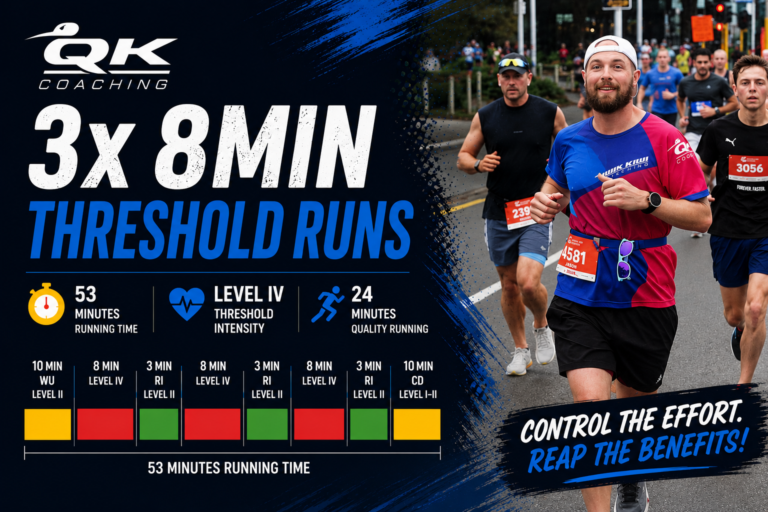
| 3x 8min Threshold Runs | 24 minutes | 53 minutes |
| 4x 8min Threshold Runs | 32 minutes | 60 minutes |
Each variation uses a 10-minute Level II warm-up, two-minute Level I recovery after each repetition, and a 10-minute Level I–II cool-down.
Progression comes from increasing the amount of quality running an athlete can complete while maintaining the correct intensity.
It doesn’t come from running each repetition faster.
An athlete should demonstrate that they can complete the shorter versions consistently before progressing to the full four repetitions.
When Should You Include This Workout?
I primarily use 4x 8min Threshold Runs during the Transition Quality (TQ) Phase of half marathon preparation.
My periodisation approach progresses through four phases.
Foundation & Injury Prevention (FI) Phase
The emphasis is on establishing aerobic fitness, training consistency and the resilience needed to tolerate more demanding running.
Most running is completed at easier intensities, with training volume developed progressively.
Early Quality (EQ) Phase
Structured quality training is introduced while aerobic development continues.
Workouts such as hill repetitions and shorter quality intervals help develop running strength, aerobic power and running economy.
Transition Quality (TQ) Phase
Training becomes more demanding as athletes develop their ability to sustain stronger intensities.
This is where longer threshold intervals become particularly valuable.
The 4x 8min Threshold Runs workout fits well here because it provides 32 minutes of sustained Level IV running.
Final Quality (FQ) Phase
Training becomes increasingly specific to the demands of the half marathon.
Greater emphasis is placed on sustained Level III tempo running, race-specific pacing and developing the ability to maintain the required intensity over 21.1 kilometres.
The threshold fitness developed during earlier phases supports this more specific training.
The objective is to progressively develop the capabilities required for race day rather than attempting to replicate race intensity throughout the entire programme.
Coach Ray’s Verdict
4x 8min Threshold Runs is a demanding but effective threshold workout for half marathon runners.
With 32 minutes of Level IV running, the session provides a substantial opportunity to develop threshold fitness, aerobic endurance and running economy.
The two-minute Level I recoveries help you maintain the intended intensity across all four repetitions.
The challenge isn’t to run the first repetition as fast as possible.
It’s to complete four consistent eight-minute efforts at Level IV.
Warm up properly.
Settle into your threshold intensity.
Respect the recovery intervals.
Maintain good technique.
And finish the final repetition with the same control as the first.
For a half marathon runner progressing through the Transition Quality Phase, this workout can provide an important stepping stone towards the more sustained, race-specific running that follows.
Control the intensity. Accumulate quality. Build the fitness you’ll need on race day.
Ready to Put Workouts Like This Into a Complete Half Marathon Plan?
Threshold workouts can be extremely effective, but their real value comes from completing the right session at the right point in your training programme.
Inside the NZ Half Marathon Hub+, my structured training plans progress through the Foundation & Injury Prevention (FI), Early Quality (EQ), Transition Quality (TQ) and Final Quality (FQ) phases.
That means you’re not simply collecting individual workouts.
You’re following a progressive training programme designed to develop your fitness and prepare you for the demands of your half marathon.
Whether you’re training for your first half marathon or looking to improve your personal best, structured training can help you make the most of the time you have available.

Explore the NZ Half Marathon Hub+ and find your next training programme.





One Comment
Comments are closed.