Coach Ray’s Workout of the Week: 4x 4min Hill Reps
Hill training has long been one of the most effective ways to become a stronger, faster and more efficient runner. While many runners associate hills with simply building stronger legs, a well-designed hill session also develops aerobic fitness, improves running economy and reinforces good running technique.
This week’s Coach Ray’s Workout of the Week is one of my favourite sessions during the Early Quality (EQ) phase of half marathon training. The sustained four-minute efforts are long enough to challenge your cardiovascular system while the uphill gradient naturally encourages efficient running form and powerful stride mechanics.
If you’re preparing for a half marathon, this is a session that can lay the foundation for faster, stronger running later in your training programme.
The Workout
Warm-up
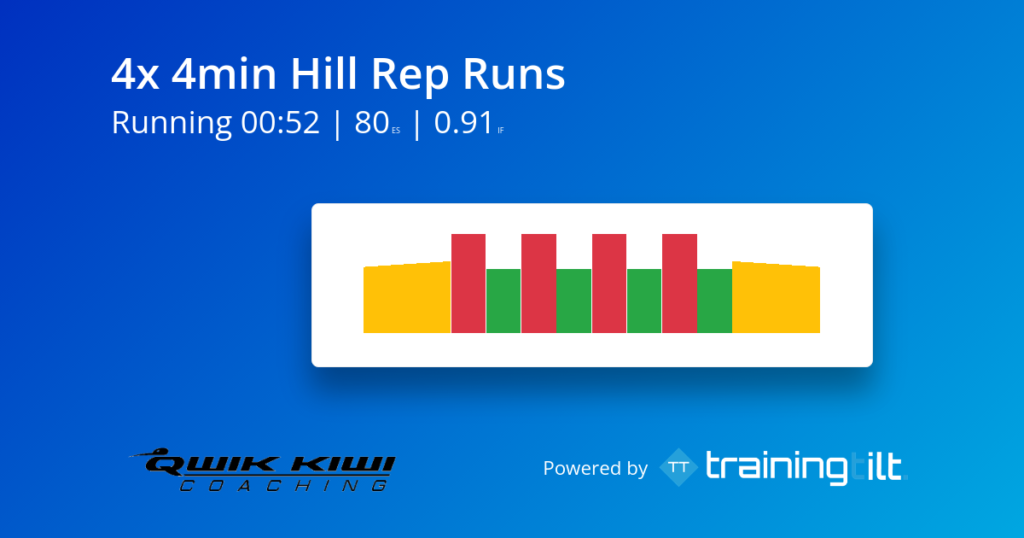
- 10 minutes Level II easy running
Main Set
- 4 × 4 minute hill repetitions at Level V
- Recover with an easy jog back down the hill (approximately 4 minutes)
Cool-down
- 10 minutes Level I–II easy running
- 10 minutes stretching
Why This Workout Works
Hill repetitions are often described as strength training for runners, and for good reason.
Running uphill forces your glutes, hamstrings, calves and quadriceps to work harder with every stride. At the same time, your heart and lungs are challenged to deliver more oxygen to the working muscles, making this an excellent aerobic conditioning session.
Unlike fast intervals on flat ground, hill running naturally limits your speed while maintaining a high physiological workload. This means you can train at a high intensity with less impact through your joints, reducing the risk of excessive fatigue and injury.
This workout helps develop:
- Aerobic power
- Running-specific strength
- Improved running economy
- Better climbing ability
- Greater mental resilience
- More efficient running mechanics
The benefits don’t just apply to hilly races. Stronger, more economical runners are generally faster on flat courses as well.
Session Snapshot
| Goal | Build aerobic power, running strength and climbing ability |
| Duration | 52 minutes |
| Intensity | Level V |
| Training Phase | Early Quality (EQ) |
| Best For | Half Marathon runners |
| Terrain | A steady hill with a consistent moderate gradient |
| Equipment | Running shoes and GPS watch (optional) |
| Difficulty | Intermediate to Advanced |
| Session Type | Hill Repetitions |
Choosing the Right Hill
The hill you choose can make a significant difference to the quality of the session.
Ideally, look for a hill that:
- Takes more than four minutes to climb, preferably eight minutes or longer (so you don’t accidentally get to the summit).
- Has a consistent gradient.
- Allows you to run continuously without stopping for intersections or traffic.
- Has a safe route to jog back down for recovery.
- Is challenging without being excessively steep.
A moderate gradient allows you to maintain good running form throughout each repetition while still producing a strong training stimulus.
How Hard Should Level V Feel?
The goal is to maintain a consistent effort, not a consistent pace.
Because gradients vary from hill to hill, pace is largely irrelevant during this session. Instead, use your perceived effort.
Level V should feel comfortably hard. Your breathing should be deep and controlled, you’re working with purpose, but you’re not sprinting.
Aim to complete the fourth repetition at a similar effort to the first. If you’re dramatically slowing down, you’ve probably started too hard.
Coaching Tips
To get the most from this workout:
- Run tall with a slight lean from your ankles rather than bending at the waist.
- Keep your stride slightly shorter than normal while maintaining a quick cadence.
- Drive your arms naturally to help generate rhythm and power.
- Relax your shoulders and upper body.
- Look several metres ahead rather than down at your feet.
- Jog easily back down the hill so you’re ready for the next repetition.
Remember, good technique becomes even more important as fatigue builds.
Common Mistakes
Starting Too Fast
Many runners attack the first repetition far too aggressively, leaving themselves unable to maintain the required effort later in the session.
Choosing a Hill That’s Too Steep
If the hill is excessively steep, your running mechanics change significantly and the workout becomes more of a strength exercise than an aerobic quality session.
Racing the Recovery
The jog back down should be exactly that—a recovery. Use the time to lower your heart rate, relax your breathing and prepare for the next effort.
Focusing on Pace
Forget your pace during hill sessions. Concentrate on maintaining a consistent effort and good running form.
Variations
Beginner
- 4 × 2 minutes uphill
- Easy jog back down
Intermediate
- 4 × 4 minutes uphill (this session)
Advanced
- 5–6 × 4 minutes uphill
or
- 4 × 5 minutes uphill
When Should You Include This Workout?
This session is ideally suited to the Early Quality (EQ) phase of a half marathon training programme.
During this phase, the objective is to begin introducing structured quality sessions after establishing a solid aerobic base. Hill repetitions are an excellent choice because they develop strength, aerobic power and running economy while placing less impact stress on the body than fast intervals on the flat.
As training progresses towards race-specific preparation, hill sessions are generally replaced with threshold and half marathon pace workouts. However, the strength developed during the EQ phase continues to provide benefits throughout the remainder of your training.
I typically schedule this workout every two to three weeks during the Early Quality phase, depending on the athlete’s experience, race goals and overall training load.
Coach Ray’s Verdict
If I could only prescribe one hill workout for half marathon runners, this would be one of my first choices.
The four-minute repetitions are long enough to produce meaningful aerobic adaptations while simultaneously developing the strength and running economy that every successful half marathon runner needs. It’s challenging without being overwhelming, suits a wide range of abilities and provides benefits that carry through to every subsequent phase of training.
Don’t worry about how fast you’re running uphill. Focus instead on maintaining a consistent effort, good posture and relaxed technique. Over time you’ll become stronger, more efficient and better prepared for the faster workouts that follow.
Ready to Take Your Half Marathon Training to the Next Level?
A workout like this is powerful on its own, but it’s even more effective when it’s completed at the right time within a structured training programme.
Inside the NZ Half Marathon Hub, you’ll receive a personalised half marathon training programme built around my periodised coaching philosophy, showing you exactly when to complete sessions like this and how they fit into your overall progression. You’ll also gain access to fortnightly coaching calls, the Qwik Kiwi Coaching community, training resources and ongoing support to help you train with confidence.
Whether your goal is simply to finish your first half marathon or set a new personal best, the NZ Half Marathon Hub provides the structure, accountability and coaching to help you get there.