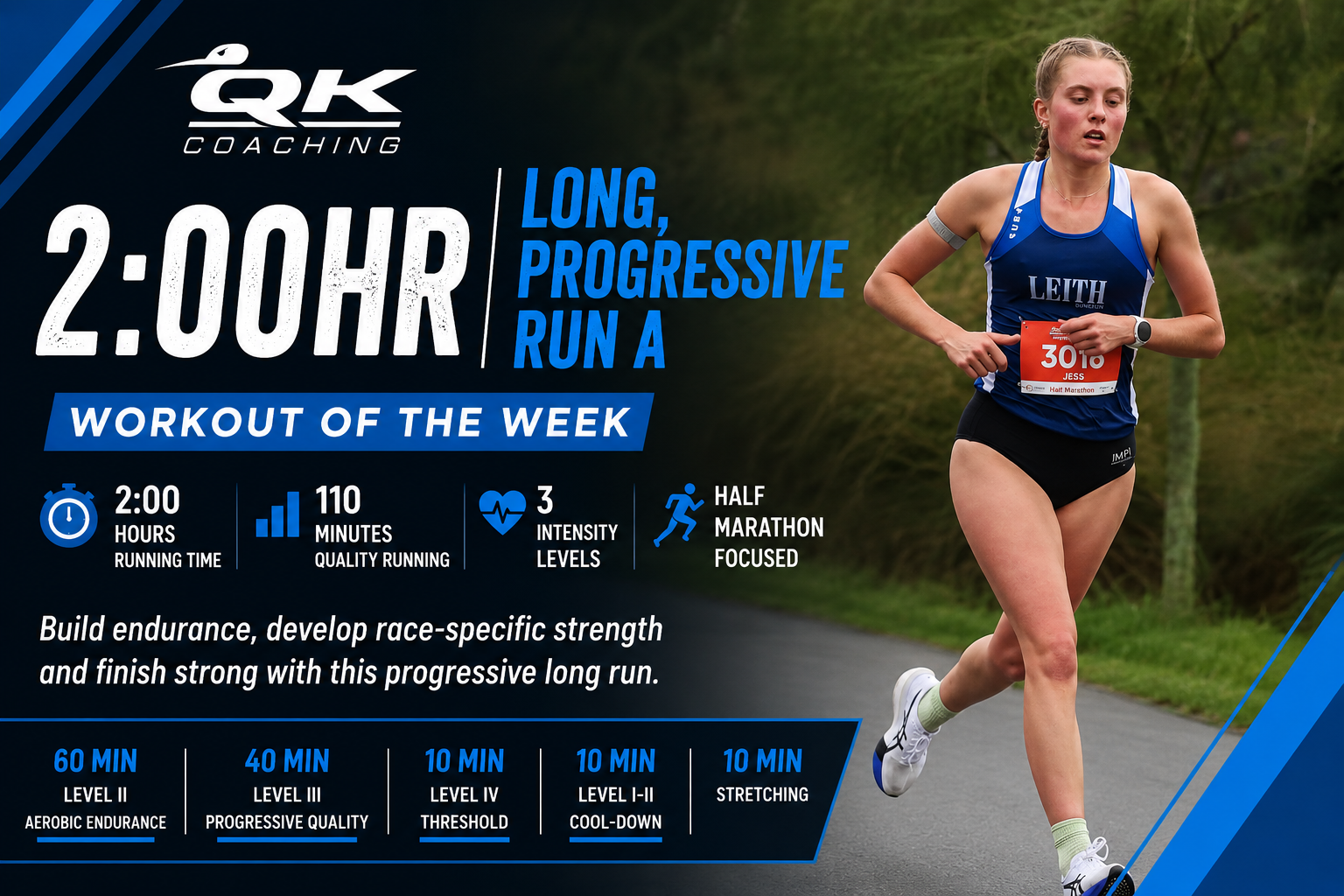
Coach Ray’s Workout of the Week: 2:00hr Long, Progressive Run A
Long runs are a cornerstone of half marathon preparation, but as an athlete develops, some long runs can become much more than simply accumulating easy kilometres.
This week’s Coach Ray’s Workout of the Week is 2:00hr Long, Progressive Run A. It begins with a full hour at Level II before progressively increasing the intensity through 40 minutes at Level III and 10 minutes at Level IV, followed by a 10-minute easy cool-down.
This is an advanced, demanding half marathon workout. I only use a session like this once an athlete has developed sufficient aerobic capacity to cope with the stress involved. It isn’t an introductory long run and it isn’t appropriate simply because an athlete can physically complete two hours of running.
When an athlete is ready for it, however, the combination of duration, progression and increasingly demanding intensity makes this an excellent workout during the Transition Quality (TQ) and/or Final Quality (FQ) phase of a half marathon build-up.
The Workout
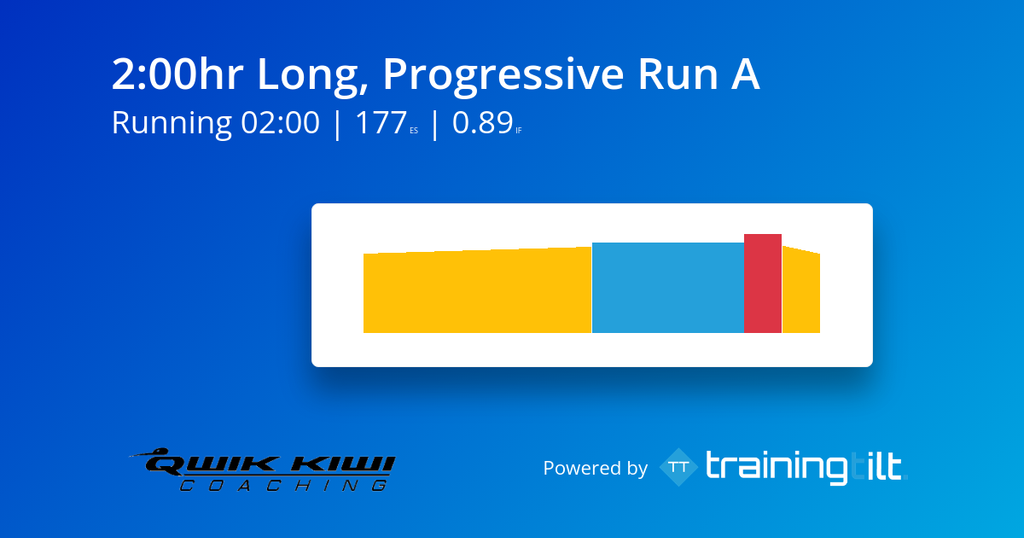
Aerobic Endurance
- 60 minutes at Level II
Progressive Quality Running
- 40 minutes at Level III
- 10 minutes at Level IV
Cool-Down
- 10 minutes at Level I–II
- 10 minutes stretching
Running Duration: 2 hours
Total Session Duration Including Stretching: 2 hours 10 minutes
Why This Workout Works
What makes this workout valuable isn’t simply that you’re running for two hours.
It’s when the harder running occurs.
You complete an entire hour at Level II before increasing to Level III. After another 40 minutes of running, you then lift the intensity again and complete 10 minutes at Level IV.
By the time you reach that final Level IV section, you’ve already been running for 100 minutes.
That changes the nature of the quality work considerably.
Running at Level III or Level IV when fresh is one thing. Maintaining efficient technique, appropriate intensity and concentration after a substantial amount of running is another.
For a well-prepared half marathon runner, this workout can develop:
- Aerobic endurance
- Race-Pace Development
- Threshold
- Running economy
- Resistance to fatigue
- Pace control
- Mental resilience
You’re teaching your body to do more than simply tolerate a long run. You’re asking it to progressively increase the quality of the running as fatigue accumulates.
Session Snapshot
| Goal | Develop aerobic endurance and the ability to run strongly as fatigue accumulates |
| Running Duration | 2 hours |
| Total Session Duration | 2 hours 10 minutes including stretching |
| Level II Running | 70 minutes |
| Level III Running | 40 minutes |
| Level IV Running | 10 minutes |
| Training Phase | Transition Quality (TQ) and/or Final Quality (FQ) Phase |
| Best For | Experienced Half Marathon runners with sufficient aerobic capacity |
| Terrain | Flat to gently rolling |
| Equipment | Running shoes, watch/timer; fluids and fuelling as required |
| Difficulty | Advanced |
| Session Type | Long Run / Progression Run |
This Workout Needs to Be Earned
This is one of the most important things to understand about 2:00hr Long, Progressive Run A.
I wouldn’t prescribe this workout to an athlete simply because they’re training for a half marathon.
Before introducing a long progressive session like this, I want the athlete to have developed the aerobic capacity and training resilience necessary to absorb it.
They need to be comfortable completing appropriate long runs and recovering from them.
Why?
Because we’re combining two different forms of training stress.
First, there is duration.
Two hours is already a significant run for many half marathon runners.
Then we’re adding intensity.
The final 50 minutes aren’t simply easy endurance running. Forty minutes are completed at Level III before progressing immediately into 10 minutes at Level IV.
That’s a substantial workload.
Prescribing it before an athlete is ready doesn’t make the programme more advanced. It simply creates unnecessary fatigue and potentially compromises the training that follows.
The First 60 Minutes: Be Patient
The opening hour is completed at Level II.
And Level II means Level II.
One of the biggest mistakes you can make is feeling fresh early in the run and allowing the intensity to creep upwards.
Remember what is coming.
You still have:
- 40 minutes at Level III
- 10 minutes at Level IV
- 10 minutes of easy running
The opening hour establishes the aerobic foundation of the workout while also creating the fatigue that makes the later quality running so valuable.
There is absolutely no prize for reaching 60 minutes ahead of schedule.
Be disciplined.
The Next 40 Minutes: Settle Into Level III
After 60 minutes, increase the intensity to Level III.
This shouldn’t feel like suddenly changing gears and attacking the run.
Instead, smoothly increase your effort until you’ve settled into a strong, controlled tempo rhythm.
You’ve now got 40 minutes to maintain.
The key word remains controlled.
Your breathing will increase and the running will feel considerably more purposeful than Level II, but you shouldn’t be drifting into Level IV.
This section represents a substantial block of quality running in its own right.
By the end of it, you’ll have been running for 100 minutes.
That’s when the workout asks its biggest question.
The Final 10 Minutes of Quality: Level IV
After 40 minutes at Level III, increase to Level IV for 10 minutes.
There is no recovery interval.
That’s deliberate.
You’re moving directly from sustained tempo running into threshold intensity while carrying the fatigue accumulated during the previous 100 minutes.
This isn’t about sprinting.
It’s about demonstrating that you can still run strongly, efficiently and with control late in a demanding endurance workout.
The final 10 minutes should be hard.
But Level IV still means Level IV.
Don’t turn it into Level V because you can see the end of the quality work approaching.
Why the Progression Matters
The structure of this workout teaches an important lesson:
Don’t spend your best running too early.
You begin easy.
Then you run steadily.
Then you run hard.
Only after completing the hardest section do you back off and cool down.
That’s very different from the common mistake of starting a long run enthusiastically, gradually slowing as fatigue develops and finishing considerably slower than you began.
Progressive running encourages discipline early and strength later.
For half marathon runners, that can be particularly valuable as training becomes increasingly race-specific.
Run by Intensity, Not a Predetermined Pace
A two-hour workout gives plenty of opportunity for conditions to change.
You might encounter:
- Hills
- Headwinds
- Heat
- Different running surfaces
- Accumulating fatigue
Your pace may therefore vary considerably throughout the session.
That’s okay.
The workout is prescribed using Levels I–IV, not an instruction to hold one rigid GPS pace regardless of conditions.
Use pace, heart rate or running power as appropriate to help guide the workout, but always consider the purpose of each section.
A hill during your Level III block doesn’t suddenly mean you need to force your flat-road Level III pace uphill.
Maintain the appropriate intensity.
Choosing the Right Route
Because the quality component is substantial, I prefer a route that allows reasonably consistent running.
A flat to gently rolling course works particularly well.
Ideally, avoid:
- Frequent traffic lights
- Busy intersections
- Extremely steep climbs
- Technical trails
- Locations where you’ll regularly need to stop
Gentle undulations are perfectly acceptable and can actually be useful because they encourage you to regulate your effort rather than becoming fixated on pace.
If possible, plan the route so that the final 50 minutes can be completed relatively uninterrupted.
Fuelling and Hydration Matter
A two-hour progressive run is also an opportunity to practise the fuelling and hydration strategies you’ll use during longer training and racing.
Don’t deliberately under-fuel the workout to make it harder.
The goal is to produce quality running late in the session.
Arrive appropriately fuelled and consider your carbohydrate and fluid requirements based on your individual needs, environmental conditions and race-day strategy.
This can make the workout useful for developing not only your physical fitness but also your race-day routines.
Coaching Tips
Respect the First Hour
Running Level II properly gives you the best opportunity to execute the later stages of the workout.
Progress Smoothly
Don’t sprint when the clock reaches 60 minutes or again when you reach 100 minutes. Gradually lift the effort into the next prescribed intensity.
Stay at Level III for the Full 40 Minutes
Don’t allow excitement—or fatigue—to turn Level III into Level IV prematurely.
Protect Your Running Form
As fatigue accumulates, think about posture, cadence and relaxed upper-body movement.
Level IV Is Not Level V
The final 10 minutes should be hard, but controlled.
Think Beyond the Workout
A successful session is one you can recover from appropriately and incorporate into the rest of your training programme.
Common Mistakes
Attempting the Workout Before You’re Ready
This isn’t a session I’d use early in an athlete’s development. Build the aerobic capacity to handle the duration first.
Running the Opening Hour Too Hard
Every little bit of unnecessary intensity early in the workout can come back to you during the final 50 minutes.
Turning Level III Into a Race
Forty minutes is a substantial tempo effort, especially after an hour of running. Stay disciplined.
Attacking the Final 10 Minutes
The goal is Level IV threshold running—not seeing how fast you can cover the final section.
Ignoring Fuelling
If fuelling is appropriate for the athlete and session, practise it. A demanding long run isn’t improved by unnecessarily running out of energy.
Treating Completion as the Only Measure of Success
Finishing two hours isn’t enough.
The objective is to execute the progression correctly.
How Do You Know You’re Ready for This Workout?
Before I’d prescribe this session, I’d want an athlete to have demonstrated that they can comfortably tolerate the underlying endurance workload.
That means building progressively through easier long runs rather than jumping directly to two hours with 50 minutes of quality running at the end.
You should be able to complete your current long runs consistently, maintain good technique and recover appropriately afterwards.
The training surrounding the long run matters too.
If a workout like this leaves you so fatigued that you’re unable to complete the following days of training properly, the session may be too demanding for your current level of preparation.
A training programme isn’t a collection of isolated heroic workouts.
Each session needs to contribute to the overall progression.
When Should You Include This Workout?
I use 2:00hr Long, Progressive Run A only once an athlete has built sufficient aerobic capacity to handle the stress of the workout.
Even then, I would primarily use it during the Transition Quality (TQ) and/or Final Quality (FQ) Phase of a half marathon build-up.
During the Foundation & Injury Prevention (FI) Phase, the priority is developing the aerobic conditioning, consistency and resilience required for the later stages of training.
The Early Quality (EQ) Phase introduces quality training and develops some of the underlying capabilities needed to become a stronger runner.
By the time we reach Transition Quality, a suitably prepared athlete can begin handling more demanding combinations of endurance and intensity.
During Final Quality, the specificity becomes even more important.
That’s where a workout like this can become particularly valuable.
Rather than completing quality running while fresh, you’re developing the ability to maintain—and ultimately increase—your running intensity after already accumulating substantial fatigue.
For a half marathon runner who has earned the fitness required to perform it, that’s a powerful training stimulus.
Coach Ray’s Verdict
2:00hr Long, Progressive Run A is not a beginner’s long run.
Nor is it a session that should be added simply because harder training looks more impressive on Strava.
It’s a workout that needs to be earned through consistent aerobic development.
When you’re ready for it, however, it combines several valuable half marathon training qualities in one session.
You develop endurance through the opening hour.
You practise sustained Level III running while already carrying fatigue.
You then challenge yourself to complete 10 minutes at Level IV after 100 minutes on your feet.
And throughout all of it, you’re learning one of the most valuable skills a half marathon runner can develop:
Be patient early so you can run strongly late.
Ready to Put Workouts Like This Into a Complete Half Marathon Plan?
A workout this demanding illustrates why simply collecting individual sessions isn’t the same as following a well-structured half marathon programme.
The important question isn’t only what workout should I do?
It’s also:
Am I ready for it, and where should it sit within my training?
Inside the NZ Half Marathon Hub+, training follows my periodised approach through the Foundation & Injury Prevention (FI), Early Quality (EQ), Transition Quality (TQ) and Final Quality (FQ) phases.
That means advanced sessions such as this are introduced only when the training that comes before them has prepared you to handle the workload.




2 Comments
Comments are closed.