Half Marathon Hub Weekly: Four NZ Results, Smarter Pacing & Your Weekend Preview | 1 September 2026
Kia ora and welcome to another edition of the Half Marathon Hub Weekly.
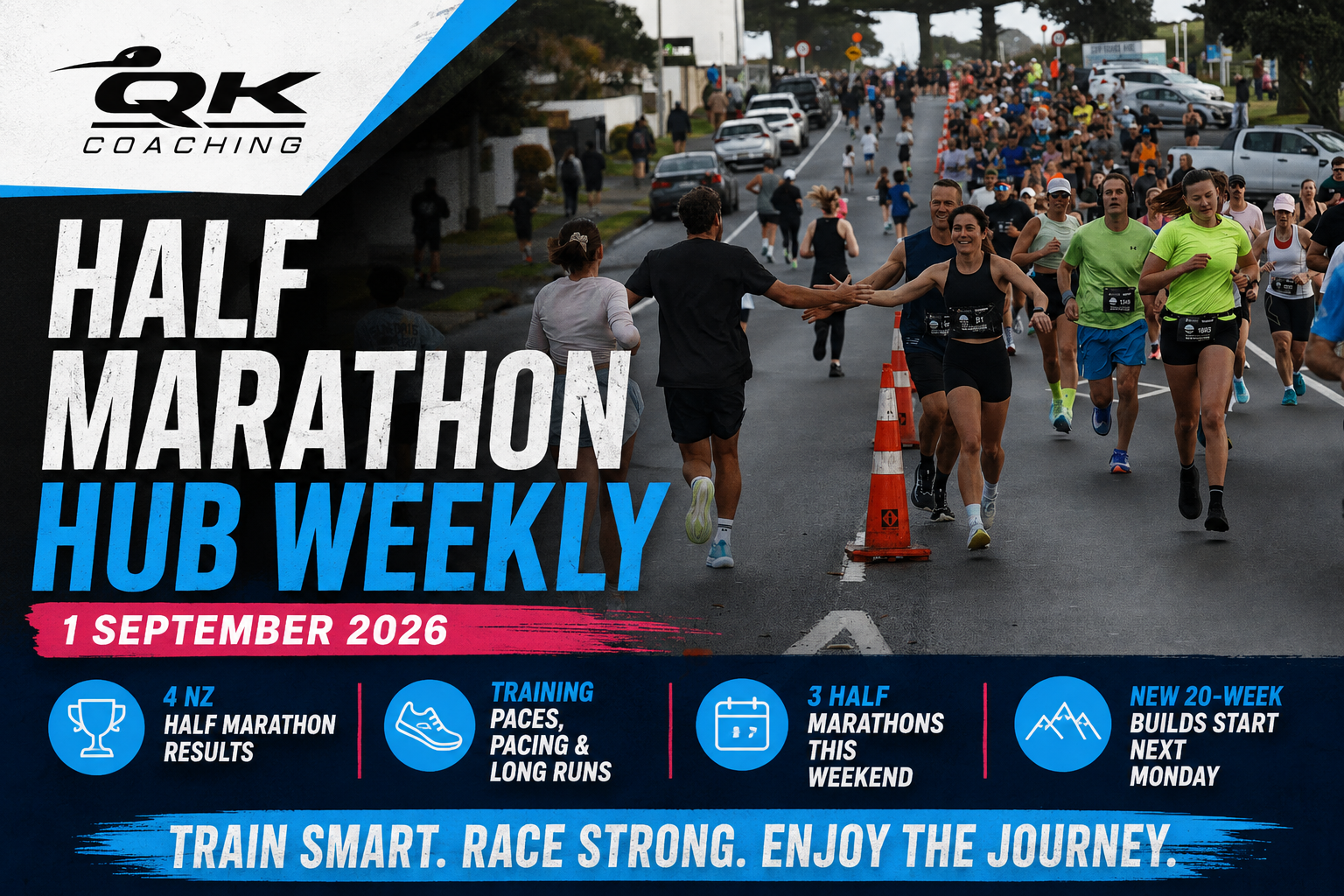
We’re into September, and there was plenty of half marathon action around New Zealand over the weekend. We had racing from the Far North to Central Otago, including a very quick 1:08:53 at Mount Maunganui.
This week on www.HalfMarathonTraining.co.nz, we’ve also been looking at three subjects that fit together particularly well: how to establish your training paces, how to pace the half marathon itself, and how to use a progressive long run to prepare for racing strongly rather than simply surviving the final kilometres.
We’ve also got three more half marathons coming up around New Zealand this weekend, while another pair of 20-week training plans begins next Monday.
But first, let’s see who made the podium over the weekend.
🏆 Weekend Half Marathon Results
Kaitaia Trail Run/Walk
The Kaitaia event took runners off-road into Te Hiku Forest, with the half marathon providing a very different challenge from a conventional road race.
Men
🥇 Michael Lea — 1:21:38
🥈 Trey Subritzky — 1:23:29
🥉 Callum Gadd — 1:35:06
Women
🥇 Tamsin Horne — 1:33:38
🥈 Cara Pinny — 1:43:03
🥉 Jess Frear — 1:47:36
Congratulations to Michael and Tamsin on taking the wins, and to everyone who tackled the trails.
Mount Maunganui Half Marathon
There was some seriously quick running at Mount Maunganui.
Lachlan Haycock led the men’s field home in an impressive 1:08:53, with less than two minutes separating the first three finishers.
Men
🥇 Lachlan Haycock — 1:08:53
🥈 Darian Sorouri — 1:10:22
🥉 Jayden Austin — 1:10:31
The women’s race was also quick, with Arleah Tippins producing an excellent 1:15:04 to take the victory.
Women
🥇 Arleah Tippins — 1:15:04
🥈 Alice Mason — 1:19:09
🥉 Clara Lachurie — 1:22:14
Some outstanding half marathon performances there.
Auckland Trail Series Race 6 – Long Course
At Waitawa Regional Park, the Auckland Trail Series concluded Race 6 with another demanding long-course trail event.
Men
🥇 Hamish Marsden — 1:33:36
🥈 Kyle Nortje — 1:35:06
🥉 Kevin Rankin — 1:39:02
Women
🥇 Juliette Foley — 1:45:31
🥈 Tracy McCartney — 1:49:51
🥉 Gilly Davy — 2:00:08
As we’ve mentioned previously with these Auckland Trail Series events, the long course isn’t necessarily an exact 21.1km road-style half marathon. But it’s close enough to the distance — and certainly demanding enough — to earn its place in our weekly round-up.
Lake Dunstan Trail Half Marathon
Further south, runners took to the spectacular Lake Dunstan Trail.
Men
🥇 Hanish Elliott — 1:15:04
🥈 Bradley Lang — 1:20:46
🥉 Scott Smith — 1:26:41
Women
🥇 Frances Redmond — 1:29:54
🥈 Rebecca Kingsford — 1:33:51
🥉 Amy Montagu — 1:38:53
Congratulations to Hanish and Frances on their victories and to everyone who raced around the country over the weekend.
🏃 Training Focus: Are You Training at the Right Pace?
One of the easiest ways to undermine an otherwise sensible half marathon training programme is to run your sessions at the wrong intensity.
And it isn’t always because you’re running too slowly.
Quite often, it’s the opposite.
Easy runs gradually become moderate runs. Tempo sessions become threshold sessions. Threshold sessions creep towards VO₂ Max intensity. Before long, nearly everything is being run somewhere in that uncomfortable middle-to-hard range.
That’s why I’ve published a guide this week explaining how to establish your half marathon training paces.
Half Marathon Training Paces: How Fast Should You Run?
Within my coaching, I use Levels I–V to give each workout a specific purpose.
Level I is recovery.
Level II develops aerobic endurance and should generally feel conversational.
Level III is tempo.
Level IV is threshold.
And Level V develops VO₂ Max and top-end aerobic power.
The important point isn’t simply knowing those definitions. It’s understanding that different intensities create different training stimuli.
If the programme says Level II, running harder doesn’t automatically make it a better workout.
Your training isn’t a collection of individual sessions where you’re trying to score the highest mark possible each day. It’s the accumulated effect of weeks and months of appropriately targeted training.
Run easy enough on the easy days so you can do what is required when the hard days arrive.
⏱️ How Should You Pace a Half Marathon?
Knowing your training pace is one thing.
Knowing what to do when the gun goes on race morning is another.
One of the biggest mistakes runners make is allowing the excitement of race day to dictate their opening kilometres.
The legs feel fantastic.
Race pace feels ridiculously easy.
Other runners are flying past.
And suddenly you’re 20 or 30 seconds per kilometre quicker than planned.
Unfortunately, the half marathon has a habit of sending the bill for those early kilometres somewhere around 15–18km.
In my guide to How to Pace a Half Marathon, I recommend thinking about the race in thirds.
First third: control
The opening third is about restraint.
Settle into your planned intensity and resist the temptation to bank time. If anything, you should feel as though you’re holding something back.
Middle third: rhythm
Now you’re racing.
Settle into your rhythm, concentrate on maintaining good form, keep on top of your fuelling and hydration, and continue accumulating kilometres at the appropriate intensity.
Final third: compete
If you’ve judged the first two thirds correctly, this is where you can begin racing rather than simply hanging on.
You can gradually increase the effort and start catching runners who were more enthusiastic than disciplined during the opening kilometres.
There is a big difference between running the first 5km quickly and running your fastest possible half marathon.
The goal is the latter.
🏃♂️ Workout of the Week: 2-Hour Long Progressive Run A
That brings us nicely to this week’s featured workout.
The 2-Hour Long Progressive Run A is designed to develop something particularly valuable for the half marathon:
the ability to increase your effort when you’re already carrying fatigue.
A conventional easy long run remains one of the foundations of half marathon preparation. But as you progress through your training, selected long runs can become more race-specific.
Rather than starting hard and attempting to hang on, a progressive run teaches you the opposite behaviour.
You begin under control.
You allow the effort to build.
And you finish strongly.
That has both a physiological and psychological benefit.
You’re developing aerobic endurance and durability while also practising the discipline you’ll need on race day. Instead of teaching yourself that fatigue means slowing down, you’re learning how to maintain good technique and progressively increase the effort on tired legs.
It also reinforces the pacing lesson above:
Patience early creates opportunities later.
That is a useful habit whether you’re trying to finish your first half marathon or chase a PB.
📅 Two New 20-Week Training Builds Start Next Monday
Monday 7 September marks 20 weeks until two very different running challenges on Saturday 23 January 2027.
🌊 Mount Festival Half Marathon
The Waitoa Mount Festival Half Marathon takes runners around one of New Zealand’s most recognisable coastal locations, with the event offering 5km, 10.5km and 21.1km distances. The 2027 event is scheduled for Saturday 23 January.
With 20 weeks available, there’s no need to rush the preparation.
That gives us time to develop your aerobic foundation before progressively introducing the training qualities required to arrive at Mount Maunganui ready to race.
🐐 The Goat Adventure Run
On the very same day is something completely different.
The Goat Adventure Run crosses approximately 20km of challenging terrain through Tongariro National Park, travelling from Whakapapa to Turoa on the Round the Mountain Track. The course includes more than 1,000m of vertical ascent and terrain ranging from lava flows and scoria to forest, tussock and boulder-strewn rivers.
This isn’t a conventional half marathon where kilometre splits tell the whole story.
Preparing for The Goat requires the aerobic engine you’d expect for an event of this duration, but also trail-specific strength, climbing ability, descending durability and the ability to maintain momentum across technical terrain.
Twenty weeks gives us an excellent runway to develop those qualities progressively rather than trying to cram them into the final few weeks.
If either event is your summer goal, your 20-week build starts next Monday.
🇳🇿 Coming Up This Weekend
We’ve got another three half marathons to follow around New Zealand on 5–6 September.
🐋 Kaikōura Whale Run — Saturday 5 September
The 20th Kaikōura Whale Run includes its half marathon alongside 12km, 5km and MaraFun events.
The course takes competitors across farmland, rivers and bush, making this considerably more varied than simply running 21.1km around the streets of Kaikōura.
🌲 Kinloch Off Road Challenge — Saturday 5 September
Also on Saturday is the Kinloch Off Road Challenge.
This is another chance to get away from the road, with both marathon and half marathon distances among the events being contested at Kinloch. The organisers confirm the event for Saturday 5 September 2026.
🌊 North Shore Marathon — Sunday 6 September
Then on Sunday, attention moves to Auckland for the North Shore Marathon.
The half marathon takes runners through a mixture of road, beach and grass trails around the North Shore coastline. The half marathon run starts at 7:15am from Takapuna Beach, five minutes after the compulsory race briefing.
We’ll have the podium results from all three events in next week’s Hub.
💡 This Week’s Takeaway
There’s a common theme connecting all three of this week’s training articles:
Control.
Control your intensity during training.
Control the opening kilometres of your race.
And learn through workouts such as the progressive long run how to increase your effort when it actually matters.
Runners often associate improvement with the ability to push harder.
Sometimes the bigger breakthrough comes from learning when not to.
Save the hard running for when it has a purpose.
📩 Want the Half Marathon Hub Every Monday?
From next week, I’m making an important change to how the Half Marathon Hub Weekly is delivered.
I’ve previously been sharing the Hub more broadly with runners on my email list. From now on, I’ll send the Weekly Hub email only to people who have specifically asked to receive it.
So if you enjoy these weekly NZ results, upcoming race previews, workouts and half marathon coaching articles, make sure you’re signed up.
It’s completely free.
Join the FREE Half Marathon Hub Weekly →
🔜 Coming Next Week
Next Monday we’ll have:
🏆 Results from the Kaikōura Whale Run
🏆 Results from the Kinloch Off Road Challenge
🏆 Results from the North Shore Half Marathon
🏃 Another featured half marathon workout
📚 More practical half marathon training advice
🇳🇿 And a look ahead to the following weekend’s racing around New Zealand.
Until then, enjoy your training, race smart if you’re lining up this weekend, and remember that the best half marathon isn’t usually produced by the runner who is most aggressive at the start.
It’s produced by the runner who has something left when it counts.
Coach Ray