Coach Ray’s Workout of the Week: 4x 5min Threshold Runs
Threshold training is one of the most valuable components of half marathon preparation. It teaches you to run strongly at a sustained intensity without crossing the line into an effort that causes fatigue to accumulate too quickly.
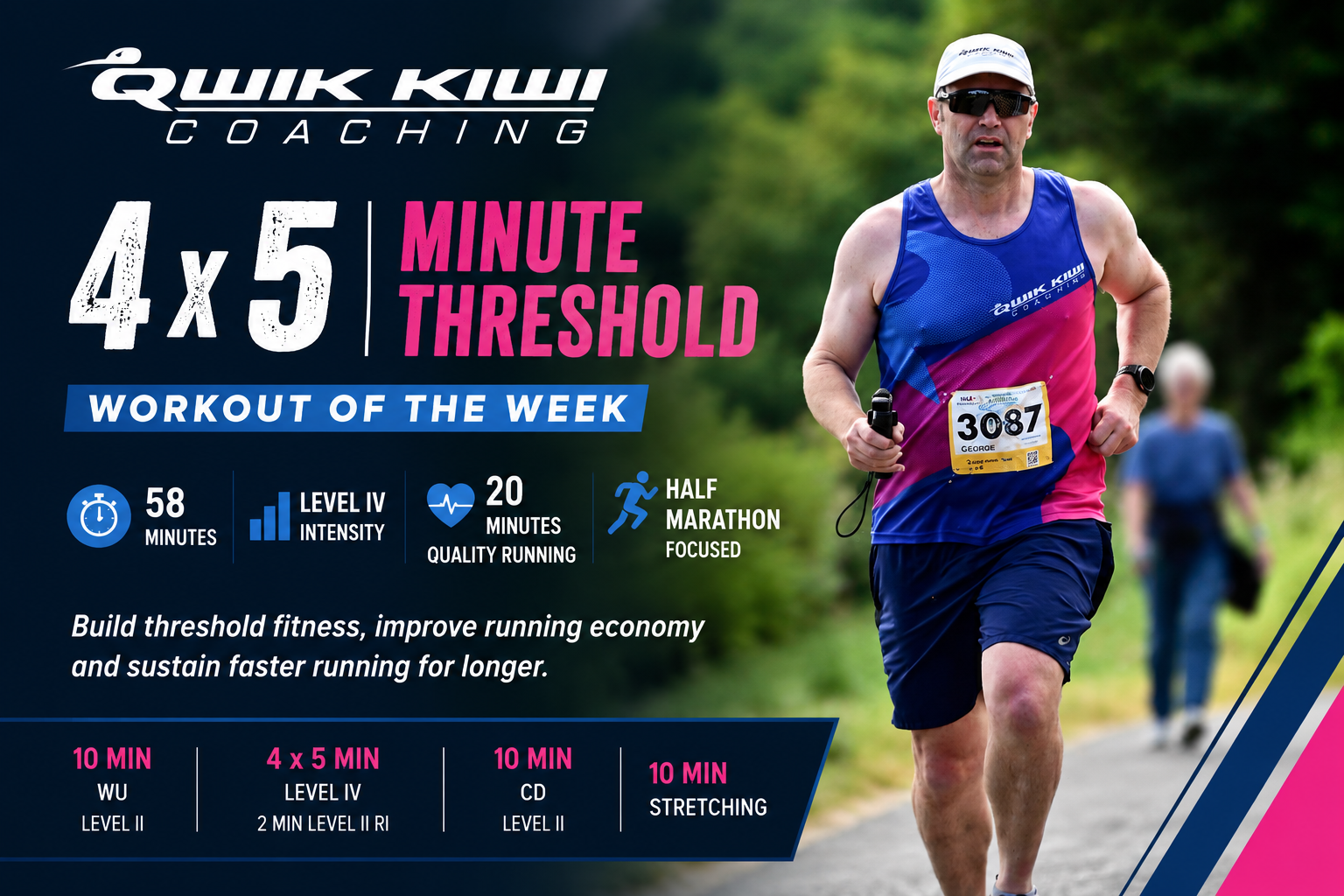
This week’s Coach Ray’s Workout of the Week is 4×5 Minute Threshold—a simple but highly effective session consisting of four, five-minute efforts at Level IV, separated by two minutes of easy Level II running.
For half marathon runners, this session develops the ability to sustain faster running efficiently while maintaining control. It is particularly useful during the Transition Quality (TQ) Phase, when training begins moving from the more general quality work of the Early Quality phase towards the increasingly race-specific demands of the Final Quality phase.
The Workout
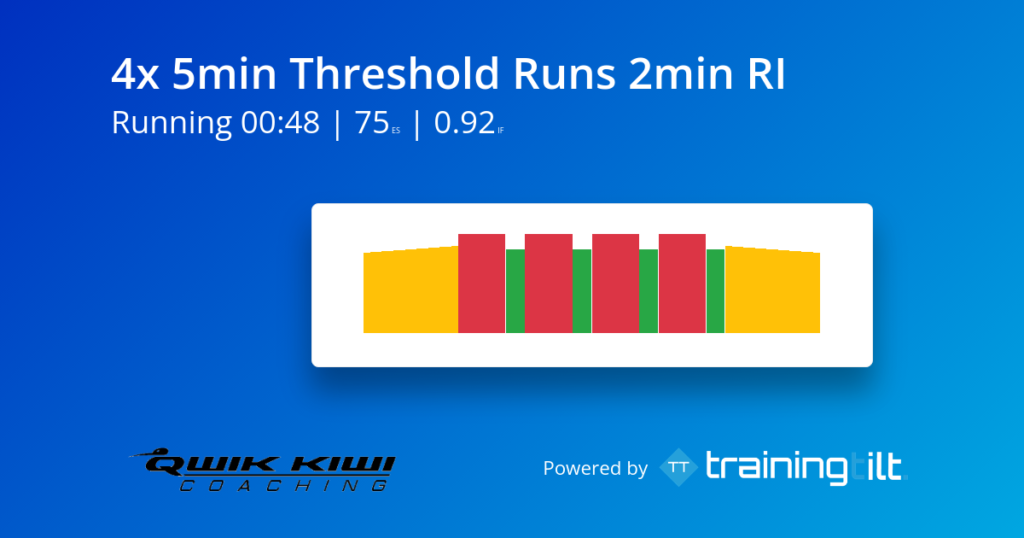
Warm-Up
- 10 minutes at Level II
Main Set
4×:
- 5 minutes at Level IV
- 2 minutes at Level II recovery
Cool-Down
- 10 minutes at Level II
- 10 minutes stretching
Total Duration: 48 minutes running
Why This Workout Works
Threshold running improves your ability to sustain a relatively high percentage of your aerobic capacity without fatigue rapidly accumulating.
For half marathon runners, that’s particularly important. Success over 21.1 km isn’t simply about being able to run fast—it’s about being able to maintain a strong, efficient pace for a prolonged period.
The four, five-minute efforts give you 20 minutes of quality Level IV running. Breaking that workload into repetitions allows you to accumulate meaningful time at threshold while the short Level II recoveries help you maintain the quality of each effort.
This workout helps develop:
- Threshold fitness
- Aerobic endurance
- Running economy
- Pace control
- Resistance to fatigue
- Mental resilience
As your fitness improves, you’ll become capable of sustaining faster running before fatigue begins to accumulate significantly.
Session Snapshot
| Goal | Improve threshold fitness and the ability to sustain faster running |
| Duration | 48 minutes |
| Quality Running | 20 minutes |
| Intensity | Level IV |
| Training Phase | Transition Quality (TQ) |
| Best For | Half Marathon runners |
| Terrain | Flat or gently rolling route |
| Equipment | Running shoes and GPS watch (optional) |
| Difficulty | Intermediate |
| Session Type | Threshold |
How Hard Should Level IV Feel?
The most important word for this workout is controlled.
Level IV should feel comfortably hard. You’re running significantly faster than your normal easy pace, but you shouldn’t feel as though you’re racing a five-minute interval.
Your breathing will be noticeably elevated, and conversation will be limited, but you should still feel in control of the effort.
If the first repetition feels spectacularly fast but the fourth becomes a battle for survival, you’ve started too hard.
The aim is to produce four consistent repetitions.
Ideally, you should finish the final five-minute effort feeling that you have worked hard but could have completed another repetition if the session required it.
Don’t Turn Threshold Into VO₂ Max Training
One of the most common mistakes runners make with threshold workouts is running them too hard.
Faster isn’t automatically better.
If you push the five-minute repetitions into Level V, you’ve changed the purpose of the workout. Instead of accumulating controlled threshold running, you’re creating a substantially different physiological stimulus and potentially considerably more fatigue.
That extra fatigue can then compromise the training sessions that follow.
Respect Level IV.
The goal isn’t to see how quickly you can run each repetition. The goal is to accumulate quality time at the correct intensity.
What Should the Two-Minute Recovery Feel Like?
The two-minute Level II recovery should be genuinely easy.
Keep jogging, relax your breathing and allow your heart rate to begin settling.
However, the recovery isn’t designed to completely reset you before the next repetition. You’re carrying a little fatigue from one effort into the next, which is an important part of the workout.
By the third and fourth repetitions, maintaining Level IV should require concentration—but it should remain controlled.
Choosing the Right Route
Unlike hill repetitions, where terrain provides part of the training stimulus, threshold running benefits from relatively predictable conditions.
Ideally, choose:
- A flat or gently rolling route
- A quiet stretch of road or path
- Somewhere with minimal road crossings
- A route where you can run continuously for five minutes
- A surface that allows you to establish a consistent rhythm
A measured loop can work particularly well because it allows you to compare your effort between repetitions without becoming obsessed with pace.
A treadmill is also an option when weather or location makes outdoor threshold running difficult.
Coaching Tips
Start Conservatively
The first repetition should almost feel slightly too controlled. Give your body time to settle into the workout rather than immediately chasing pace.
Run by Intensity
Your pace can vary depending on terrain, weather, fatigue and your current fitness. Level IV is the target—not an arbitrary number on your watch.
Keep the Recoveries Easy
Don’t try to improve your average pace by running the recoveries harder. Their purpose is to help you execute the next threshold effort properly.
Find Your Rhythm
Once you’ve settled into Level IV, focus on relaxed, efficient running. Keep your shoulders relaxed, maintain good posture and allow your stride to flow naturally.
Make the Final Rep Your Best
That doesn’t mean your fastest.
Your best repetition is the one where you maintain the correct intensity, good technique and control despite the accumulated fatigue.
Common Mistakes
Running the First Rep Too Hard
Threshold workouts reward patience. An overly aggressive first repetition usually makes the final repetitions unnecessarily difficult.
Chasing Your Watch
Your GPS pace will fluctuate. Don’t continually accelerate and decelerate trying to hit an exact number.
Use pace as feedback rather than allowing it to dictate every stride.
Running the Recovery Too Fast
Level II means Level II. Give yourself the recovery you’ve been prescribed.
Sprinting the Finish
There’s no need to hammer the final 30 seconds of each repetition. Maintain the same controlled Level IV intensity right through to the end.
Treating Every Session Like a Fitness Test
This isn’t a time trial.
It’s training.
Your objective is to create the appropriate stimulus and recover sufficiently to continue progressing through the rest of your programme.
Variations
The basic structure can easily be adjusted to suit your current fitness.
Developing Runner
3×:
- 5 minutes Level IV
- 2 minutes Level II recovery
This provides 15 minutes of threshold running.
Standard Workout
4×:
- 5 minutes Level IV
- 2 minutes Level II recovery
This provides 20 minutes of threshold running.
Experienced Runner
5×:
- 5 minutes Level IV
- 2 minutes Level II recovery
This increases the total threshold volume to 25 minutes without requiring longer individual repetitions.
The appropriate progression isn’t necessarily to run the intervals faster. Increasing the amount of quality running while maintaining the correct intensity is often the better progression.
When Should You Include This Workout?
I would typically use a workout like 4×5 Minute Threshold during the Transition Quality (TQ) Phase of half marathon preparation.
The Foundation & Injury Prevention (FI) Phase establishes the aerobic conditioning and resilience required to train consistently. The Early Quality (EQ) Phase then introduces more demanding quality work, including sessions designed to develop areas such as running strength and aerobic power.
During the Transition Quality phase, the emphasis begins shifting towards the ability to sustain stronger running for increasingly meaningful periods.
Threshold training fits particularly well here.
It bridges the gap between earlier quality development and the increasingly race-specific training that follows during the Final Quality (FQ) Phase.
Coach Ray’s Verdict
4×5 Minute Threshold isn’t complicated—and that’s one of its strengths.
Twenty minutes of controlled Level IV running provides a substantial training stimulus without requiring an enormous session or leaving you unnecessarily exhausted.
The key is discipline.
Don’t turn Level IV into Level V because you’re feeling good. Don’t race the person in front of you. Don’t chase an impressive average pace for Strava.
Run the intensity the session calls for.
Do that consistently and threshold workouts like this can help you become a stronger, more economical half marathon runner capable of maintaining faster running for longer.
Ready to Put Workouts Like This Into a Complete Half Marathon Plan?
Individual workouts can improve your fitness, but the real value comes from completing the right workout at the right stage of your training.
Inside the NZ Half Marathon Hub, your training is structured around a periodised programme that progresses through the Foundation & Injury Prevention, Early Quality, Transition Quality and Final Quality phases.
That means sessions like this aren’t simply thrown into your week—they’re positioned where they’ll provide the greatest benefit while complementing your long runs, easy running, recovery and other quality sessions.
You’ll also have access to multiple training plans, fortnightly coaching calls and ongoing coaching support to help you prepare confidently for your next half marathon.