How I Periodise Half Marathon Training: Building Fitness in the Right Order
Training for a half marathon isn’t simply a matter of running a little farther each week until you can cover 21.1km.
Nor is it about cramming as much speed work as possible into the final few weeks before race day.
Good half marathon training is about developing the right fitness at the right time.
That’s the principle behind the way I periodise my half marathon training plans.
Over the course of a training programme, I’ll progressively change the emphasis of the training so that an athlete develops the aerobic endurance, running economy, strength, threshold and race-specific fitness they need — in an order that allows each stage to build upon what came before it.
The objective is simple:
Arrive on race day with the fitness you need to run your best half marathon — rather than having produced your best training six weeks earlier.
What Does Periodisation Mean?
Periodisation sounds complicated, but the underlying concept is quite simple.
Instead of repeating essentially the same training week after week, we divide the overall training programme into phases.
Each phase has a particular purpose.
The training you need several months before a half marathon isn’t necessarily the same training you need several weeks before it.
Early in the programme, I’m interested in establishing the foundations that allow an athlete to train consistently.
As the programme develops, we introduce increasingly demanding training stimuli.
Closer to the race, the training becomes increasingly specific to the demands of racing a half marathon.
Then, in the final days, we reduce the training load so the athlete can actually express all the fitness they’ve developed.
This idea is influenced heavily by the work of exercise physiologist and running coach Dr Jack Daniels PhD. One of the principles I particularly like from Daniels is that every workout should have a purpose. His approach also emphasises establishing easy running before progressively introducing different forms of quality training.
My own periodisation system has evolved from these principles through years of coaching recreational endurance athletes.
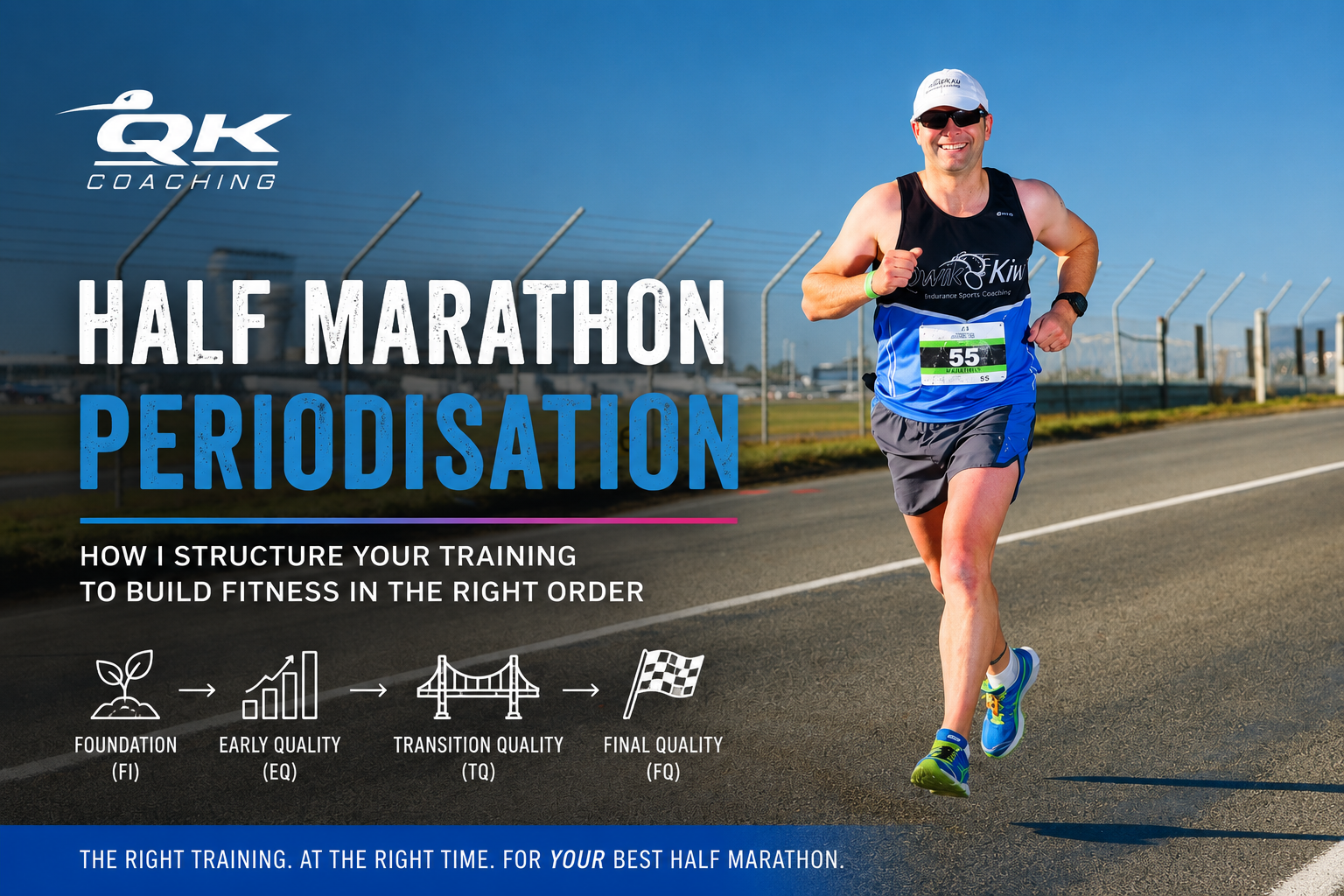
For half marathon training, I divide the programme into four primary phases:
Foundation & Injury Prevention (FI) → Early Quality (EQ) → Transition Quality (TQ) → Final Quality (FQ)
Each has a different job.
Phase One: Foundation & Injury Prevention (FI)
Build the Athlete Before Building the Performance
The Foundation & Injury Prevention phase is exactly what its name suggests.
We’re laying foundations.
For many recreational runners, there can be a temptation to jump straight into intervals, tempo runs and race-pace workouts because these sessions feel like “proper training”.
But quality training is only useful if you’re sufficiently prepared to absorb it.
During Foundation training, my priorities are developing consistency, aerobic endurance and the physical resilience required for the training that will follow.
That means plenty of Level II running.
Level II is comfortable, conversational running. You should be able to speak in full sentences rather than gasping out a few words between breaths.
Easy running shouldn’t be dismissed as filler between the “important” workouts.
It is important training.
Daniels has similarly highlighted the physiological value of slower running, including adaptations involving cardiovascular function and the mitochondria within working muscle.
The Long Run Begins to Grow
The long run is particularly important for half marathon runners.
During Foundation training, we’ll progressively develop its duration rather than suddenly making enormous jumps.
The goal isn’t to prove that you can already run 21.1km.
We’re gradually teaching your body to tolerate spending longer periods running.
Your muscles, tendons, joints and cardiovascular system all need time to adapt.
I’ll often include occasional stride outs as well. These provide a small amount of faster running without turning an otherwise aerobic session into a demanding workout.
This concept of combining easy running with strides during early preparation is also consistent with Daniels’ recommendations.
By the end of Foundation training, I want an athlete thinking:
“Running regularly now feels normal.”
That’s a far more valuable starting point than being able to smash one impressive interval workout.
Phase Two: Early Quality (EQ)
Developing Running Economy and Strength
Once we’ve established the foundation, we can start introducing more structured quality.
This is where Early Quality begins.
The objective isn’t suddenly to turn every run into a hard session.
Easy running remains easy.
The long run remains important.
Instead, we’re adding carefully selected training stimuli on top of the aerobic foundation we’ve already developed.
One of my priorities during this phase is running economy.
In simple terms, running economy describes how efficiently you can run at a given speed.
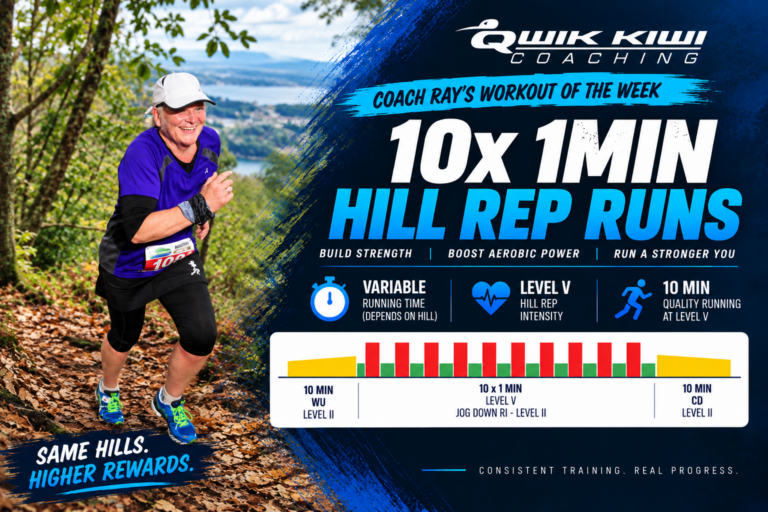
This is where you’ll often see workouts involving shorter, quicker repetitions and hill repetitions.
For example, sessions might include:
4 × 4-minute hill repetitions
or shorter repetitions performed at faster intensities with plenty of recovery.
Hill running is particularly useful because it allows us to combine cardiovascular work with running-specific strength.
We’re beginning to teach the athlete to produce more force and run faster while still maintaining good technique.
Hard Days Hard, Easy Days Easy
An important principle throughout my programmes is separation between quality and recovery.
If today’s workout is designed to provide a significant training stimulus, tomorrow probably shouldn’t be another medium-hard workout just because you’re feeling enthusiastic.
Instead, I’ll deliberately surround demanding sessions with easier training.
That hard/easy rhythm allows us to make the important workouts genuinely worthwhile while still allowing the athlete to recover.
This becomes increasingly important as training intensity increases.
More isn’t automatically better.
Daniels describes “hypertraining” as doing harder training than is necessary to achieve a result that could have been achieved with less. That’s an idea I strongly agree with.
The objective isn’t to see how much punishment an athlete can tolerate.
It’s to provide enough stimulus to create adaptation.
Phase Three: Transition Quality (TQ)
Turning Speed into Sustainable Speed
Transition Quality provides the bridge between the faster work of Early Quality and the increasingly half-marathon-specific training that will follow.
This is an important distinction.
A half marathon isn’t a sprint.
Being able to run very quickly for a few minutes doesn’t automatically mean you can run strongly for 21.1km.
We now need to take some of the speed and economy we’ve developed and improve the athlete’s ability to sustain faster running for longer periods.
That’s where threshold-oriented work becomes increasingly important.
You might see workouts involving longer repetitions or sustained efforts around Level IV, depending on the athlete and the particular purpose of the workout.
Rather than simply asking:
“How fast can you run?”
we’re beginning to ask:
“How long can you maintain a strong, controlled pace?”
That’s a much more relevant question for a half marathon runner.
The Long Run Continues to Matter
The long run doesn’t disappear because we’re introducing more quality.
Quite the opposite.
Your aerobic endurance provides the platform that allows your faster running to survive deeper into the race.
That’s why I don’t view “speed” and “endurance” as competing ideas.
A good half marathon runner needs both.
The challenge is developing them in the right proportions and at the right time.
Phase Four: Final Quality (FQ)
Now We Train Specifically for the Half Marathon
This is where everything starts coming together.
During Final Quality training, we increasingly focus on the demands you’re actually going to face on race day.
For a half marathon runner, that means being able to maintain a strong aerobic effort for a prolonged period.
This is why you’ll start seeing longer Level III tempo efforts during this phase.
A workout such as:
20 minutes Level III
2:30 minutes Level II recovery
15 minutes Level III
is a good example.
Earlier in the programme, I may have wanted you running considerably faster for shorter periods.
Now I’m interested in your ability to settle into a strong rhythm and stay there.
We’re developing the ability to run efficiently at sustained intensities when fatigue begins accumulating.
Race Specific Doesn’t Mean Racing Every Workout
There’s an important distinction here.
Race-specific training does not mean repeatedly running a half marathon as hard as possible in training.
You don’t need to prove your half marathon fitness every weekend.
Instead, we’re breaking the physiological and practical demands of the race into manageable training sessions.
Some workouts may include running around anticipated half marathon intensity. Others may target a physiological quality that supports half marathon performance.
Daniels has made a similar distinction regarding half marathon pace: practising the pace can certainly have a place, but training doesn’t need to revolve exclusively around the exact pace you intend to race.
That’s an important part of my philosophy.
Train the systems required to race well. Don’t simply rehearse the race every week.
The Training Doesn’t Simply Get Harder Every Phase
This is perhaps the most important point to understand about my periodisation philosophy.
The progression isn’t:
Easy → Hard → Harder → Brutal → Race.
Instead, the training becomes different.
Each phase changes the training stimulus.
Early training establishes the aerobic and physical foundations.
Early Quality introduces faster running and develops economy and strength.
Transition Quality develops the ability to sustain stronger running.
Final Quality becomes increasingly specific to half marathon performance.
That’s very different from simply adding more intensity every month.
If we continually increase volume and intensity without allowing the body to adapt, eventually something gives.
It might be performance.
It might be motivation.
Or it might be the athlete.
Periodisation gives the training direction.
The Long Run Runs Through the Entire Programme
Although the emphasis of the quality sessions changes, one feature remains important throughout half marathon preparation:
the long run.
A half marathon is fundamentally an endurance event.
Your long run progressively develops your ability to remain comfortable and efficient for longer periods.
Most long runs are completed at Level II, where conversation should remain comfortable.
Depending on the phase and athlete, however, I may occasionally add another stimulus.
That could include stride outs, progression running or sections of stronger running later in the session.
One approach I like is adding:
4 × 20-second stride outs
spread approximately five minutes apart during the final 30 minutes of the long run, while still leaving about 10 minutes of easy Level II running afterwards.
The long run therefore evolves with the programme without losing its primary purpose: developing endurance.
Why I Don’t Want Every Run at the Same Intensity
One of the easiest ways for a recreational runner to stagnate is to run almost everything at approximately the same moderately hard intensity.
Easy days aren’t particularly easy.
Hard days aren’t particularly hard.
Long runs gradually turn into races.
Eventually every run feels tiring.
My intensity system uses five levels:
Level I – very easy/recovery
Level II – easy aerobic/conversational
Level III – steady/tempo
Level IV – threshold
Level V – high-intensity work
There are subdivisions within those levels when a workout requires greater precision, but the underlying principle remains straightforward.
Different intensities produce different training stimuli.
The programme determines when we need each stimulus.
That is periodisation in practice.
Where Strength Training Fits
Strength isn’t something I think runners should suddenly discover three weeks before their goal race.
Where appropriate, it should complement the running programme throughout the training cycle.
The emphasis and training load may change depending on the phase, but maintaining strength can support an athlete’s overall physical robustness.
Current ACSM guidance also emphasises regular resistance training and, importantly, individualisation rather than unnecessarily complicated programming.
For recreational half marathon runners, practicality matters.
The theoretically perfect programme is useless if your work, family and life commitments make it impossible to complete.
I’d rather prescribe a sustainable programme you can execute consistently than an impressive-looking programme you abandon after three weeks.
Recovery Is Part of the Programme
Recovery isn’t what happens when training goes wrong.
It’s part of training.
A workout provides the stimulus.
Recovery allows adaptation to occur.
That’s why you’ll find easy running, recovery days and changes in training load deliberately built into my programmes.
It’s also why I don’t recommend trying to “catch up” every missed session.
If life gets in the way and you miss Tuesday’s workout, blindly squeezing it into Wednesday can disrupt everything that follows.
Training plans provide structure.
They shouldn’t become a prison sentence.
Sometimes good coaching means knowing when not to complete a workout.
The Final Step: Arriving Fresh Enough to Race
Eventually, we’ve done the work.
At that point, trying to cram extra fitness into the final few days is far more likely to create fatigue than suddenly transform your performance.
So training reduces.
We retain enough running to keep the body moving and maintain familiarity with race rhythm, while reducing the accumulated workload.
This is the taper.
Some runners find this uncomfortable.
After weeks of substantial training, doing less can make them worry they’re losing fitness.
But race week isn’t the time to build fitness.
It’s the time to reveal it.
I want you standing on the start line feeling as though you’re ready to run — not feeling relieved that you finally get a rest.
Periodisation Is a Framework, Not a Straitjacket
Although my programmes follow a structured progression through FI, EQ, TQ and FQ, that doesn’t mean every athlete responds identically.
Training history matters.
Age matters.
Current fitness matters.
Previous injuries matter.
Available training time matters.
How quickly you recover matters.
And life definitely matters.
The underlying philosophy remains consistent, but good training should still recognise the individual athlete.
This is particularly important for recreational runners.
Most of us aren’t professional athletes arranging our lives around training.
We’re arranging training around jobs, families and everything else life throws at us.
The programme needs to respect that reality.
What This Means for Your Half Marathon Training
If you’re looking at your training plan and wondering why you’re doing hill repetitions now rather than long tempo runs, there’s probably a reason.
If you’re wondering why your programme contains plenty of easy Level II running when you’d rather be smashing another hard workout, there’s a reason for that too.
And when you reach the Final Quality phase and suddenly recognise that the sessions feel much more like the demands you’ll face over 21.1km, that’s deliberate.
We’re building fitness in layers:
Foundation creates the platform.
Early Quality develops economy, speed and running strength.
Transition Quality develops sustainable speed.
Final Quality converts that fitness into half-marathon-specific performance.
Then we freshen you up and race.
No single workout makes a half marathon runner.
It’s the sequence of appropriate workouts, completed consistently over time, that produces the result.
That’s what periodisation gives us.
It ensures we’re not merely training hard.
We’re training with direction.
Want a Half Marathon Plan That Puts This Into Practice?
Understanding periodisation is one thing. Building every week of training around it is another.
With NZ Half Marathon Hub+, the periodisation is already built into your programme. You’ll progress through structured phases designed to develop your endurance, running economy, strength and race-specific fitness in the right order for your goal half marathon.
Instead of wondering what workout you should do next, you can concentrate on doing the training.
And if you’re unsure how this approach should be adapted to your current fitness, training history or half marathon goal, you can also book a free 40-minute coaching consultation with me and we can talk through your training.




2 Comments
Comments are closed.