Coach Ray’s Workout of the Week: 10x 1min Hill Rep Runs
Short hill repetitions are a simple but highly effective way to introduce harder running into a half marathon training programme. They develop qualities that will support the longer threshold, tempo and race-specific sessions that come later in your preparation.
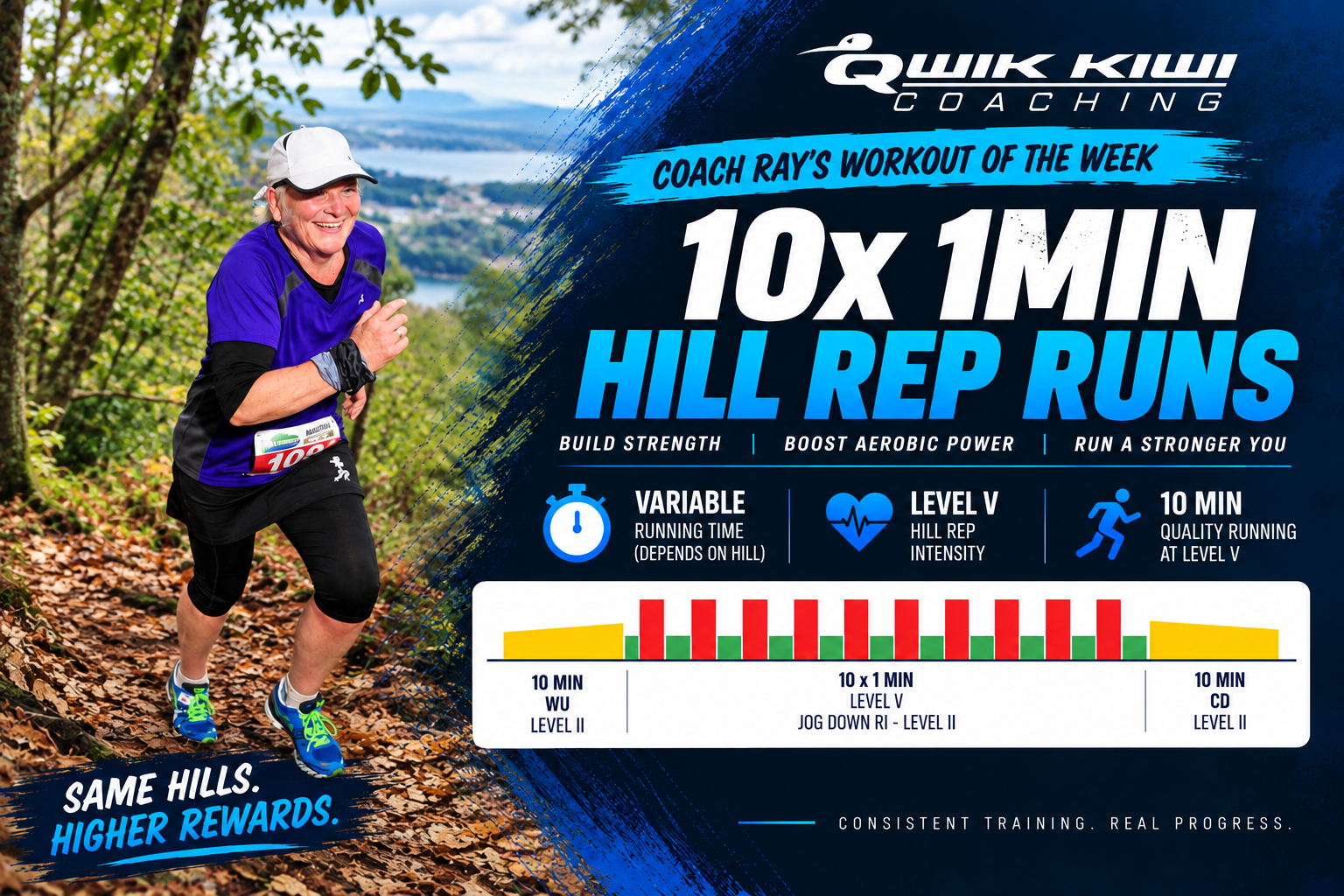
This week’s Coach Ray’s Workout of the Week is 10x 1min Hill Rep Runs.
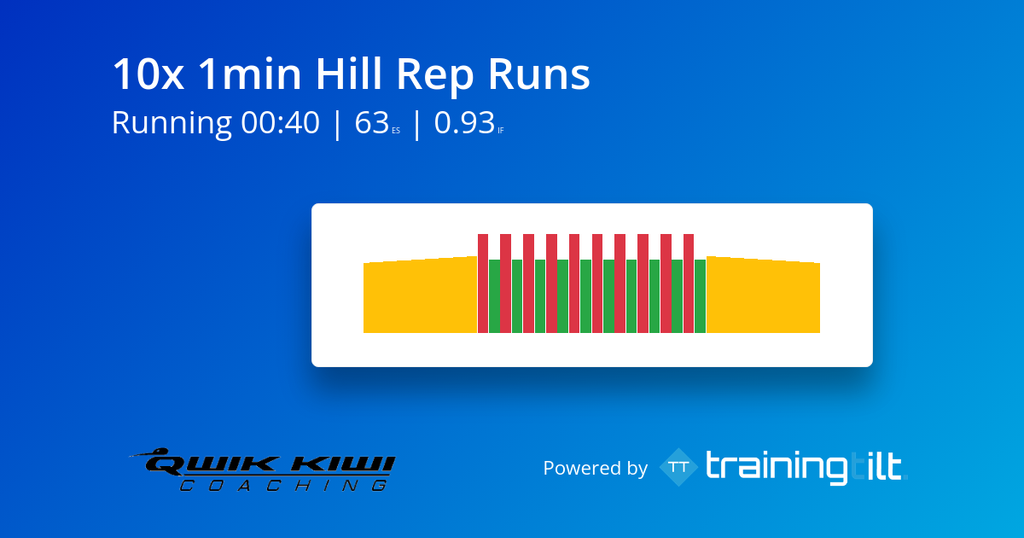
After a 10-minute Level II warm-up, you complete ten one-minute uphill repetitions at Level V, jogging back down at Level II after each repetition. Once all ten repetitions are complete, you finish with a 10-minute Level II cool-down.
That gives you 10 minutes of quality Level V running, with the total running duration varying according to how long each jog-down recovery takes.
I primarily use this type of workout during the Early Quality (EQ) Phase of half marathon preparation. The purpose isn’t to sprint up the hill or see how much pain you can tolerate. It is to produce ten strong, controlled Level V efforts while maintaining good running technique.
The Workout
Warm-Up
10 minutes at Level II
Run easily and gradually prepare yourself for the harder work ahead.
Main Set
Complete:
10x 1 minute at Level V uphill, with a Level II jog-down recovery after each repetition
Once you’ve completed each one-minute repetition, turn around and jog easily back down the hill at Level II. Start the next repetition when you return to your starting point.
Cool-Down
10 minutes at Level II
Once you’ve completed the final jog-down recovery, transition into your cool-down and run easily for another 10 minutes.
Stretching
10 minutes stretching
Quality Running: 10 minutes at Level V
Running Duration: Variable — 30 minutes plus the duration of the ten Level II jog-down recoveries
Why This Workout Works
Running uphill increases the muscular demand of each stride.
You’re working against gravity, which requires greater force production than running at the same intensity on flat terrain. At the same time, the one-minute duration allows you to work at Level V without needing to sustain that intensity for an extended period.
For half marathon runners, this combination can help develop:
- Aerobic Power
- Running Strength
- Running Economy
- Speed
- Technique
- Mental Resilience
There are only 10 minutes of Level V running, but don’t mistake a relatively small number for an easy workout.
The intensity is high, and the repeated transition from hard uphill running to an aerobic jog-down recovery creates a meaningful quality session.
Session Snapshot
| Goal | Develop aerobic power, running strength and running economy |
| Running Duration | ~40 min (depending on how fast the ten jog-down recoveries are) |
| Quality Running | 10 minutes |
| Intensity | Level V |
| Recovery | Jog downhill at Level II |
| Training Phase | Early Quality (EQ) Phase |
| Best For | Half Marathon runners |
| Terrain | Moderate, runnable hill |
| Equipment | Running shoes and watch/timer |
| Difficulty | Intermediate |
| Session Type | Hill Repetitions |
How Hard Should Level V Feel?
Level V is very hard running, but it isn’t an uncontrolled sprint.
That’s particularly important with one-minute repetitions.
If you treat the first 10 or 15 seconds as a sprint, you’ll probably slow substantially before the minute is finished. Repeat that mistake several times and the quality of the workout will deteriorate rapidly.
Instead, accelerate smoothly into Level V and establish a strong running rhythm you can maintain for the entire minute.
Think about the complete set rather than an individual repetition.
You want the tenth repetition to demonstrate the same commitment and quality as the first.
Why One-Minute Hill Repetitions?
One minute provides an effective balance between intensity and duration.
It’s long enough to place a substantial demand on your aerobic system but short enough to allow you to maintain a strong running action.
This makes one-minute hills particularly useful during the Early Quality Phase.
At this point in your half marathon preparation, we’re not necessarily trying to replicate race intensity. We’re developing some of the underlying capabilities that you’ll rely on when the training becomes longer and more race-specific.
The hills provide resistance.
Level V provides the intensity.
Repeating the effort ten times provides the training stimulus.
The Hill Is Your Resistance
You don’t need to dramatically change your running technique simply because the road or trail points uphill.
The gradient itself increases the resistance.
Concentrate on maintaining a strong, efficient running action.
Stay tall rather than collapsing forward from your waist. Allow a slight lean that comes naturally from your ankles, use your arms positively and maintain purposeful turnover.
Your pace will obviously be slower than it would be at Level V on flat ground.
That’s irrelevant.
This is an intensity-based workout, not a pace-based workout.
Choosing the Right Hill
The steepest hill you can find isn’t necessarily the best hill for this session.
You need a gradient that allows you to run strongly for the entire minute.
If you’re reduced to an awkward shuffle halfway through each repetition, the hill is probably too steep for the purpose of the workout.
Look for a hill that:
- Has a moderate, runnable gradient
- Climbs continuously for at least one minute
- Has a safe and predictable surface
- Has minimal traffic or interruptions
- Allows you to jog safely back down
- Doesn’t require sharp turns or road crossings
Ideally, use the same section of hill for all ten repetitions.
That provides consistency and makes it easier to concentrate on your effort and technique.
Your Jog Down Is Part of the Workout
Once each one-minute repetition finishes, turn around and jog back down at Level II.
The recovery isn’t a prescribed number of seconds because the time required to return to your starting point will depend on the hill, how far you cover during the repetition and your Level II running.
That means two runners completing exactly the same workout may record different overall durations.
That’s completely normal.
What matters is that the recovery remains at Level II.
Don’t stand at the top waiting until you feel completely recovered.
Equally, don’t attack the downhill in an attempt to make the workout harder.
Run easily, remain controlled and use the descent to prepare yourself for the next repetition.
Why There’s Still a Cool-Down
The jog down after the tenth repetition isn’t the end of the session.
Once you return to the bottom of the hill, you still have a 10-minute Level II cool-down to complete.
That distinction is useful.
The jog-down recovery belongs to the interval set. The cool-down begins once the set has been completed.
Those final 10 minutes give you an opportunity to return to steady aerobic running after the Level V work rather than simply stopping as soon as the final recovery is finished.
Keep it easy.
The hard work is done.
Don’t Race the First Repetition
One minute sounds short.
And during the first repetition, when you’re warmed up and fresh, it will probably feel short.
That’s where athletes can get themselves into trouble.
The objective isn’t to find out how far you can run uphill in 60 seconds.
You’ve got ten repetitions to complete.
Use the first repetition to establish the Level V effort you want to reproduce throughout the session.
If you reach dramatically farther up the hill on repetition one than you do on repetitions eight, nine and ten, there’s a good chance you started too aggressively.
Consistency Beats One Brilliant Rep
If you’re running on the same hill, you’ll naturally start noticing where each minute finishes.
A particular tree, driveway, sign or bend may become your unofficial marker.
That’s useful feedback, but don’t turn it into an obsession.
Wind, footing and accumulating fatigue can all influence exactly how far you travel.
The aim is not to hit precisely the same spot ten times.
The aim is to produce ten consistent Level V efforts with good running technique.
Your last repetition should be as purposeful as your first.
Technique Under Fatigue
Hill repetitions provide an excellent opportunity to practise maintaining good running mechanics while working hard.
As fatigue develops, pay attention to:
Posture: Stay tall and avoid folding excessively at your waist.
Arms: Use your arms positively to help maintain rhythm.
Cadence: Keep your turnover active rather than allowing your stride to become slow and laboured.
Foot contact: Think quick and purposeful rather than trying to bound excessively uphill.
Relaxation: Running hard doesn’t require unnecessary tension through your shoulders, hands or face.
Maintaining these qualities becomes increasingly challenging during the later repetitions.
That’s part of the value of the workout.
Run by Intensity, Not Pace
This isn’t the session to obsess over your min/km pace.
The gradient makes direct comparisons with flat running largely meaningless.
A steeper section will slow you down.
A gentler gradient will allow you to run faster.
Wind and surface conditions will also affect your speed.
Your target is Level V.
Use your perceived effort, heart rate or running power where appropriate, but don’t force yourself to hit a flat-road pace while running uphill.
The hill changes the pace.
It doesn’t change the prescribed intensity.
Coaching Tips
Start Controlled
Accelerate smoothly into Level V. Don’t sprint the first 15 seconds and spend the rest of the minute slowing down.
Use the Same Hill
Consistency makes it easier to judge your effort and technique from repetition to repetition.
Jog the Recovery
Your downhill recovery is Level II. Keep moving, but keep it easy.
Respect the Descent
Don’t race downhill. The recovery should prepare you for the next Level V effort.
Maintain Your Technique
Strong, efficient running is more important than gaining a few extra metres.
Complete the Cool-Down
The workout doesn’t finish when you’ve jogged down after repetition ten. Complete another 10 minutes at Level II.
Make Rep Ten Count
You’re not trying to make the final repetition faster than the others. You’re trying to demonstrate that you can still produce a strong Level V effort with good technique.
Common Mistakes
Choosing a Hill That’s Too Steep
Steeper isn’t automatically better. You need to be able to run properly for the entire minute.
Sprinting the Opening Repetitions
You’ll pay for an overly aggressive start later. Establish Level V and maintain it.
Standing During the Recovery
The recovery is prescribed as a Level II jog downhill, not standing at the top.
Racing Downhill
Save the hard running for the uphill repetitions.
Chasing Pace
Uphill pace isn’t directly comparable with your normal flat-running pace. Run according to intensity.
Turning Level V Into an All-Out Sprint
Level V is very hard, but this workout still requires control.
Skipping the Cool-Down
The final jog-down isn’t your cool-down. Once you’ve returned to the bottom, complete the prescribed 10 minutes at Level II.
How Can This Workout Progress?
Progression doesn’t necessarily mean running each one-minute repetition faster.
For an athlete who isn’t yet ready for the full session, I might initially prescribe fewer repetitions before progressing towards all ten.
Once an athlete can complete 10x 1 minute at Level V consistently and with good technique, there are several ways their hill training can subsequently develop.
That might involve changing the repetition duration, changing the number of repetitions or progressing towards different types of quality running as their half marathon programme advances.
The important principle is that progression comes from manipulating the training stimulus appropriately.
It doesn’t come from turning every hill repetition into a race.
When Should You Include This Workout?
I primarily use 10x 1min Hill Rep Runs during the Early Quality (EQ) Phase of half marathon preparation.
During the Foundation & Injury Prevention (FI) Phase, we’re establishing the aerobic fitness, consistency and resilience required to support the harder training that follows.
The Early Quality (EQ) Phase introduces structured quality while continuing that aerobic development.
Short hill repetitions fit particularly well here because they help develop aerobic power, running strength and running economy before the training becomes more sustained.
During the Transition Quality (TQ) Phase, the quality work becomes more demanding and starts bridging the gap towards race-specific performance.
Then, during the Final Quality (FQ) Phase, the training becomes increasingly specific to the intensity and demands of your half marathon.
The 10x 1min Hill Rep Runs therefore aren’t trying to replicate race day.
They’re helping develop some of the physical qualities you’ll need when the training becomes more race-specific later.
Coach Ray’s Verdict
10x 1min Hill Rep Runs is a straightforward workout that can deliver a substantial training stimulus when it’s executed correctly.
Warm up for 10 minutes at Level II.
Run strongly uphill for one minute at Level V.
Jog back down at Level II.
Repeat that ten times.
Then complete another 10 minutes at Level II for your cool-down.
Simple doesn’t mean easy.
The challenge is producing ten controlled, technically sound Level V repetitions, rather than smashing the opening few and hanging on.
Choose a runnable hill, control your effort, respect the jog-down recovery and maintain your technique as fatigue accumulates.
For a half marathon runner moving through the Early Quality Phase, it’s an effective way to develop the aerobic power, running strength and running economy that will support the more sustained training ahead.
Ready to Put Workouts Like This Into a Complete Half Marathon Plan?
Individual workouts are only one piece of the training puzzle. Their real value comes from completing the right session at the right point within an appropriately structured programme.
Inside the NZ Half Marathon Hub+, my training progresses through the Foundation & Injury Prevention (FI), Early Quality (EQ), Transition Quality (TQ) and Final Quality (FQ) phases, gradually progressing from building your foundation towards increasingly specific half marathon preparation.

WordPress & Rank Math SEO
Recommended Permalink:
Remember to shorten the WordPress permalink before publishing rather than retaining the full automatically generated article title.
SEO Title:
Meta Description:
Primary Focus Keyword:
Secondary Keywords:half marathon hill workout, hill repetitions, Level V running, running hill workout, aerobic power running
Taxonomy Suggestions
Category: Training → Coach Ray’s Workout of the Week
Workout Type: Hill Repetitions
Training Phase: Early Quality (EQ) Phase
Target Event: Half Marathon
Session Duration: Variable — depends on the duration of the jog-down recoveries
Training Benefits: Aerobic Power, Running Strength, Running Economy, Speed, Technique, Mental Resilience





One Comment
Comments are closed.