Coach Ray’s Workout of the Week: 3×8min Threshold Runs
Threshold training plays an important role in half marathon preparation because it develops your ability to sustain a strong running intensity without allowing fatigue to accumulate so rapidly that your pace falls apart.
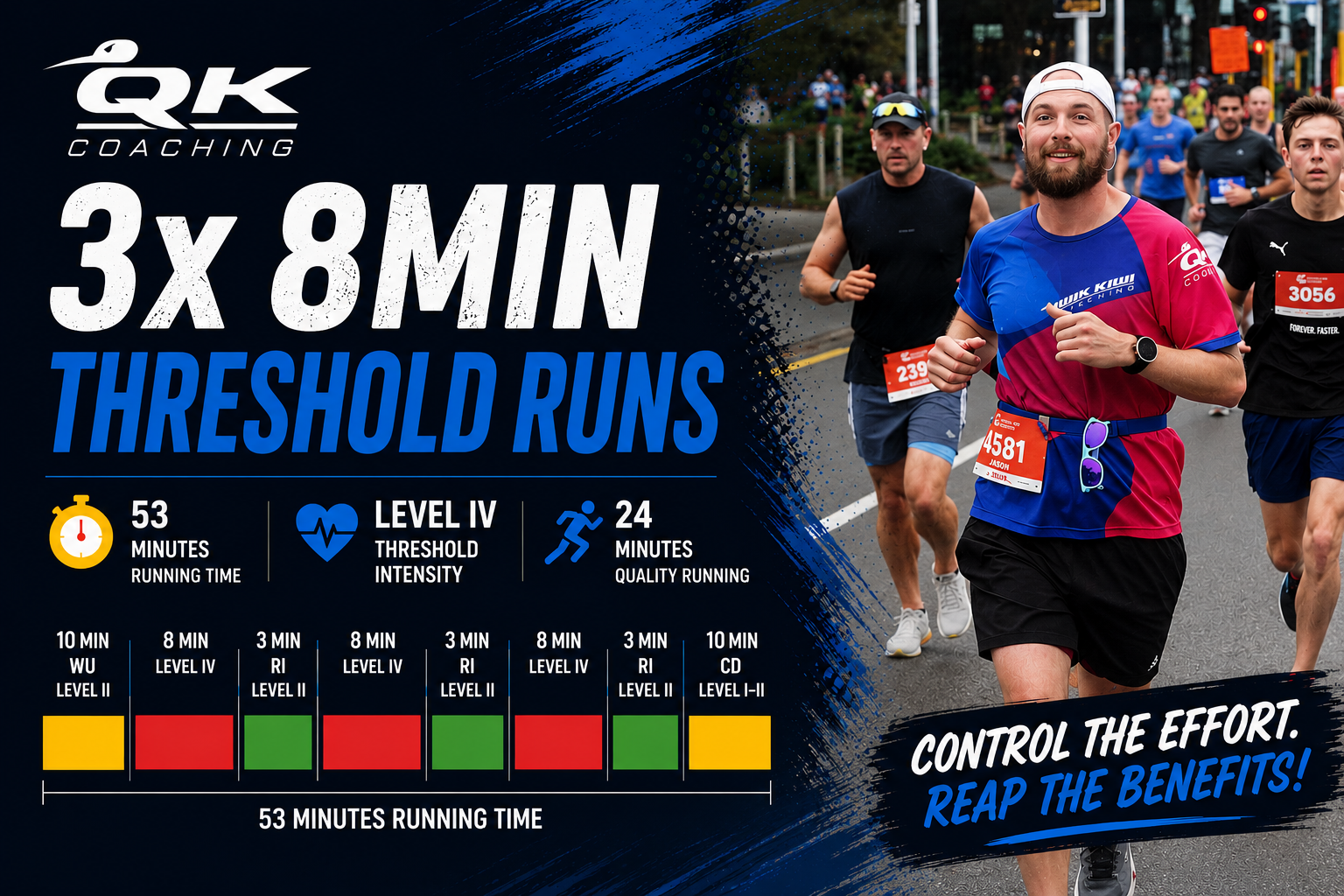
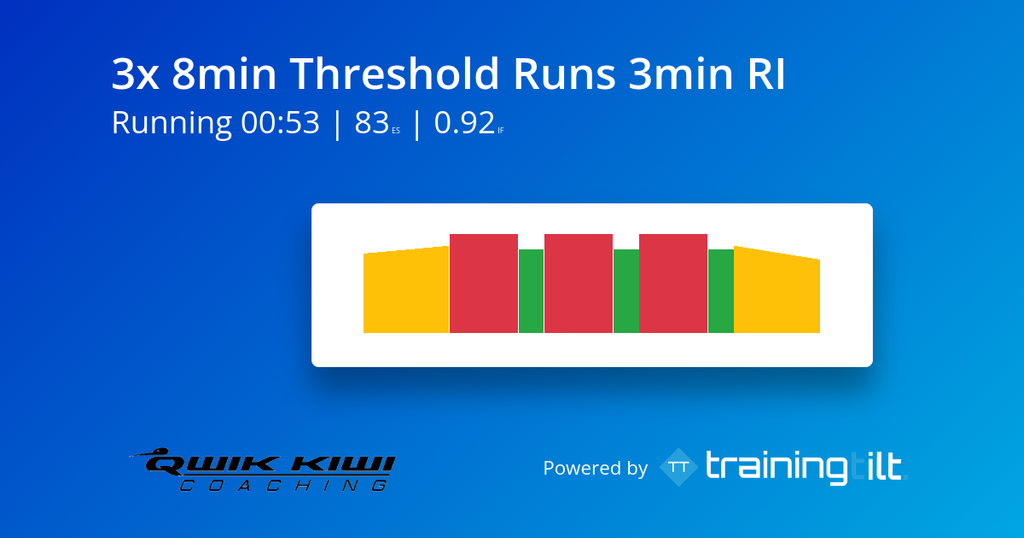
This week’s Coach Ray’s Workout of the Week is 3×8min Threshold Runs. After warming up, you’ll complete three eight-minute efforts at Level IV, with three minutes at Level II between each effort.
That gives you 24 minutes of quality threshold running within a 53-minute run.
The eight-minute repetitions are long enough that pacing and discipline become important. You can’t simply attack each repetition and hang on. Instead, you need to establish the correct Level IV intensity, settle into it and maintain it throughout all three repetitions.
For half marathon runners, this is a valuable workout for developing threshold fitness, aerobic endurance, running economy and the ability to sustain strong running as fatigue accumulates.
The Workout
Warm-Up
- 10 minutes at Level II
Main Set
3×:
- 8 minutes at Level IV
- 3 minutes at Level II recovery
Cool-Down
- 10 minutes at Level I–II
- 10 minutes stretching
Running Duration: 53 minutes
Quality Running: 24 minutes at Level IV
Why This Workout Works
Threshold training develops your ability to sustain faster running before fatigue begins accumulating rapidly.
For half marathon runners, improving this ability is particularly valuable. The faster you can run aerobically while remaining controlled, the greater the foundation you have for maintaining a strong pace across 21.1km.
The 3×8min Threshold Runs workout gives you 24 minutes at Level IV, divided into three substantial blocks.
Eight minutes is long enough that you can’t bluff your way through the repetition with enthusiasm.
You need to pace it properly.
The three-minute Level II recovery provides a brief reduction in intensity while keeping you moving aerobically. You recover sufficiently to produce another quality effort without completely resetting between repetitions.
Over the course of the session, this helps develop:
- Threshold
- Aerobic endurance
- Running economy
- Pace control
- Resistance to fatigue
- Mental resilience
The objective isn’t to produce your fastest possible eight-minute efforts.
The objective is to accumulate 24 minutes of controlled, high-quality Level IV running.
Session Snapshot
| Goal | Improve threshold fitness and the ability to sustain strong running |
| Running Duration | 53 minutes |
| Quality Running | 24 minutes |
| Intensity | Level IV |
| Recovery | 3 minutes Level II |
| Training Phase | Transition Quality (TQ) Phase |
| Best For | Half Marathon runners |
| Terrain | Flat to gently rolling |
| Equipment | Running shoes and watch/timer |
| Difficulty | Intermediate–Advanced |
| Session Type | Threshold |
How Hard Should Level IV Feel?
Level IV should feel comfortably hard but controlled.
Your breathing will be elevated, conversation will be difficult and you’ll certainly know you’re completing a quality workout.
But Level IV isn’t an all-out effort.
That’s particularly important when the repetitions are eight minutes long.
If you’re already wondering how you’re going to survive the remaining minutes halfway through the first repetition, you’ve almost certainly started too hard.
Instead, settle into an intensity that feels demanding but sustainable.
As each repetition progresses, the effort required to maintain Level IV will increase. The final couple of minutes should require concentration, but you should still be maintaining good running form and control.
You have three repetitions to complete.
The goal is to run all three well—not win the first one.
Why Eight-Minute Repetitions?
Longer threshold repetitions create a different challenge from shorter intervals.
Eight minutes gives you enough time to establish your threshold rhythm and then spend a meaningful amount of time maintaining it.
That makes pacing increasingly important.
Start too quickly and you’ll pay for it later in the repetition.
Start appropriately and you can accumulate a substantial amount of controlled Level IV running.
Across three repetitions, you complete 24 minutes at threshold.
Breaking that workload into three blocks allows you to accumulate significant time at Level IV while maintaining better quality than you might achieve during one continuous 24-minute threshold effort.
Why Is the Recovery Level II?
The three-minute recovery is completed at Level II.
That distinction matters.
Rather than dropping right down to a very easy Level I recovery, you continue running aerobically at Level II.
Your breathing should settle and the intensity should feel noticeably easier than the Level IV repetition you’ve just completed, but you’re still maintaining purposeful aerobic running.
This means the recovery isn’t complete.
And that’s part of the workout.
You’re given enough opportunity to regroup before the next eight-minute effort, but you’re continuing to accumulate aerobic work throughout the session.
This creates a useful combination for half marathon runners: quality threshold running interspersed with controlled aerobic running.
The recovery still needs to be Level II, though.
Don’t turn it into Level III because you’re feeling good or because you want your average pace for the workout to look better.
The recovery has a purpose.
Respect it.
Don’t Turn Threshold Into VO₂ Max
One of the easiest mistakes to make with threshold training is running too hard.
You feel good during the first repetition, so you push the pace.
Initially, that may feel productive.
But you’ve changed the purpose of the workout.
Level IV means Level IV.
Moving into Level V doesn’t make the workout better. It changes the training stimulus and increases the fatigue generated by the session.
That becomes particularly problematic with eight-minute repetitions.
Run the first one too hard and the second becomes considerably more difficult.
By the third, you’re no longer completing a controlled threshold workout. You’re simply trying to survive.
A much better execution is three controlled efforts where your final repetition is completed with the same quality as your first.
The Level II Recoveries Are Part of the Workout
It’s easy to think of recovery intervals as dead time between the important parts of an interval session.
They’re not.
The recovery intensity influences the entire workout.
In 3×8min Threshold Runs, the Level II recoveries mean you continue accumulating aerobic work while preparing for the next Level IV effort.
Don’t stop unnecessarily.
Don’t walk unless circumstances require it.
And don’t accelerate the recovery because three minutes feels generous.
Settle back into your normal Level II running, allow yourself to recover and then prepare to smoothly increase the intensity when the next repetition begins.
The Third Rep Is Where the Workout Comes Together
The first eight-minute repetition should feel controlled.
The second will usually require a little more concentration.
The third is where you’ll experience the accumulated effect of the workout.
You’ve already completed 16 minutes at both Level IV and Level II (with the warm up and recovery running) within the main set before beginning your final effort.
You aren’t starting fresh.
That’s where good pacing becomes particularly important.
The goal isn’t necessarily to run the third repetition faster.
Instead, aim to maintain the same appropriate Level IV intensity and good running technique despite the accumulated fatigue.
If you can do that, you’ve executed the workout well.
Choosing the Right Route
A flat or gently rolling route works particularly well for this workout.
You’re looking for somewhere that allows you to establish a rhythm and run continuously for eight minutes without unnecessary interruptions.
Good options include:
- A quiet stretch of road
- A cycle path
- A waterfront or riverside path
- A measured running loop
- A non-technical trail with reliable footing
- A treadmill
Avoid routes with frequent traffic lights, busy intersections or anything else that repeatedly interrupts your threshold efforts.
Gentle hills aren’t necessarily a problem.
If the terrain changes, allow your pace to change with it while maintaining the prescribed Level IV intensity.
Run by Intensity, Not Just Pace
Your threshold pace won’t necessarily be identical every time you complete a threshold workout.
Temperature, wind, terrain, fatigue and your current training load can all influence how quickly you’re running at Level IV.
That’s why the prescribed intensity matters.
Your GPS watch provides useful information, but don’t become a slave to the number displayed on it.
If you’re running into a headwind or climbing a gentle hill, your pace may slow while the physiological intensity remains exactly where it should be.
Likewise, a tailwind or slight downhill might increase your pace without requiring additional effort.
Maintain Level IV during the repetitions and Level II during the recoveries, allowing pace to reflect the conditions.
Coaching Tips
Start Conservatively
Eight minutes gives you plenty of time to work. Don’t try to establish your fastest possible pace in the opening 30 seconds.
Find Your Rhythm
Settle into Level IV, relax your shoulders and allow your breathing and cadence to establish a sustainable rhythm.
Keep the Recovery at Level II
Back off appropriately after each repetition, but continue running at your normal aerobic Level II intensity.
Transition Smoothly
Don’t sprint when each eight-minute repetition begins. Gradually increase your effort from Level II until you’ve settled back into Level IV.
Maintain Good Technique
As fatigue develops, continue running tall and relaxed rather than forcing the pace through unnecessary tension.
Keep the Repetitions Consistent
The third repetition shouldn’t be dramatically slower than the first because you were too aggressive early.
Finish Under Control
There is no need to sprint the final 30 seconds. Maintain Level IV through to the end.
Common Mistakes
Running the First Rep Too Hard
Eight minutes is considerably longer than it initially feels. Respect the duration and remember you’ve got three repetitions.
Turning Level IV Into Level V
Harder isn’t automatically better. Train at the intensity prescribed.
Running the Recoveries Too Hard
Level II is aerobic, conversational running. Don’t allow the recovery to drift into Level III.
Running the Recoveries Too Easy
At the other extreme, don’t deliberately drop to Level I when Level II has been prescribed. The aerobic nature of the recovery is part of the workout design.
Chasing an Exact GPS Pace
Conditions change. Maintain intensity rather than continually accelerating and decelerating because your watch moves a few seconds either side of a target.
Racing the Final Rep
The third repetition isn’t a time trial.
A strong final repetition means maintaining the correct Level IV intensity and good technique despite fatigue—not sprinting to produce your fastest split.
Variations
Developing Runner
2×:
- 8 minutes Level IV
- 3 minutes Level II recovery
This provides 16 minutes of threshold running.
Standard Workout
3×:
- 8 minutes Level IV
- 3 minutes Level II recovery
This provides 24 minutes of threshold running.
Experienced Runner
4×:
- 8 minutes Level IV
- 3 minutes Level II recovery
This increases the threshold workload to 32 minutes.
Adding another repetition isn’t automatically the appropriate progression, however.
The athlete needs to be able to maintain the correct intensity throughout and absorb the additional training stress within the context of their overall programme.
When Should You Include This Workout?
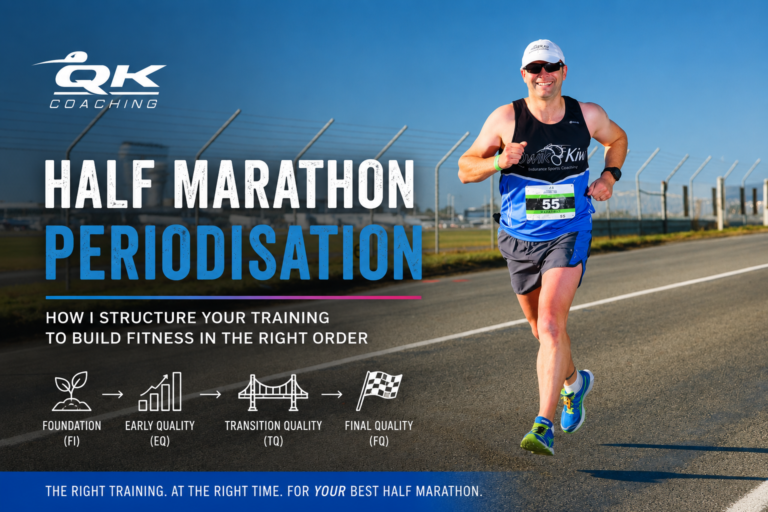
I would primarily use 3×8min Threshold Runs during the Transition Quality (TQ) Phase of a half marathon build-up.
The Foundation & Injury Prevention (FI) Phase develops the aerobic conditioning, consistency and resilience required for the quality training that follows.
During the Early Quality (EQ) Phase, we begin introducing structured quality and developing capabilities such as aerobic power, running strength and running economy.
As we move into the Transition Quality (TQ) Phase, the training begins shifting towards longer sustained quality efforts that bridge the gap between those earlier training adaptations and the increasingly race-specific work to come.
That’s where 3×8min Threshold Runs fits particularly well.
The repetitions are long enough to require sustained, controlled Level IV running, while the Level II recoveries maintain the aerobic nature of the workout and allow you to accumulate a substantial amount of threshold work.
As you progress towards the Final Quality (FQ) Phase, training becomes increasingly specific to the demands and intensity of your half marathon.
The threshold fitness developed through sessions such as this provides an important foundation for that race-specific work.
Coach Ray’s Verdict
3×8min Threshold Runs looks simple on paper.
That’s part of what makes it such a useful workout.
There are no complicated changes of pace or elaborate interval structures. You simply need to run at the correct intensity for eight minutes, settle back into Level II for three minutes and then do it again.
The challenge is having the discipline to execute it correctly.
Don’t race the first repetition.
Don’t turn Level IV into Level V.
Don’t turn the Level II recovery into another quality effort.
Instead, aim to produce three consistent, controlled eight-minute threshold efforts, connected by disciplined aerobic running.
If the third repetition is every bit as well executed as the first—even though it feels considerably harder—you’ve got the workout right.
Ready to Put Workouts Like This Into a Complete Half Marathon Plan?
Individual threshold sessions can improve your fitness, but their real value comes from knowing when to use them and how they fit with the rest of your training.
Inside the NZ Half Marathon Hub+, training follows my periodised approach through the Foundation & Injury Prevention (FI), Early Quality (EQ), Transition Quality (TQ) and Final Quality (FQ) phases.
That means workouts such as 3×8min Threshold Runs are placed where they complement your long runs, easy running, recovery and other quality sessions rather than simply being added because they’re challenging.



One Comment
Comments are closed.