Train Your Gut Before Race Day: Practise Your Half Marathon Fuelling in Training
You can have the fitness.
You can have the perfect pacing strategy.
You can arrive at the start line rested, confident and ready to run your best half marathon.
But if your stomach doesn’t tolerate the fuel you’re putting into it, your race can unravel surprisingly quickly.
Nausea, bloating, stomach cramps or an urgent search for the nearest toilet can turn months of good training into a very uncomfortable 21.1km.
That’s why your race-day nutrition strategy shouldn’t begin on race morning.
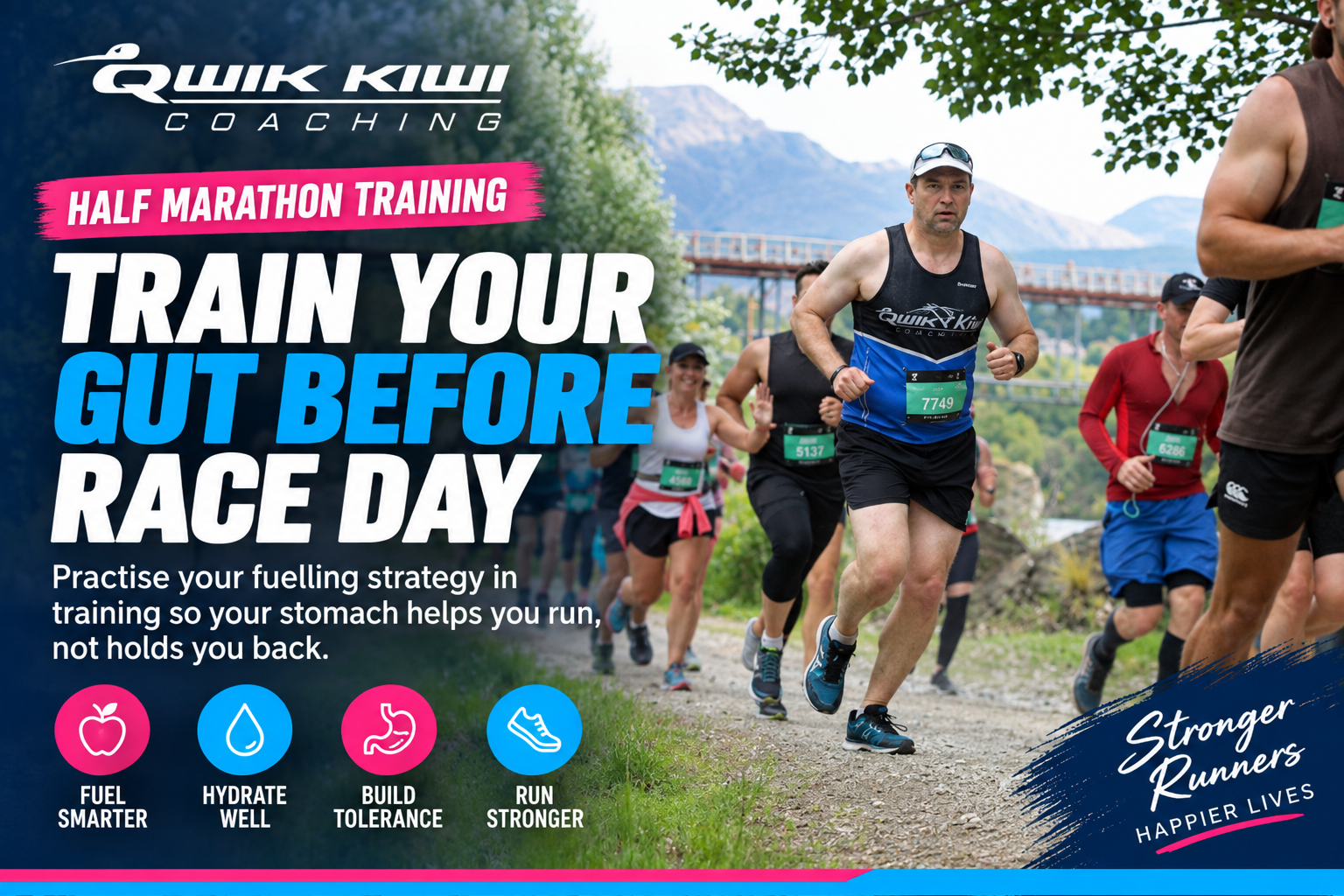
You need to train your gut before race day.
Just as you train your legs to handle running for 21.1km, you can practise eating and drinking while running so your digestive system becomes familiar with what you’re asking it to do.
Your long runs aren’t only opportunities to develop endurance.
They’re also your dress rehearsals for race-day fuelling.
What Does “Training Your Gut” Actually Mean?
Gut training sounds complicated, but the basic idea is simple.
You repeatedly practise consuming the food, gels, sports drink and fluids you intend to use during your half marathon.
You practise:
- what you’re going to consume;
- how much you’re going to consume;
- when you’re going to consume it; and
- how you’re going to carry or access it.
Over time, you learn what your stomach tolerates and what it doesn’t.
More importantly, you’re not discovering those things for the first time while racing.
You wouldn’t buy a new pair of shoes the night before your half marathon and hope they’ll be comfortable for 21.1km.
Your fuelling strategy deserves the same preparation.
Why Fuelling a Half Marathon Can Be Difficult
Running and digestion aren’t always perfect partners.
When you’re exercising, your body is prioritising the muscles doing the work. The harder you’re running, the more challenging it can become to comfortably process food and fluid.
Then add the realities of race day.
You’re nervous.
You might have eaten breakfast earlier than usual.
It could be warmer than expected.
You’re running harder than you normally do on a Sunday morning.
You might grab a sports drink you’ve never tried from an aid station.
Perhaps you take a gel and wash it down with sports drink instead of water.
Suddenly, the nutrition strategy that looked straightforward on paper isn’t quite so straightforward.
That’s why race day shouldn’t be your experiment.
Your training should answer as many of these questions as possible beforehand.
Don’t Wait Until Race Week to Think About Fuelling
One of the biggest mistakes runners make is treating nutrition as something to organise during their taper.
They spend weeks or months developing their running fitness and then, a few days before the race, start thinking:
How many gels should I take?
What should I eat for breakfast?
Should I drink sports drink?
Do I even need to fuel during a half marathon?
By then, there isn’t much opportunity to test anything properly.
Instead, begin developing your strategy during your training build-up.
Your longer runs provide repeated opportunities to experiment, refine and eventually rehearse what you intend to do on race day.
You don’t need to have everything perfect the first time.
That’s the point of practising.
Use Your Long Runs as Fuelling Practice
Your long run is one of the best places to train your gut.
As your long runs become longer and more race-specific, start using them to practise your intended race nutrition.
That doesn’t necessarily mean every long run has to replicate race day exactly.
Early in your programme, you might simply practise taking a gel while running.
Later, you can become much more specific.
You might practise your planned breakfast before the run, take your first fuel at the same point you intend to during the race, follow your planned schedule and drink similar fluids.
Eventually, some of your key long runs can become genuine race rehearsals.
The goal is to arrive at race week already knowing:
“I’ve done this before, and I know it works.”
Practise Fuelling While You’re Actually Running
There’s an important distinction here.
Being able to tolerate a particular gel while standing in your kitchen doesn’t mean you’ll tolerate it while running at half marathon intensity.
Your fuelling strategy needs to be tested in the environment in which you’re going to use it.
That means taking your fuel during your runs.
Practise opening the packet without stopping.
Practise taking the gel gradually if that’s more comfortable for you.
Practise drinking afterwards.
Practise carrying your fuel.
These might sound like tiny details, but small inconveniences can become surprisingly irritating during a race.
The more familiar the process becomes, the less attention it requires on race day.
Don’t Wait Until You’re Running Out of Energy
Fuelling works best when it’s proactive rather than reactive.
If you’re waiting until you feel completely depleted before taking something, you’ve probably waited too long.
You can’t swallow a gel and expect an instant transformation.
Your body needs time to digest and absorb what you’ve consumed.
That’s why your strategy should be established beforehand.
Rather than asking yourself:
“Do I feel like I need a gel yet?”
you should already have a good idea of approximately when you’re going to fuel.
Your exact requirements will depend on factors including your expected finishing time, body size, pre-race nutrition, intensity, conditions and what you’ve found works during training.
The important point is to develop that strategy through practice rather than improvising it when you’re already tired.
How Much Carbohydrate Do You Need?
There isn’t one universal fuelling prescription that every half marathon runner should follow.
A runner completing the event in 75 minutes has very different requirements from someone who’ll be racing for two and a half hours.
As a general sports-nutrition guideline, athletes exercising for around 1–2.5 hours are commonly advised to consider approximately 30–60 grams of carbohydrate per hour (whilst running).
But that isn’t a target you should blindly copy.
Your individual requirements and tolerance matter.
Some runners will perform well towards the lower end of that range. Others—particularly those racing for longer—may benefit from more carbohydrate.
The important thing is that whatever strategy you choose is practised in training.
If you’re currently taking very little carbohydrate during your long runs, don’t suddenly jump to a much larger intake because you’ve read that more carbohydrate can improve endurance performance.
Build gradually and learn how your body responds.
If you have specific nutritional or gastrointestinal concerns, an appropriately qualified sports dietitian can provide individual advice.
Your Gut Can Adapt
One of the reasons for practising your nutrition repeatedly is that your digestive system isn’t necessarily fixed in what it can tolerate.
Regularly consuming carbohydrate during exercise can help you become more accustomed to taking in fuel while running.
There’s also a psychological benefit.
If you’ve successfully used the same strategy repeatedly during training, you’re less likely to worry about whether it will work on race day.
You’ve removed another unknown.
That’s valuable because there will already be plenty happening during your half marathon without wondering whether the gel in your hand is about to upset your stomach.
Practise Your Race-Day Breakfast Too
Gut training doesn’t begin with your first gel.
Your pre-race breakfast is part of your fuelling strategy as well.
Race morning isn’t the time to discover that the breakfast somebody recommended on social media doesn’t agree with you.
Use appropriate training days to practise what you intend to eat before your race.
Consider:
What will you eat?
How much will you eat?
How long before running will you eat it?
What will you drink?
Then test it.
Your normal long-run morning can be an ideal opportunity.
As you get closer to your event, you can make the rehearsal increasingly realistic.
If your race starts at 8:00am, for example, think about when you’ll need to wake up and when you’ll need to eat.
You don’t necessarily need to recreate this every weekend, but doing it before an important race can identify problems while you’ve still got time to fix them.
Practise With the Fuel You’ll Use on Race Day
Not all gels, chews and sports drinks are identical.
Different products contain different types and concentrations of carbohydrate, flavours, textures and ingredients.
Something your training partner loves might make your stomach miserable.
That’s why finding “the best gel” is less important than finding something that works for you.
Once you’ve found a product you tolerate well, practise with it consistently.
If you plan to carry your own nutrition during the race, that’s relatively straightforward.
If you’re planning to rely on aid stations, find out what the event provides.
Then, where practical, obtain that product beforehand and test it in training.
Don’t assume that because you’ve tolerated one brand of sports drink you’ll automatically be comfortable with another.
Think About Water and Sports Drink
Another detail worth practising is what you consume alongside your fuel.
For example, many gels are designed to be consumed with water.
If you normally practise taking your gel with water but then grab a cup of sports drink on race day, you’ve suddenly changed your carbohydrate concentration and overall strategy.
That might be fine for you.
Or it might not.
Again, that’s what training is for.
Know what you’re taking and what you’re drinking with it.
If you’re relying on aid stations, look at where they’re positioned and what they’ll provide.
Your race nutrition plan should fit the actual race you’re entering.
Hydration Needs Practice Too
Training your gut isn’t only about calories and carbohydrates.
Your hydration strategy should also be rehearsed.
How much you need to drink depends on factors including the weather, your sweat rate, your pace and how long you’ll be on the course.
More isn’t automatically better.
The goal isn’t to drink as much as possible.
You want an appropriate strategy that helps support performance without creating unnecessary discomfort—or excessive fluid intake.
Training gives you the opportunity to learn what feels appropriate in different conditions.
A cool winter long run might require a very different approach from a warm race day.
Pay attention to how conditions affect your thirst and fluid needs, and avoid waiting until race morning to think about it.
Don’t Forget Electrolytes
Electrolytes are another area where runners can become unnecessarily complicated.
For some athletes—particularly those running for longer, sweating heavily or racing in warm conditions—sodium and other electrolytes may form part of their overall hydration strategy.
But don’t add products simply because somebody else uses them.
If you’re going to use an electrolyte drink, capsule or other product on race day, practise with it beforehand and understand how it fits alongside your carbohydrate and fluid intake.
The principle remains the same:
Nothing important in your race-day nutrition strategy should be a surprise.
Train Your Gut at Race-Specific Intensities
Taking fuel during a relaxed Level II long run is a good start.
But as your programme progresses, there can also be value in practising nutrition during sessions that include your intended half marathon race pace.
Why?
Because your digestive system may respond differently when you’re running harder.
A gel that’s perfectly comfortable during an easy run may feel quite different when you’re working at race intensity.
You don’t need to turn every quality session into a nutrition experiment.
But during appropriate race-specific workouts or long runs containing sections at half marathon pace, practise the strategy you’re considering for race day.
This gives you greater confidence that it works under realistic conditions.
Learn From the Sessions That Don’t Go Well
Not every fuelling experiment will be successful.
That’s useful information.
Maybe a particular gel makes you feel nauseous.
Maybe taking an entire gel quickly causes stomach discomfort.
Perhaps you need more water with it.
Maybe your breakfast was too large, too close to the run.
Perhaps the combination of sports drink and gels was simply too much.
Don’t automatically label a bad session as a disaster.
Ask what you learned from it.
Training is exactly where you want these problems to occur because you have time to make adjustments.
Change one thing, test it again and keep refining your approach.
By race day, you want very few unanswered questions.
Don’t Copy Someone Else’s Strategy
Your training partner takes three gels.
A runner on YouTube takes five.
An elite athlete you’ve been following uses a particular drink.
None of that automatically means you should do the same.
Your race duration, pace, physiology, diet and tolerance are individual.
Use established sports-nutrition principles as a starting point, but then determine what works for you.
A simple strategy that you’ve successfully practised repeatedly is far more valuable than an elaborate strategy copied from somebody else the night before your race.
Nothing New on Race Day
This is one of the simplest rules in endurance sport.
Nothing new on race day.
That includes:
- your breakfast;
- gels;
- chews;
- sports drink;
- electrolyte products;
- caffeine strategy; and
- the timing of your nutrition.
The expo isn’t the place to pick up a free sample of an exciting new gel and decide you’ll try it at kilometre 15.
Save it for training.
Likewise, don’t suddenly double your carbohydrate intake because somebody in the start corral tells you that you’re not taking enough.
Trust what you’ve practised.
Race morning should be about executing a familiar plan—not inventing one.
Your Simple Half Marathon Gut-Training Checklist
As your race approaches, you should be able to answer a few basic questions confidently:
What am I eating before the race?
When am I eating it?
What fuel am I taking during the race?
When am I taking it?
What am I drinking with it?
Am I carrying my own nutrition or using aid stations?
Have I successfully practised this while running?
Have I tested it during longer or race-specific sessions?
If you can’t answer those questions yet, that’s okay.
But don’t wait until race morning to find out.
Train Your Gut Before Race Day
Your stomach is part of your half marathon performance.
You train your aerobic system.
You train your legs.
You practise your pacing.
You prepare mentally for the difficult kilometres.
Your fuelling deserves practice too.
Use your long runs to test your breakfast, gels, drinks and timing.
Gradually develop a strategy that suits your race duration and individual needs.
Practise it often enough that it becomes familiar.
Then, when race morning arrives, you aren’t hoping your nutrition works.
You already know it does.
Want Help Preparing for Your Half Marathon?
If you’re unsure how to structure your half marathon training, where race-specific sessions should fit, or how to practise your pacing and fuelling before race day, let’s talk.
Book a free, no-obligation 40-minute coaching consultation with me and we can discuss your current training, target event and what you need to work on before race day.
Book your free 40-minute consultation:
For more practical half marathon training, nutrition, pacing and race-day advice, visit:
www.HalfMarathonTraining.co.nz
Train smart. Race strong.