How to Pace a Half Marathon: A Smarter Strategy for Running Your Best Race
One of the easiest ways to make a half marathon harder than it needs to be is also one of the most common: running too fast at the start.
You’ve tapered. You’re rested. You’ve got fresh legs. The adrenaline is flowing, everyone around you is moving quickly, and goal pace can suddenly feel ridiculously easy.
The problem is that a half marathon doesn’t really punish you for that mistake in the first few kilometres.
It makes you pay for it later.
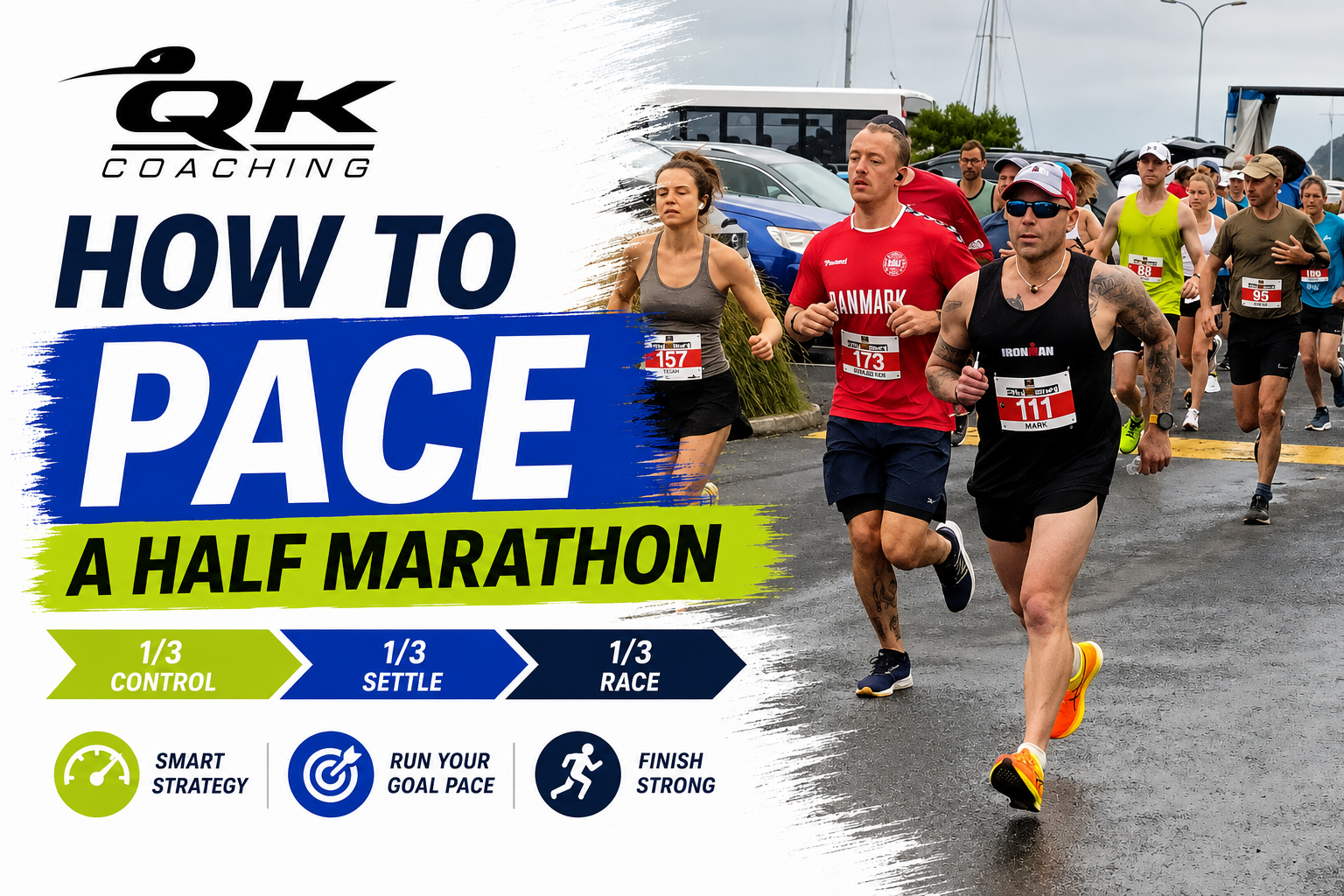
For most runners, I prefer a simple pacing strategy that divides the half marathon into three roughly equal sections:
Control the first 7 km. Settle into the middle 7 km. Race the final 7 km.
Rather than trying to hold exactly the same pace from the gun to the finish, the aim is to deliberately start slightly slower than goal pace, move onto goal pace through the middle of the race, and then finish faster.
When executed well, it gives you an excellent opportunity to run a negative split, finish strongly and spend the final kilometres passing runners rather than simply trying to survive.
Let’s look at how it works.
The 7 km + 7 km + 7 km Half Marathon Pacing Strategy
A half marathon is 21.1 kilometres, which divides almost perfectly into three blocks of approximately seven kilometres.
That makes the strategy straightforward:
| Section | Pacing Strategy | Objective |
|---|---|---|
| Start–7 km | 10–15 sec/km slower than goal pace | Control |
| 7–14 km | Goal pace | Settle |
| 14–21 km | 10–15 sec/km faster than goal pace | Race |
| Final ~100 m | As fast as you can | Finish |
There is an important assumption behind this strategy: your goal pace needs to be realistic.
No pacing strategy can compensate for choosing a finishing time that your current fitness doesn’t support. Your training leading into the event should give you a good indication of an appropriate goal.
Once you’ve established that goal, however, the three-thirds strategy gives you a very simple framework for executing it.
First Third: Control — Start to 7 km
The first seven kilometres should feel controlled.
If your goal pace is 5:00/km, for example, I’d be looking for approximately 5:10–5:15/km during this opening section.
That can feel surprisingly slow on race morning.
That’s exactly the point.
Why Starting Conservatively Is So Important
The first kilometre is perhaps the easiest kilometre of the entire race to get wrong.
You’re tapered and rested. Your legs feel fantastic. Adrenaline is high. You’ve got hundreds or thousands of runners around you, and inevitably some of them are going considerably faster than you should be.
You can look at your watch and discover you’re running 15 or 20 seconds per kilometre faster than planned — yet it still feels easy.
Don’t confuse feeling easy now with being sustainable for 21.1 km.
You need to resist the temptation to race those people.
Let them go.
Your race doesn’t begin in the first kilometre.
Feeling Great at 7 km Is a Good Thing
Another temptation comes towards the end of this first third.
You’ve been conservative for seven kilometres and you feel fantastic. It’s very easy to think:
“I’m having a great day. I’m going faster now.”
Don’t.
Feeling strong at seven kilometres isn’t evidence that you’ve been running too slowly.
It’s evidence that the plan is working.
You’ve still got approximately two-thirds of the half marathon ahead of you. Move onto goal pace and settle into the race.
You’ll get your opportunity to race later.
Middle Third: Settle — 7 km to 14 km
At approximately seven kilometres, start bringing your pace towards your target.
Using our runner targeting 5:00/km as the example, this section should now be approximately:
5:00/km.
The emphasis changes from control to settle.
You shouldn’t suddenly surge at the seven-kilometre marker. Smoothly increase your pace and find the rhythm you’ve practised in training.
This is where you want to become almost boringly consistent.
Tick off the kilometres.
Maintain your fuelling.
Keep drinking.
Monitor how you’re feeling.
And resist the temptation to race too early.
Half Marathon Pace Isn’t the Same Intensity for Everyone
It’s worth understanding that “half marathon pace” doesn’t represent exactly the same physiological intensity for every runner.
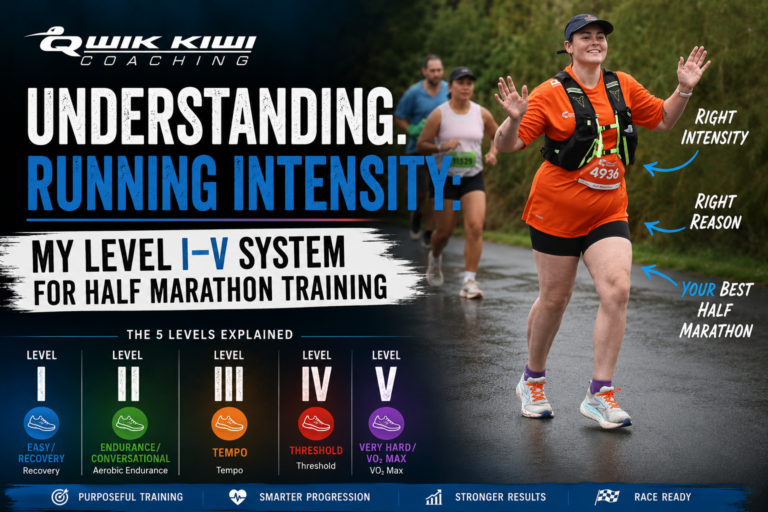
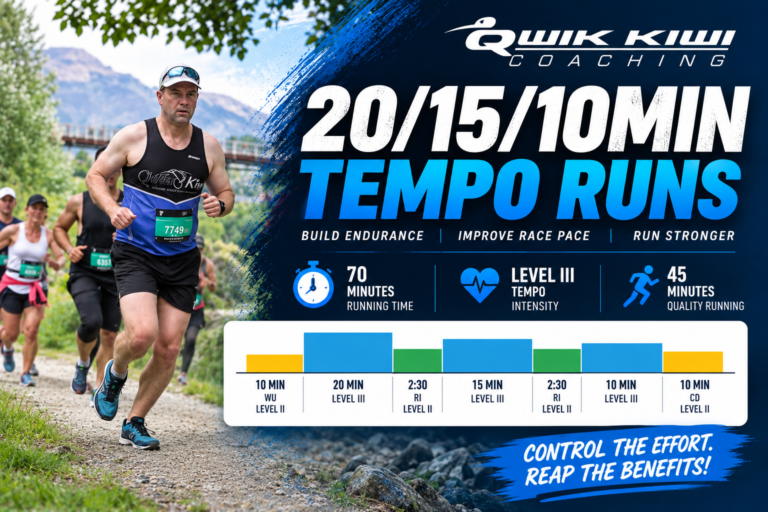
As a general rule, half marathons are raced around Level III — Tempo in my Level I–V intensity system.
For a faster athlete, the majority of the race may be towards the upper end of Level III, with some time towards the lower end of Level IV — Threshold.
For a runner taking closer to two hours or longer, much more of the race may be around Level II — Endurance/Conversational, with some Level III.
That’s one reason your race pace needs to be based on your fitness and your expected finishing time, rather than somebody else’s.
Final Third: Race — 14 km to 21 km
Fourteen kilometres is where the race changes.
You’ve controlled the opening third.
You’ve settled into goal pace through the middle.
Now you’ve earned the right to race.
If everything is going according to plan, aim to increase your pace to approximately 10–15 seconds per kilometre faster than goal pace.
Our runner targeting 5:00/km would now be looking for roughly:
4:45–4:50/km.
This is where the conservative start begins to pay dividends.
You haven’t spent the first half of the race accumulating unnecessary fatigue. You’ve preserved enough capacity to increase your speed at the point where many runners around you are beginning to slow.
And that creates another advantage that shouldn’t be underestimated.
Start Passing People
The closing stages of a half marathon are difficult.
But there’s an enormous psychological difference between struggling while people continually pass you and working hard while you are passing them.
If you’ve paced the race correctly, you’ll often find yourself moving through the field during the final seven kilometres.
Pick someone ahead.
Gradually catch them.
Pass them.
Then look for the next runner.
Instead of the final kilometres becoming a countdown to survival, you’re actively racing.
That momentum can be extremely motivating when your legs are beginning to hurt.
What If You Don’t Feel Good at 14 km?
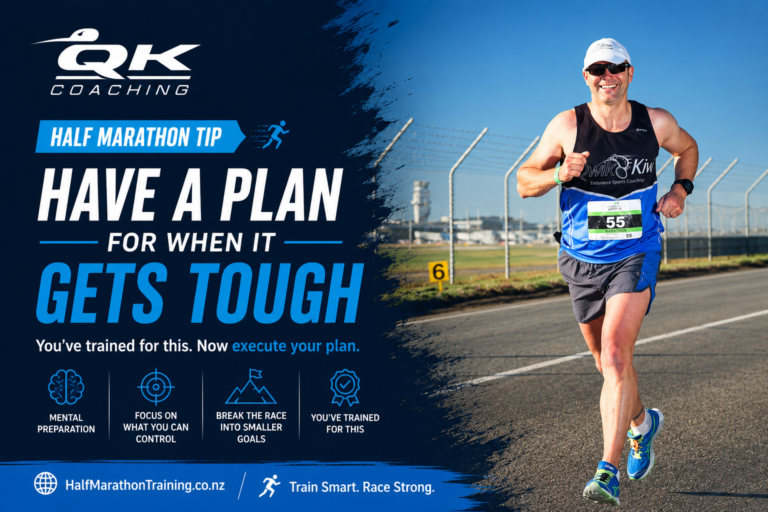
Race plans are plans — not guarantees.
Sometimes you reach 14 kilometres and you’re simply not ready to increase the pace.
Don’t panic, and don’t assume the race is ruined.
Go with the flow and keep assessing the situation.
Perhaps you can maintain goal pace.
Then reassess with five kilometres remaining.
Still not ready?
Keep going and reassess with three kilometres to go.
You may find that you’ve worked through the difficult patch and can increase your pace later.
If you can’t, do the best you can on the day.
Maybe you finish slightly outside your original goal. Maybe conditions have affected everyone. Maybe the goal was slightly ambitious. Maybe you’re simply having an off day.
The important thing is that you continue making decisions based on what is happening now, rather than allowing one difficult patch to dictate the remainder of your race.
Don’t Let Your Watch Ruin a Good Pacing Strategy
Your GPS watch can be extremely useful during a half marathon, but only if you look at the right information.
I recommend checking your kilometre lap pace.
Rather than reacting constantly to instantaneous pace, assess how you’ve run each completed kilometre.
I don’t recommend using your overall average race pace as your primary pacing metric with this strategy.
Think about what happens during the opening seven kilometres.
You’re deliberately running 10–15 seconds per kilometre slower than target pace.
When you reach seven kilometres and move onto goal pace, your overall average pace will therefore still show that you’re behind target.
You can run perfectly at goal pace for the next kilometre and your overall average will barely move.
Another kilometre passes.
Still behind.
That can become psychologically frustrating and tempt you to start chasing your average.
Don’t.
If you’ve executed the strategy correctly, your overall average pace may not begin approaching your target until around kilometres 18 or 19.
Focus on the kilometre you’re running now.
The Course Has a Say in Your Pacing Strategy
The 7 km / 7 km / 7 km framework is deliberately simple, but that doesn’t mean every half marathon should be raced identically.
The course matters.
Imagine the opening seven kilometres contain significant climbing.
Blindly insisting on running exactly 10–15 seconds slower than your flat-course goal pace may require considerably too much effort.
The terrain has already made your first third more conservative.
That changes what is required later.
Likewise, hills in the final third may make the planned acceleration more difficult.
Before race day, look at the course profile and understand where the significant climbs, descents and technical sections occur.
Build your pacing strategy around the actual race you’re running.
Weather Matters Too
Your goal pace isn’t protected from the weather.
Extreme heat can slow you down.
Strong winds can have a major effect.
Heavy rain, snow or sleet can change both the physical demands of the race and the conditions underfoot.
That doesn’t mean throwing your entire race plan away when you wake up and discover the forecast isn’t ideal.
It means being prepared to adjust the plan intelligently.
And make sure you’re appropriately equipped for the conditions.
As the saying goes:
There’s no such thing as poor weather, just poor clothing choices.
Don’t Forget Your Fuelling and Hydration
You can pace the first 14 kilometres perfectly and still struggle to accelerate if you haven’t supported your body appropriately.
If you want to finish strongly, you need to arrive at the final third with enough fuel available to do it.
That means your fuelling and hydration strategy starts well before you feel like you need it.
Don’t wait until the final seven kilometres and suddenly realise you’re running low on energy.
Use the aid stations appropriately, follow the fuelling strategy you’ve practised during training, and give yourself the best possible opportunity to execute the planned acceleration.
The goal isn’t simply to want to run faster at 14 kilometres.
You need to have preserved the physiological resources to actually do it.
Practise Finishing Fast in Training
Race day shouldn’t be the first time you’ve tried to increase your intensity late in a long run.
This concept is built into some of the training I prescribe.
Progressive Long Runs
A progressive long run can begin at Level II, progress into Level III, and eventually include some Level IV running before the final cool-down.
That doesn’t necessarily mean reproducing your exact race-day paces.
The purpose is to teach your body — and your mind — to increase intensity after you’ve already accumulated fatigue.
You’re practising the skill of finishing strongly.
Final Quality Tempo Sessions
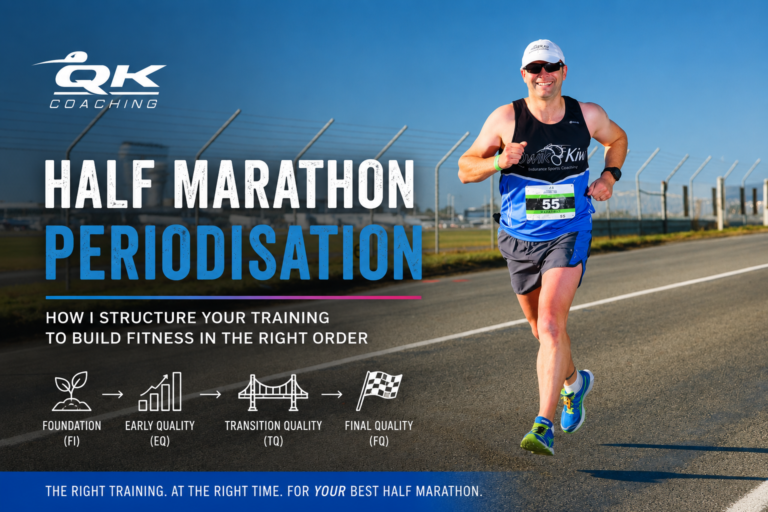
During the Final Quality (FQ) phase of my periodisation system, tempo training becomes particularly important.
These sessions help you dial in that Level III intensity that plays such an important role in half marathon performance.
By race day, the sensations associated with this intensity shouldn’t be unfamiliar.
What About Your First Half Marathon?
If this is your first half marathon, I generally don’t think your primary goal should be chasing an ambitious finishing time.
Your first goal should be to finish.
Experience the event.
Learn what 21.1 kilometres feels like.
Learn how your body responds.
Learn how aid stations work.
Learn how your fuelling strategy works under race conditions.
Learn what you’d do differently next time.
Your first half marathon is automatically going to be a PB — you’ve never run one before.
So there’s no previous best you need to beat.
That doesn’t mean you can’t use the three-thirds strategy.
In fact, it can be an excellent way of preventing the classic first-half-marathon mistake of getting carried away early.
Run conservatively.
Settle through the middle.
Then, if you’re feeling good later in the race, start increasing your pace as circumstances allow.
Finish your first half marathon wanting to come back and see how much faster you can run the next one.
Worked Example: A 1:45 Half Marathon
Let’s make the strategy practical.
A 1:45 half marathon requires an average pace of approximately 4:59/km, so we’ll simplify the target pace to around 5:00/km.
The race could therefore look something like this:
0–7 km — Control
Approximately 5:10–5:15/km
7–14 km — Settle
Approximately 5:00/km
14–21 km — Race
Approximately 4:45–4:50/km
Final ~100 m — Sprint
Whatever you’ve got left.
Notice that you’re not desperately trying to “make up time” after seven kilometres.
You’re simply progressing through the pacing strategy.
The mathematics of running slower initially, approximately at target pace through the middle and faster during the final third brings your overall pace towards the target as the race progresses.
The Strategy Works Across Different Goal Times
The same basic principle can work whether you’re targeting approximately 1:25 or 2:05.
The absolute pace changes.
The physiological intensity changes somewhat.
Your training background changes.
But the basic race execution remains:
Control → Settle → Race.
That’s one of the reasons I like this strategy.
You don’t need to memorise a complicated pacing chart while you’re racing.
You have three jobs.
For seven kilometres, control yourself.
For seven kilometres, settle into your target.
For seven kilometres, race.
Then you’ve got about 100 metres left.
And at that point, there’s not much need for a pacing strategy.
Sprint.
Common Half Marathon Pacing Mistakes
There are several mistakes that can undermine an otherwise good training build-up:
- Starting at goal pace or faster because the opening kilometres feel easy.
- Following other runners rather than following your own race plan.
- Treating a good feeling at 7 km as permission to start racing early.
- Constantly reacting to instantaneous GPS pace.
- Becoming discouraged because overall average pace looks slow during the first half.
- Choosing a goal pace that isn’t supported by your current fitness.
- Ignoring the course profile or weather conditions.
- Neglecting fuelling and hydration and expecting to accelerate late anyway.
- Giving up on the pacing strategy because you can’t increase your speed precisely at 14 km.
A pacing strategy should give you structure without preventing you from responding intelligently to what’s actually happening during the race.
How to Pace Your Next Half Marathon
When you’re standing on the start line, remember this:
Don’t race the first 7 km. Control it.
Let people go.
Ignore the adrenaline.
Allow yourself to feel as though you’re holding back.
At seven kilometres:
Settle.
Move onto your target pace. Find your rhythm. Stay patient. Fuel and hydrate.
At 14 kilometres:
Race.
If you’re feeling good, begin increasing your pace. Start catching people. Keep reassessing what you’ve got available.
If you’re not ready to increase yet, stay composed and reassess later.
At 21 kilometres?
Empty the tank.
The best half marathon pacing strategy isn’t the one that makes you feel fast during the first kilometre.
It’s the one that allows you to be fast when it matters.
Control. Settle. Race.
And if you execute those three stages well, there’s a very good chance you’ll spend the closing kilometres doing something far more enjoyable than hanging on:
passing people.
Take the Guesswork Out of Your Half Marathon Training
Knowing how you want to race your half marathon is one thing. Arriving at the start line with the fitness and confidence to execute that strategy is another.
Inside NZ Half Marathon Hub+, my structured training programmes bring together long runs, Level II endurance running, tempo, threshold and other quality sessions within a periodised build-up designed specifically for the demands of the half marathon.
The aim isn’t simply to get you through more training.
It’s to prepare you to arrive on race day knowing what pace you’re capable of — and having the fitness to finish strongly.
One Comment
Comments are closed.