Understanding Running Intensity: My Level I–V System for Half Marathon Training
Running harder doesn’t automatically make you fitter.
In fact, one of the most common mistakes I see among half marathon runners is not that they aren’t working hard enough. It’s that they don’t have enough distinction between the different intensities in their training.
Their easy runs gradually become moderate runs. Their long runs become progressively harder. Their quality sessions are then compromised because they’re carrying unnecessary fatigue from the supposedly easy training around them.
Good half marathon training requires a range of intensities.
Some runs should feel incredibly easy. Some should be conversational. Some deliberately challenge your ability to sustain a strong pace. And occasionally, we need to run considerably faster than half marathon race pace to develop physiological qualities that will ultimately make race pace easier.
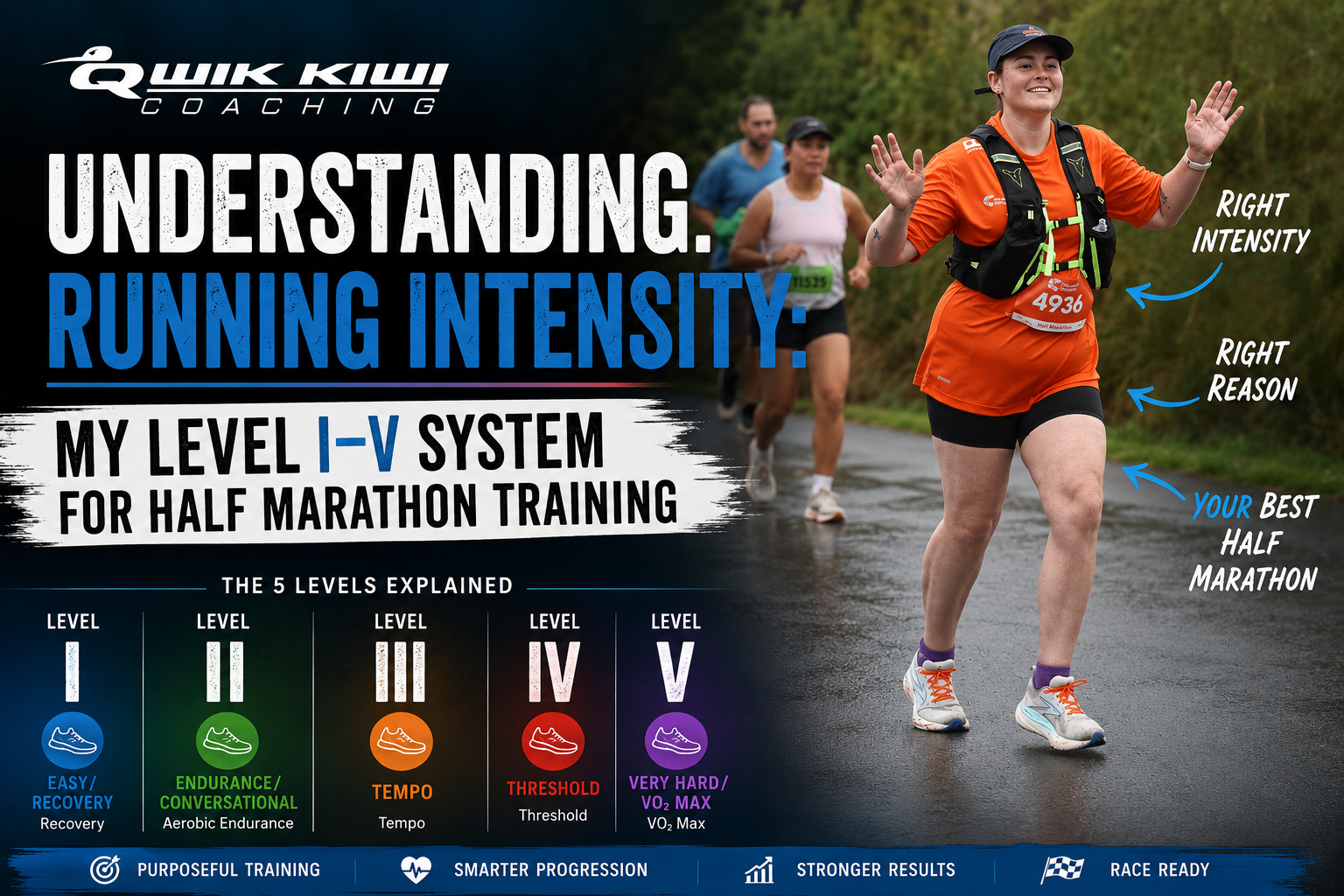
To make those distinctions clear, I use a five-level intensity system:
Level I — Easy/Recovery
Level II — Endurance/Conversational
Level III — Tempo
Level IV — Threshold
Level V — Very Hard/VO₂ Max
Each level has a different purpose.
Understanding those purposes — and having the discipline to run at the appropriate intensity for each workout — is one of the keys to getting the most from your half marathon training.
Why Do We Need Different Training Intensities?
Your body responds to the demands you place upon it.
If every run is completed at essentially the same intensity, you’re repeatedly providing a similar training stimulus.
Instead, I want different sessions to accomplish different things.
A recovery run should help you recover while still providing some gentle aerobic activity.
An endurance run should develop your aerobic fitness without generating excessive fatigue.
A tempo session should teach you to sustain a stronger aerobic effort.
Threshold training should improve your ability to sustain faster running around your threshold.
VO₂ max training should provide a powerful cardiovascular stimulus at an intensity considerably faster than you could sustain for a half marathon.
None of these intensities is inherently “better” than another.
The appropriate intensity depends on what we’re trying to achieve with that particular workout.
That’s why I don’t want an athlete making an easy run harder simply because they feel good that morning.
If I’ve prescribed Level II, I want Level II.
Save the harder running for when it has a purpose.
Level I — Easy/Recovery
Level I is the easiest intensity in my system.
Its primary purpose is recovery.
This is very gentle running. It should feel relaxed, controlled and deliberately easy.
Depending on the athlete and where we are in the training programme, I might use Level I during a recovery run, between harder repetitions, as part of a warm-up or cool-down, or whenever I specifically want to minimise the physiological stress of the running.
There can sometimes be an instinct among runners to think:
“Surely running this slowly isn’t doing anything?”
But that’s looking at an individual run without considering the entire training programme.
If yesterday contained a demanding quality workout and tomorrow contains another important session, today’s job may simply be to promote recovery without adding significant fatigue.
Making that run harder doesn’t necessarily improve the programme.
It can actually make it worse.
Level I Training Zones
Level I sits below the lower boundary of Level II:
- Pace: below 81% of threshold pace
- Running power: below 81% of threshold power
- Heart rate: below 69% of threshold heart rate
Don’t become obsessed with sitting exactly underneath a percentage, though.
The overriding characteristic of Level I is that it should feel very easy.
Level II — Endurance/Conversational
If there is one intensity every half marathon runner needs to become comfortable with, it’s Level II.
Level II is your primary aerobic endurance intensity.
This is where a significant amount of your running will take place, including many easy runs and most of your long runs.
I often describe Level II as conversational running.
You should be able to run alongside a training partner and comfortably hold a conversation in complete sentences.
No training partner?
Talk to yourself.
Or try singing part of a song.
It might look slightly strange to somebody walking past you, but it gives you useful immediate feedback about your intensity.
If you’re struggling to get a sentence out because you’re breathing too hard, there’s a good chance your “easy” run isn’t actually easy.
Level II Training Zones
- Pace: 81–89% of threshold pace
- Running power: 81–88% of threshold power
- Heart rate: 69–83% of threshold heart rate
These numbers provide objective guidance, but I still want athletes paying attention to how the effort feels.
Your training device gives you information.
Your body gives you information too.
Use both.
The Biggest Intensity Mistake I See
The biggest issue isn’t necessarily runners scheduling too many Level III workouts.
It’s runners turning their Level II workouts into Level III workouts.
They head out for an easy run feeling good.
The pace gradually increases.
Perhaps somebody runs past them.
Perhaps their normal pace looks disappointingly slow on their watch.
Or perhaps running easily simply feels as though they’re not training hard enough.
Before long, their Level II run has become something else entirely.
Do that occasionally and it probably doesn’t matter.
Do it repeatedly and you change the structure of the training week.
You’re generating more fatigue on days that are supposed to support aerobic development while allowing recovery from harder training.
Then when the planned quality workout arrives, you’re not as fresh as you should be.
This is why easy enough is important.
A good Level II run isn’t one where you demonstrate how fast you can run while technically remaining below some arbitrary ceiling.
It’s one where you accomplish the purpose of the session.
Level III — Tempo
Level III is where we deliberately begin to increase the intensity.
I typically describe this as tempo running.
It should feel purposeful. You’re no longer jogging along having an effortless conversation, but neither are you running at threshold.
Level III plays an especially important role in half marathon preparation because the half marathon requires the ability to sustain a strong aerobic effort for a prolonged period.
Level III Training Zones
- Pace: 90–94% of threshold pace
- Running power: 89–95% of threshold power
- Heart rate: 84–94% of threshold heart rate
Unlike accidentally running your easy days too hard, planned Level III training is extremely valuable.
That’s an important distinction.
I don’t want athletes avoiding Level III because they’ve heard that moderate-intensity running is somehow “bad”.
I want Level III used deliberately.
Where Tempo Training Fits Into Half Marathon Preparation
Within my periodisation system, Level III becomes particularly important during the Transition Quality (TQ) and Final Quality (FQ) phases.
Earlier training has established the aerobic foundation and developed other qualities.
Now we increasingly need to convert that fitness into the ability to sustain a strong running pace for longer.
A workout such as:
20min Level III;
2:30min Level II recovery;
15min Level III;
is a good example.
Rather than simply asking you to run faster, we’re asking you to sustain a controlled, purposeful effort for substantial periods.
That’s highly relevant to the demands of racing 21.1km.
Level IV — Threshold
Level IV is threshold training.
This is a significant step up from tempo running.
Threshold workouts are designed to improve your ability to sustain relatively fast running before fatigue forces you to slow significantly.
Level IV Training Zones
- Pace: 100–103% of threshold pace
- Running power: 96–105% of threshold power
- Heart rate: 95–105% of threshold heart rate
Threshold training is demanding, which is why we normally break it into manageable repetitions rather than simply trying to run at threshold for as long as possible.
An example might be:
4 × 5min Level IV
with appropriate recovery between repetitions.
The recovery allows you to accumulate a useful amount of quality running while maintaining the intended intensity and good running form.
Why Train at Threshold for a Half Marathon?
Because training intensity and race intensity aren’t the same thing.
You don’t have to race your entire half marathon at Level IV for Level IV training to improve your half marathon performance.
Threshold training can raise the level of fitness sitting above your normal half marathon effort.
As your threshold improves, the pace you can sustain at lower relative intensities can improve as well.
This becomes particularly important when we consider athletes of different abilities, which I’ll come back to shortly.
Level V — Very Hard/VO₂ Max
Level V is very hard running, with the primary physiological purpose of developing VO₂ max.
These efforts are considerably faster and therefore considerably shorter than your normal half marathon running.
Level V Training Zones
- Pace: approximately 110–120% of threshold pace
- Running power: approximately 116–128% of threshold power
- Heart rate: approximately 106–116% of threshold heart rate
There’s an important qualification here.
Heart rate doesn’t behave like pace or power.
You can immediately increase your running pace or power output substantially above Level V. Heart rate, however, takes time to respond and has an upper physiological limit.
That’s one reason I don’t generally prescribe half marathon training from heart rate.
Can You Run Harder Than Level V?
Absolutely.
With pace and running power, you can run considerably harder than the Level V ranges.
In some areas of my coaching you’ll see intensities described as Level V+, Level V++ or even Level V+++.
As intensity increases, the amount of time you can sustain it becomes progressively shorter.
Those very high intensities have applications in certain forms of endurance training, but they aren’t typically required within my half marathon programmes.
For half marathon preparation, Level V gives us more than enough intensity at the top end of the system.
The Five Levels at a Glance
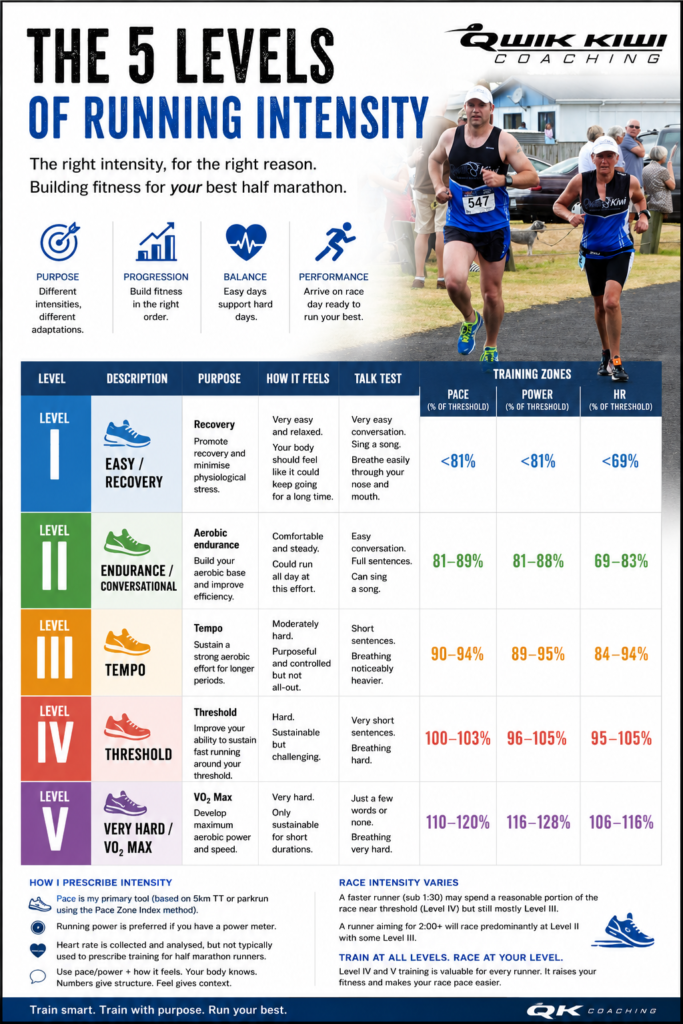
| Level | Description | Primary Purpose | Pace | Running Power | Heart Rate |
|---|---|---|---|---|---|
| Level I | Easy/Recovery | Recovery | <81% | <81% | <69% |
| Level II | Endurance/Conversational | Aerobic endurance | 81–89% | 81–88% | 69–83% |
| Level III | Tempo | Sustained aerobic/tempo fitness | 90–94% | 89–95% | 84–94% |
| Level IV | Threshold | Threshold development | 100–103% | 96–105% | 95–105% |
| Level V | Very Hard/VO₂ Max | VO₂ max | 110–120% | 116–128% | 106–116% |
All percentages are relative to the appropriate threshold pace, threshold running power or threshold heart rate.
You’ll notice there are sometimes small gaps between levels depending on which measurement we’re using.
That’s okay.
The body doesn’t know that your watch has divided exercise intensity into neat boxes.
The Levels are a coaching tool designed to help us prescribe the appropriate training stimulus.
How I Establish Your Running Intensities
For most half marathon runners, I primarily prescribe training using pace.
If an athlete has a reliable running power meter, however, I’ll generally recommend using running power.
Power has the advantage of providing an immediate measure of output. This can be particularly useful when terrain, wind or other conditions make pace less representative of the effort you’re producing.
Heart rate is different.
Although I want athletes collecting heart-rate data because it can provide useful information when we analyse training afterwards, I don’t generally use heart rate to prescribe intensity for half marathon runners.
I’m more likely to prescribe training from heart rate for ultra-endurance athletes.
For half marathon training, pace or power is normally my preferred tool.
Establishing Your Pace Zones
For athletes training by pace, I’ll typically use a recent 5km time trial or parkrun to establish the appropriate training intensities.
I then use a Pace Zone Index (PZI) approach based on the work of Matt Fitzgerald to establish the training zones.
This gives us an objective starting point.
But it’s important to understand what it doesn’t do.
It doesn’t remove the need to pay attention to how you’re feeling.
If your watch says you’re running at Level II but you can barely hold a conversation, that’s useful information.
Something may be influencing the relationship between pace and effort.
You could be tired.
It could be hot.
You could be running into a strong wind.
The terrain might be different.
You may be getting sick.
That’s where perceived effort and the talk test become valuable.
Numbers and Feel Should Work Together
I don’t see objective training data and perceived effort as competing approaches.
They complement one another.
Your prescribed pace or power gives you an objective target.
Your breathing, conversational ability and perception of effort give you an in-the-moment reality check.
For example, during Level II running, ask yourself:
Could I comfortably talk to somebody right now?
If you’re alone:
Could I talk to myself in complete sentences?
Or:
Could I sing along to a song?
If the answer is no, consider whether you’re actually running at the intended intensity.
This is particularly valuable because your fitness and training environment aren’t static.
Numbers provide structure.
Feel provides context.
A good runner learns to understand both.
Where Each Level Fits Into My Half Marathon Periodisation
My half marathon programmes aren’t simply a random collection of workouts.
I periodise training through four primary phases:
Foundation & Injury Prevention (FI) → Early Quality (EQ) → Transition Quality (TQ) → Final Quality (FQ)
The intensity mix changes as we progress through those phases.
Foundation & Injury Prevention (FI) phase
The priority is establishing consistency, aerobic endurance and the physical foundation required for later training.
That means plenty of Level II.
Level I has a role in recovery, and we can still include small amounts of quicker running where appropriate, but the aerobic foundation is the priority.
Early Quality (EQ)
We begin introducing more deliberate quality.
This can include faster repetitions and hill work designed to improve running economy, strength and aerobic power.
Level II remains important because quality training doesn’t replace aerobic training — it sits on top of it.
Transition Quality (TQ)
Now Level III tempo training becomes increasingly important.
We’re beginning to take the fitness developed earlier and improve your ability to sustain stronger running for longer.
Threshold work at Level IV can also play an important role. But Level II training still provides the vast majority of our training time.
Final Quality (FQ)
Training becomes increasingly specific to half marathon performance.
Level III is particularly valuable because of its relationship with sustained half marathon running, while Level IV and other intensities can continue to support the physiological qualities required to race well.
As the half marathon is a test of aerobic efficiency, we continue to include plenty of Level II running.
The important point is that periodisation doesn’t mean:
Level II → Level III → Level IV → Level V.
We don’t simply move up through the Levels as race day approaches.
Instead, we change how much emphasis we place on different training qualities depending on what the athlete needs at that stage of preparation.
What Intensity Should You Race a Half Marathon At?
There isn’t one Level that represents half marathon race intensity for every runner.
This is where the duration of the event becomes extremely important.
Consider two runners.
One is capable of completing a half marathon in under 90 minutes.
The other will take more than two hours.
They’re both racing exactly 21.1km, but physiologically they’re participating in events of very different durations.
The Faster Half Marathon Runner
A sub-90-minute athlete may spend a reasonable portion of the race running around Level IV/threshold, although the event will still contain a substantial Level III component.
A well-trained faster runner can sustain a much higher relative intensity because they’re completing the event sooner.
The Two-Hour-Plus Half Marathon Runner
For somebody racing for two hours or longer, the event will predominantly be Level II with some Level III.
Trying to prescribe the same relative race intensity as the 80- or 90-minute runner wouldn’t make sense.
But here’s the important part:
That doesn’t mean the slower runner shouldn’t train at Level IV or Level V.
Race pace does not determine the only intensities that are useful in training.
A two-hour-plus half marathon runner can still use threshold and VO₂ max workouts to improve their underlying fitness.
Those improvements can ultimately make their Level II and Level III running faster.
That’s why we train across a range of intensities.
Your Long Run Is Usually Level II for a Reason
The long run is one of the most important sessions in half marathon preparation.
And for most of it, most of the time, I want you at Level II.
The goal is to develop aerobic endurance and your ability to remain running comfortably for increasingly long periods.
Turning every long run into a Level III workout doesn’t automatically make it better.
It changes the stimulus and increases the recovery cost.
There are times when I’ll deliberately add something extra to a long run.
That might include tempo running, a progression, or 4 × 20-second stride outs spread five minutes apart during the final 30 minutes, leaving approximately 10 minutes of easy running after the final stride.
But those additions are deliberate.
There’s a significant difference between:
“Coach prescribed some faster running during my long run.”
and:
“I felt good, so I ran the entire second half too hard.”
Purpose matters.
Don’t Turn Every Training Session Into a Test
Your training watch gives you enormous amounts of information.
Pace.
Power.
Heart rate.
Cadence.
Training load.
Predicted race times.
And plenty more.
That information can be incredibly useful.
It can also tempt you into constantly proving your fitness.
You don’t need a PB during Tuesday’s easy run.
You don’t need to win the final kilometre of Sunday’s long run.
You don’t need to turn a Level III tempo workout into Level IV because you’re having a good day.
Complete the session that was prescribed.
Training isn’t about producing your best possible performance today.
It’s about creating the adaptations that allow you to produce your best performance on race day.
Easy Means Easy — But Hard Still Needs to Be Hard
When runners hear coaches emphasising easy running, they can sometimes take away the wrong message.
I’m not suggesting you should run everything slowly.
Far from it.
Level III, Level IV and Level V all have important roles in half marathon development.
When the programme calls for a quality workout, I want you capable of completing that quality properly.
And that’s one of the reasons Level I and Level II discipline matters so much.
By keeping your easier training genuinely easy, you give yourself a better chance of arriving at the important quality sessions sufficiently recovered to achieve their intended purpose.
Easy days support hard days.
And hard days give purpose to easy days.
The Goal Isn’t to Spend More Time at Higher Levels
Level V isn’t “better” than Level II because the number is higher.
They’re different tools.
Think of a carpenter’s toolbox.
A hammer isn’t better than a screwdriver because it can hit something harder.
The right tool depends on the job.
Training intensity works the same way.
Level I helps us recover.
Level II develops aerobic endurance.
Level III develops tempo fitness and the ability to sustain stronger running.
Level IV develops threshold.
Level V develops VO₂ max.
A well-designed half marathon programme combines those tools in the right proportions and introduces them at the appropriate points in your preparation.
That’s much more effective than simply trying to run harder.
Learn What Each Level Feels Like
Ultimately, I don’t want you dependent on your watch for every decision you make.
Technology is incredibly useful, and I use it extensively when prescribing and analysing training.
But one of the skills you should develop through consistent training is an understanding of your own body.
You should gradually learn what Level II feels like.
You should recognise the controlled pressure of Level III.
You should understand the difference between tempo and threshold.
And when you reach Level V, there shouldn’t be much doubt that you’re working hard.
The numbers help teach you those sensations.
Eventually, the sensations also help you interpret the numbers.
That combination makes you a more knowledgeable, adaptable runner.
Train at the Right Intensity for the Right Reason
The purpose of my Level I–V system isn’t to make running more complicated.
It’s to make the purpose of each workout clearer.
When your programme says Level II, you know I’m asking for conversational aerobic endurance.
When it says Level III, there’s a deliberate tempo stimulus.
When you see Level IV, we’re targeting threshold.
And when Level V appears, we’re deliberately working at a very hard intensity to develop VO₂ max.
Don’t judge the importance of a workout by how exhausted you feel afterwards.
A perfectly executed Level II long run can be every bit as important to your half marathon performance as a demanding threshold session.
They’re simply doing different jobs.
Half marathon fitness comes from putting those jobs together in the right sequence:
the right intensity, for the right duration, at the right stage of your training.
That’s how we build the fitness required to race your best 21.1km.
Ready to Put the Levels Into Practice?
Knowing what Level I through Level V mean is useful.
Knowing when to use them, how much training to complete at each intensity, and how to progress that training towards your goal race is where a structured programme makes the difference.
NZ Half Marathon Hub+ takes care of that structure for you, with progressive half marathon training plans built around purposeful training intensities and my FI → EQ → TQ → FQ periodisation system.
You don’t need to guess whether today’s run should be easy, tempo, threshold or VO₂ max.
The programme tells you what you’re doing — and now you understand why you’re doing it.