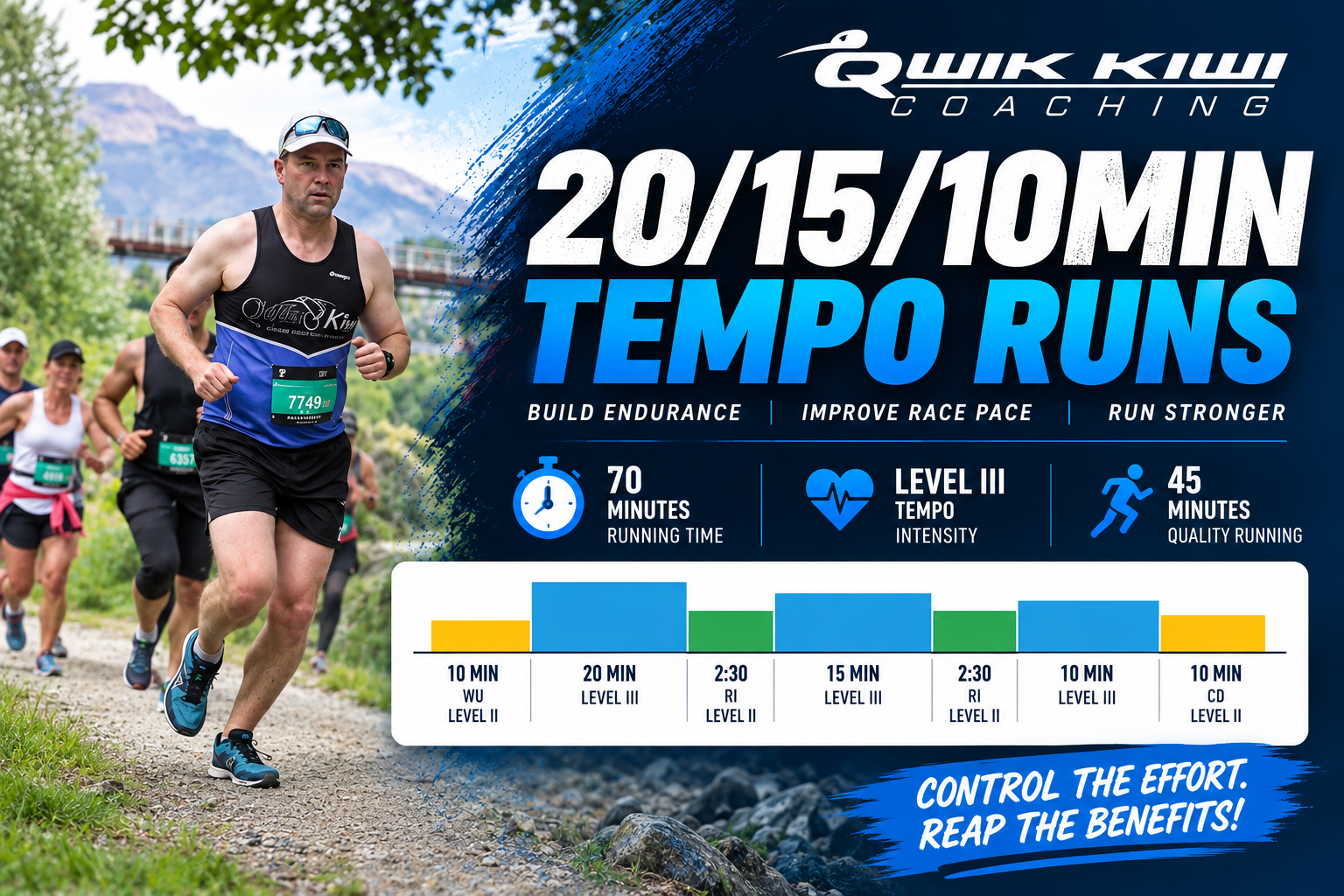
Coach Ray’s Workout of the Week: 20/15/10min Tempo Runs
As a half marathon approaches, training needs to become increasingly specific to the demands of race day. The aerobic fitness, running strength and threshold fitness developed earlier in the build-up now need to be converted into the ability to sustain the intensity required for the half marathon itself.
This week’s Coach Ray’s Workout of the Week is 20/15/10min Tempo Runs.
The workout contains three substantial blocks at Level III, beginning with 20 minutes, then 15 minutes, and finishing with 10 minutes. Between the first and second efforts, and again between the second and third, you get just 2:30 minutes at Level II.
That gives you 45 minutes of quality Level III running within a 70-minute run.
I primarily use this type of workout during the Final Quality (FQ) Phase of a half marathon build-up, when we are making the training intensity increasingly specific to half marathon race intensity.
The challenge isn’t to see how fast you can run each effort. It is to accumulate a substantial amount of controlled Level III running and develop the ability to maintain that quality as fatigue builds.
The Workout
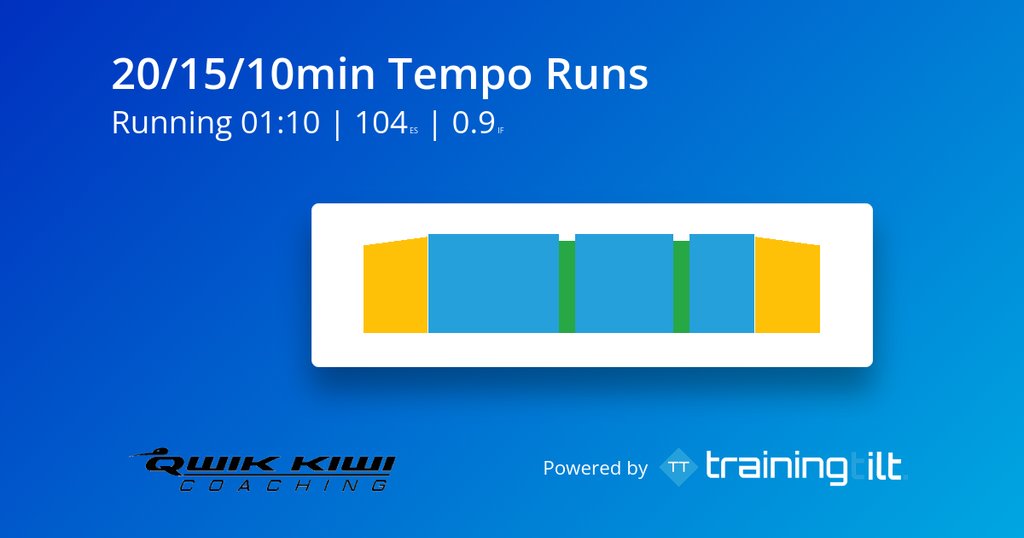
Warm-Up
- 10 minutes at Level II
Main Set
- 20 minutes at Level III
- 2:30 minutes at Level II recovery
- 15 minutes at Level III
- 2:30 minutes at Level II recovery
- 10 minutes at Level III
Cool-Down
- 10 minutes at Level II
- 10 minutes stretching
Why This Workout Works
Tempo running occupies an important place between your easier aerobic running and the harder threshold work used earlier in your half marathon build-up.
By the time I prescribe a workout such as 20/15/10min Tempo Runs, the objective isn’t simply to make you fitter.
We’re becoming more specific.
Level III allows you to settle into strong, sustained running at an intensity that is much closer to the demands of your half marathon than the shorter and harder quality sessions used earlier in your preparation.
This workout provides 45 minutes at Level III while breaking that workload into manageable sections.
The 20-minute opening effort requires patience.
The 15-minute second effort asks you to re-establish your rhythm after only a short aerobic recovery.
The final 10-minute effort then challenges you to continue producing quality running when you’ve already accumulated considerable work.
For a half marathon runner, this helps develop:
- Aerobic endurance
- Running economy
- Race-Pace Development
- Pace control
- Resistance to fatigue
- Mental resilience
Most importantly, you’re learning how to maintain strong, controlled running for a substantial period without allowing the intensity to creep unnecessarily higher.
Session Snapshot
| Goal | Develop sustained, race-specific running and the ability to maintain quality under fatigue |
| Running Duration | 70 minutes |
| Quality Running | 45 minutes |
| Intensity | Level III |
| Recovery | 2:30 minutes Level II |
| Training Phase | Final Quality (FQ) Phase |
| Best For | Half Marathon runners |
| Terrain | Flat to gently rolling |
| Equipment | Running shoes and watch/timer |
| Difficulty | Intermediate–Advanced |
| Session Type | Tempo |
How Hard Should Level III Feel?
Level III should feel strong, purposeful and controlled.
You’re well above the conversational intensity of Level II, but you’re not running at the comfortably hard threshold intensity of Level IV.
That distinction matters.
By the end of this workout, you’ll have accumulated 45 minutes at Level III. If you turn the opening 20-minute effort into Level IV because you’re feeling fresh, you’ve changed the workout and made the remaining repetitions unnecessarily difficult.
As we get closer to your half marathon, Level III is helping to dial in your race-specific intensity, utilising the fitness you’ve developed during the earlier phases of training.
The goal is not to prove how fit you are.
The goal is to train at the intensity prescribed.
Why 20, Then 15, Then 10 Minutes?
The descending structure is deliberate.
You complete your longest Level III effort while you’re relatively fresh, then progressively shorter efforts as fatigue accumulates.
But don’t mistake shorter for easier.
By the time the final 10-minute effort begins, you’ve already completed:
- 10 minutes at Level II
- 20 minutes at Level III
- 2:30 minutes at Level II
- 15 minutes at Level III
- 2:30 minutes at Level II
That’s 50 minutes of running before the final tempo effort even starts.
The decreasing repetition lengths allow you to continue accumulating high-quality Level III running despite that fatigue.
Psychologically, they also make the workout manageable.
Twenty minutes becomes 15.
Fifteen becomes 10.
Rather than facing one continuous 45-minute tempo effort, you can concentrate on executing one block at a time.
Why Only 2:30 Minutes Recovery?
The recoveries are deliberately short and completed at Level II.
You’re not trying to recover completely.
You simply back away from Level III, settle into your normal aerobic running intensity and give yourself a brief opportunity to regroup before returning to the next tempo effort.
That means the cardiovascular demand remains relatively high throughout the main set.
It also means the three Level III blocks aren’t completely independent efforts.
They form one substantial body of quality aerobic running.
For half marathon preparation, that’s exactly what we want.
You’re developing the ability to return to your race-specific intensity without requiring a lengthy recovery beforehand.
Don’t Race the First 20 Minutes
The opening repetition is the longest, but it’s also the one you’re most likely to get wrong.
You’re warmed up.
You’re fresh.
Level III feels good.
It can therefore be tempting to push the pace and convince yourself that a little faster must be a little better.
It isn’t.
Remember that you’ve got another 25 minutes of Level III running still to come.
The first 20 minutes should establish the standard you can maintain throughout the workout.
Settle into Level III and resist the temptation to drift towards Level IV.
If you’ve paced the workout properly, you should be capable of producing the same quality of running during the final 10-minute effort.
The Final 10 Minutes Matter
The final Level III block is the shortest effort of the workout, but it can also be the most valuable.
You’ve already accumulated 35 minutes of tempo running.
Your legs are no longer fresh.
Maintaining Level III now requires more concentration than it did during the opening effort.
This is where you practise maintaining your posture, cadence, rhythm and appropriate intensity despite accumulating fatigue.
Don’t turn the final 10 minutes into a race.
There is no need to progress to Level IV or finish with a Level V sprint.
The challenge is to remain at Level III.
If you can finish the final 10 minutes strongly and under control, you’ve executed the workout correctly.
Race Specificity Without Racing
One of the purposes of the Final Quality Phase is to make your training increasingly specific to your upcoming half marathon.
But race-specific doesn’t mean every workout becomes a race.
There is an important distinction.
You’re using Level III running to become familiar with the rhythm, concentration and sustained aerobic demand required during your half marathon.
You’re also learning to control that intensity.
That control is critical on race day.
Many half marathon runners lose time not because they couldn’t run fast enough, but because they used too much energy too early.
This workout rewards patience.
Start under control.
Settle into your rhythm.
Maintain the appropriate intensity.
Finish strongly.
Those are useful habits to take directly onto the start line.
Choosing the Right Route
A flat to gently rolling route works particularly well for 20/15/10min Tempo Runs.
The Level III sections are long enough that you’ll benefit from being able to settle into a consistent rhythm without frequent interruptions.
Good options include a:
- Quiet road
- Cycle path
- Waterfront or riverside route
- Park loop
- Non-technical trail
- Treadmill
Try to avoid routes with frequent road crossings, traffic lights or other obstacles that force you to stop during the tempo efforts.
Gentle hills are perfectly acceptable.
You don’t need a completely flat course, but remember to adjust your pace to maintain the correct Level III intensity as the terrain changes.
Run by Intensity, Not Just Pace
As your half marathon gets closer, it can become increasingly tempting to judge every workout against your intended race pace.
Be careful.
Your pace on any particular day can be influenced by wind, temperature, terrain, accumulated training fatigue and many other factors.
The workout is prescribed at Level III for a reason.
On a favourable day, Level III may result in a faster pace.
On a windy, warm or particularly fatigued day, the same Level III intensity may produce a slower pace.
That’s okay.
Use your pace, heart rate or running power where appropriate to help guide the workout, but don’t force an arbitrary GPS number at the expense of the prescribed intensity.
The purpose is to develop the physiological and pacing qualities required for your half marathon—not to win a training session.
Coaching Tips
Be Patient During the First 20 Minutes
Don’t spend energy unnecessarily simply because you’re fresh. Establish a sustainable Level III rhythm.
Use the Recoveries Properly
Return to Level II immediately. Keep running aerobically, allow your breathing to settle and prepare for the next effort.
Transition Smoothly
When each recovery finishes, smoothly increase the intensity back to Level III rather than suddenly sprinting into the next repetition.
Relax at Tempo Intensity
Keep your shoulders relaxed, maintain good posture and allow your cadence to remain natural.
Maintain the Same Intensity
The repetition duration changes. The prescribed intensity doesn’t.
Finish Strong, Not Fast
A well-executed final 10 minutes at Level III is more valuable than turning the end of the workout into an unscheduled Level IV or Level V effort.
Common Mistakes
Running the Opening 20 Minutes Too Hard
The workout contains 45 minutes of quality running. Don’t use all your enthusiasm during the first 20.
Turning Level III Into Level IV
Tempo isn’t threshold. Increasing the intensity changes the purpose and fatigue cost of the session.
Running the Recoveries Too Hard
The recovery is Level II. Allow yourself to return properly to your aerobic intensity.
Running the Recoveries Too Easy
Conversely, the recovery isn’t prescribed at Level I. Continue running at Level II so the aerobic demand of the session remains purposeful.
Chasing Pace Regardless of Conditions
Wind, hills and fatigue affect pace. Maintain Level III intensity.
Racing the Final 10 Minutes
The workout doesn’t finish at Level IV or Level V. Stay disciplined and finish at Level III.
How This Progresses From the 20/15 Tempo Runs
If you’ve previously completed 20/15 Tempo Runs, this workout represents a logical progression.
That session provides 35 minutes of Level III running.
20/15/10min Tempo Runs increases that to 45 minutes.
Importantly, the additional workload comes at the end.
You’re not making the opening efforts harder. Instead, you’re asking yourself to produce another 10 minutes of controlled Level III running after you’ve already completed the previous workload.
That’s a useful way to progress the session for an athlete who has developed the fitness to handle the additional training stress.
More isn’t automatically better, though.
The progression is appropriate when you’re able to complete the shorter version correctly and recover well enough for the remainder of your training programme.
When Should You Include This Workout?
I primarily use 20/15/10min Tempo Runs during the Final Quality (FQ) Phase of a half marathon build-up.
The earlier phases of training have different jobs.
During the Foundation & Injury Prevention (FI) Phase, we establish the aerobic fitness, consistency and resilience required to support the training that follows.
The Early Quality (EQ) Phase introduces structured quality and develops capabilities such as aerobic power, running strength and running economy.
During the Transition Quality (TQ) Phase, the quality becomes more demanding as we bridge the gap between general fitness and the increasingly race-specific training to come.
Then we reach Final Quality.
As your half marathon approaches, the intensity of your training becomes more specific to the intensity you’ll need on race day.
That’s where substantial Level III workouts such as this become particularly valuable.
Rather than continuing to chase harder and harder training, we’re taking the fitness developed earlier in the programme and teaching you to use it at an intensity increasingly relevant to your half marathon.
Coach Ray’s Verdict
20/15/10min Tempo Runs is a substantial half marathon workout.
Forty-five minutes of Level III running gives you plenty of opportunity to develop race-specific endurance, but the structure allows you to accumulate that workload without turning the session into one continuous effort.
The workout rewards discipline.
Keep the first 20 minutes controlled.
Use the 2:30-minute Level II recoveries properly.
Settle back into Level III for 15 minutes.
Then, when fatigue has accumulated, demonstrate that you can still produce another 10 minutes of strong, efficient, controlled running.
Don’t chase Level IV.
Don’t sprint the finish.
Run the intensity you’re supposed to run.
As race day approaches, the goal isn’t to continually prove your fitness.
It’s to prepare yourself to use that fitness when it matters.
Ready to Put Workouts Like This Into a Complete Half Marathon Plan?
A workout such as 20/15/10min Tempo Runs becomes most valuable when the training you’ve completed beforehand has prepared you for it—and when it is positioned appropriately within the rest of your programme.
Inside the NZ Half Marathon Hub+, training follows my periodised approach through the Foundation & Injury Prevention (FI), Early Quality (EQ), Transition Quality (TQ) and Final Quality (FQ) phases.
That means your training progresses from building the foundation through to increasingly specific half marathon preparation as race day approaches.






One Comment
Comments are closed.