Don’t Waste Your Legs on the Early Downhills
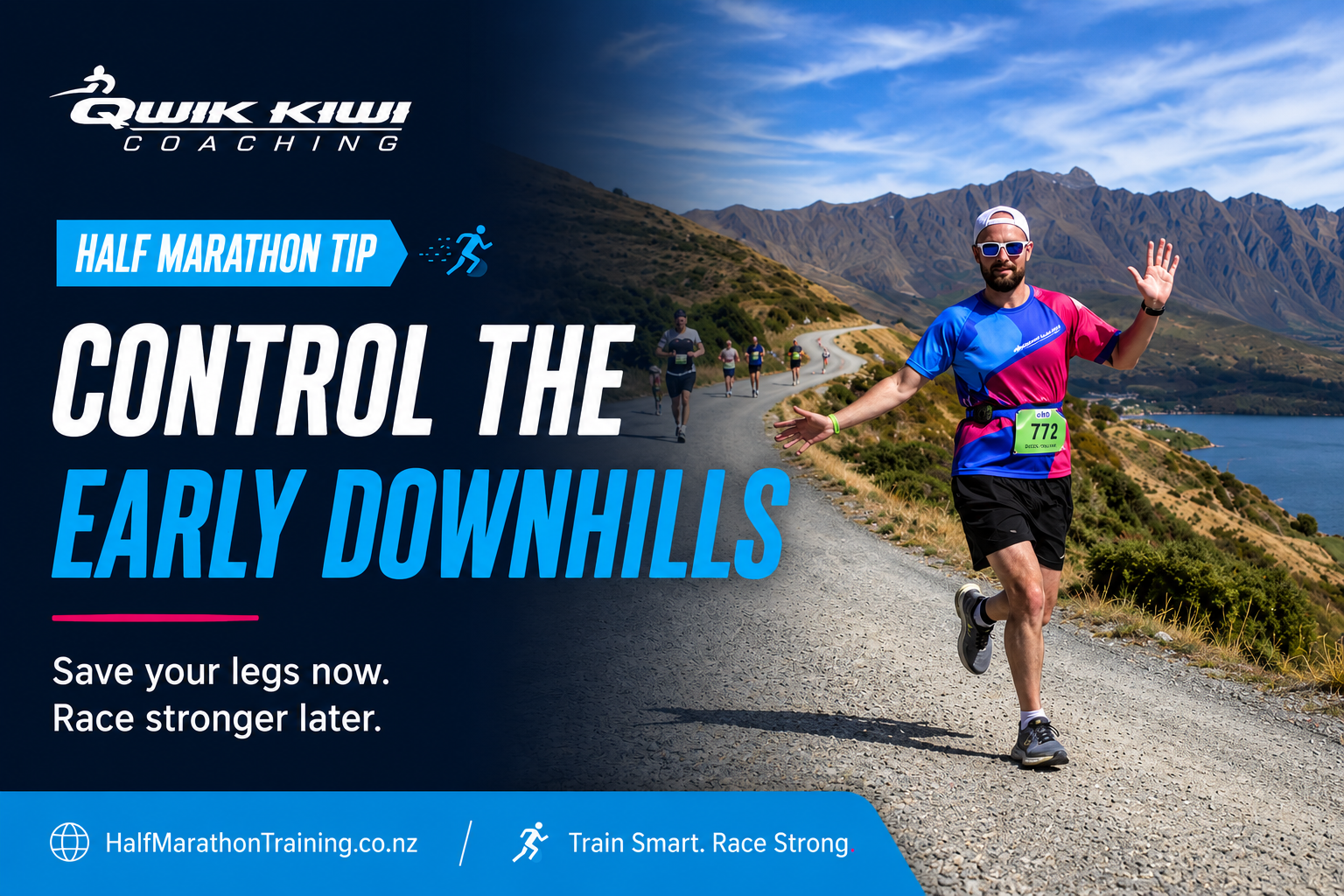
A downhill in the opening kilometres of a half marathon can feel like free speed.
Your legs are fresh. Your breathing is comfortable. Gravity is helping you along, and suddenly you’re running considerably faster than your planned race pace without feeling like you’re working any harder.
It’s tempting to take advantage of it.
After all, why not bank a little time while the running feels easy?
Because those fast early downhill kilometres might cost you far more later in the race than they save you now.
Downhill Running Isn’t Free
Running downhill generally requires less cardiovascular effort than running at the same speed on flat terrain.
That’s why it can feel so easy.
But your muscles are still working hard.
When you run downhill, your quadriceps in particular perform a large amount of eccentric muscle work—they’re working to control your body as you descend and absorb the impact of each stride.
If you attack a downhill aggressively, especially early in a half marathon, you can create muscular fatigue that isn’t immediately obvious.
Your heart and lungs might be telling you everything is fine.
Your legs could be accumulating a very different story.
And you may not discover that until much later.
Don’t Chase Your Average Pace
One of the problems with GPS watches is that they encourage runners to become obsessed with maintaining an exact pace every kilometre.
Suppose you’re targeting 5:00 minutes per kilometre for your half marathon.
You reach an early downhill and suddenly see 4:40/km on your watch.
It feels fantastic.
You might even think:
“I’ll take those 20 seconds and put them in the bank.”
But there’s no requirement for every kilometre of a half marathon to be run at exactly the same pace.
Your goal is to distribute your effort intelligently across the entire 21.1 kilometres.
On a hilly course, that means allowing your pace to change with the terrain.
Let the Hill Give You Speed—Don’t Force It
I’m not suggesting you should put the brakes on every downhill.
That’s inefficient too.
Instead, relax and let gravity do some of the work.
Keep your cadence flowing.
Avoid dramatically lengthening your stride.
Stay relaxed through your shoulders and upper body.
Let your pace naturally increase without deliberately attacking the descent.
There’s an important difference between running faster because you’re going downhill and actively pushing harder to run downhill faster.
Early in a half marathon, you generally want the first one.
The Steeper the Descent, the More Important Control Becomes
A gentle downhill can be an excellent opportunity to settle into a smooth rhythm.
A steep descent is different.
The faster you run, the more aggressively your legs have to manage the forces involved with each foot strike.
This is particularly important if your target half marathon has substantial downhill sections.
If that’s the case, downhill running should be something you prepare for during training.
Your legs need experience handling the specific muscular demands of descending.
Don’t wait until race day to discover what several kilometres of downhill running does to your quadriceps.
Think About What Comes Next
Whenever you encounter a significant downhill during a race, ask yourself:
What happens after this?
If there’s a climb immediately afterwards, attacking the descent could leave your legs unnecessarily fatigued before the harder part of the course.
If the downhill comes in the opening 5 kilometres, you’ve still got a very long way to run.
And if you’re racing a course with several climbs and descents, managing each one becomes part of your overall race strategy.
Don’t evaluate a downhill in isolation.
Think about where it sits within the entire course.
Early Restraint Creates Late-Race Opportunities
This comes back to one of the most important principles of half marathon racing:
You don’t need to prove how fit you are in the opening kilometres.
Your opportunity to race comes later.
If you reach 16 kilometres with strong legs, you can start increasing your effort.
You can chase runners ahead of you.
You can maintain your pace while others begin slowing.
You can make decisions based on how you’re feeling rather than simply trying to survive to the finish.
That’s far more valuable than saving 20 or 30 seconds by attacking an early descent.
Practise Downhill Running in Training
If your target race has significant downhill sections, prepare specifically for them.
That doesn’t mean sprinting down every hill you encounter.
Include controlled downhill running within selected training sessions so you can practise maintaining good technique while gradually developing the muscular resilience required for race day.
Course knowledge helps too.
Study the elevation profile before your event and identify where the major descents occur. That allows you to decide in advance where you’ll stay controlled and where, later in the race, you might be prepared to take advantage of the terrain.
You want those decisions made before race day—not while adrenaline is encouraging you to do something you’ll regret 15 kilometres later.
Final Thoughts
Early downhills are one of the easiest places to get carried away in a half marathon.
You feel fantastic.
Your pace looks brilliant.
And the effort seems almost effortless.
That’s precisely why you need discipline.
Let gravity help you, but don’t attack the descent simply because you’re feeling good.
Control the early downhills.
Protect your legs.
Save the racing for later.
Because nobody gets a prize for having the fastest first 5 kilometres if they’re walking through the final five.
Want a Race Strategy That Matches Your Course?
Every half marathon course presents different challenges. Hills, descents, surface, weather and the location of aid stations can all influence how you should approach race day.
If you’d like help developing your training and pacing strategy for your next half marathon, book a free, no-obligation 40-minute coaching consultation.
We can look at the race you’re preparing for, your current fitness and your goals, and discuss how to structure your training so you’re prepared for the course—not just the distance.
Book your free 40-minute consultation: