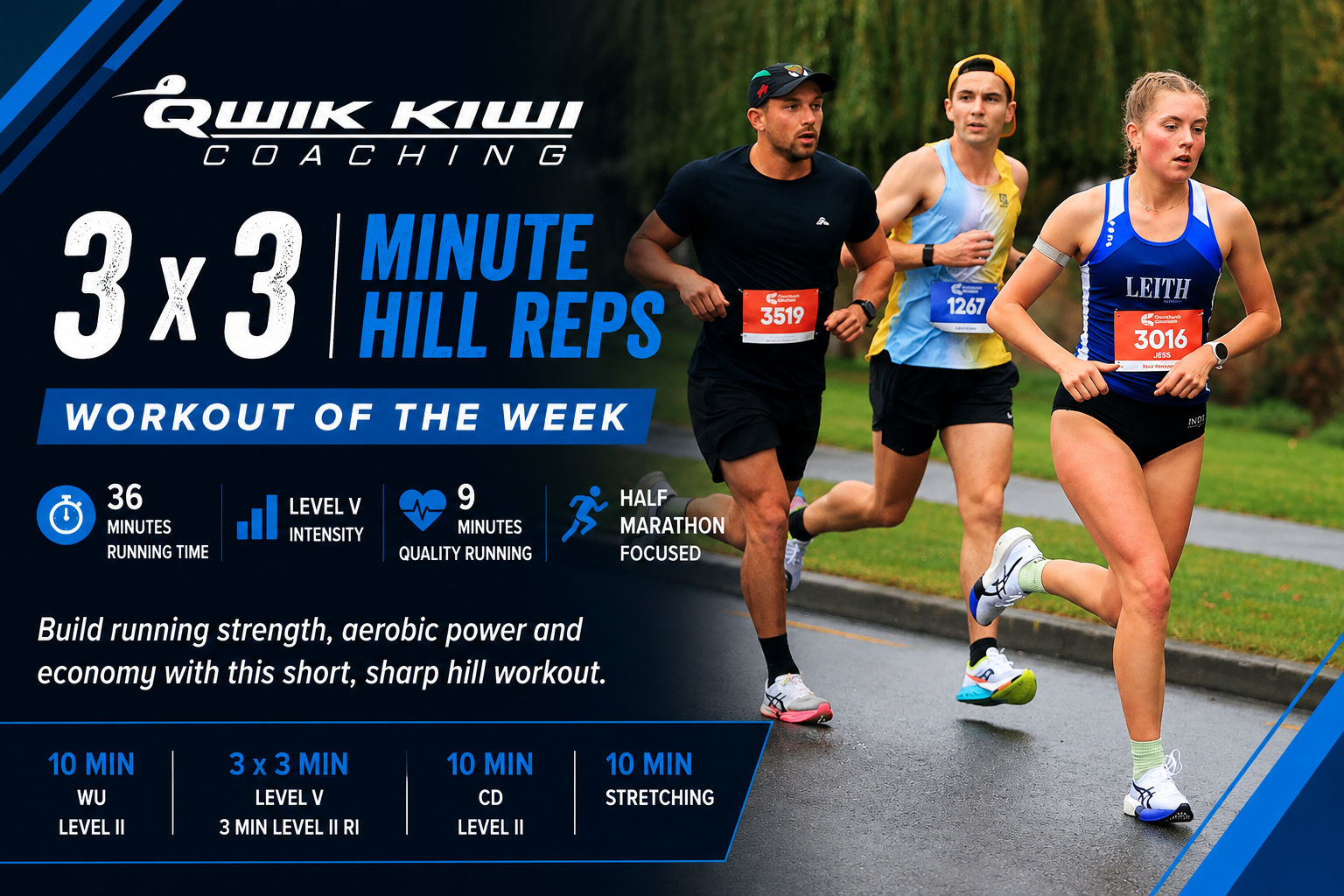
Coach Ray’s Workout of the Week: 3×3 Minute Hill Reps
Hill repetitions are one of my favourite ways to develop running-specific strength and aerobic power without needing to chase an exact pace on your watch.
This week’s Coach Ray’s Workout of the Week is 3×3 Minute Hill Reps. After warming up, you’ll complete three three-minute uphill efforts at Level V, with three minutes of easy Level II recovery between repetitions.
It’s a relatively small amount of high-intensity running—just nine minutes at Level V—but when those nine minutes are completed on a suitable hill and at the correct intensity, they can provide a powerful training stimulus for a half marathon runner.
I would primarily use a session like this during the Early Quality (EQ) Phase, where hill repetitions can help develop the strength, aerobic power and running economy that you’ll draw upon during the more race-specific phases of your half marathon preparation.
The Workout
Warm-Up
- 10 minutes at Level II
Main Set
3×:
- 3 minutes uphill at Level V
- 3 minutes at Level II recovery
Cool-Down
- 10 minutes at Level II
- 10 minutes stretching
Running Duration: 36 minutes
Total Session Duration Including Stretching: 46 minutes
Why This Workout Works
Running uphill changes the demands placed on your body.
Compared with running at the same effort on flat terrain, climbing requires greater force production while naturally encouraging a strong running posture, purposeful arm action and powerful drive through the legs.
Combine that with Level V intensity, and you have a workout that develops both running-specific strength and aerobic power.
For half marathon runners, this is useful because your performance isn’t determined solely by your ability to maintain race pace. The fitness developed earlier in the programme provides the foundation that allows you to run efficiently and sustain stronger running later.
This workout helps develop:
- Aerobic power
- Running strength
- Running economy
- Speed
- Technique
- Mental resilience
The aim isn’t simply to get to the top of the hill as quickly as possible. You’re looking for three high-quality efforts completed at the correct intensity while maintaining good running form.
Session Snapshot
| Goal | Develop aerobic power, running-specific strength and running economy |
| Running Duration | 36 minutes |
| Total Session Duration | 46 minutes including stretching |
| Quality Running | 9 minutes |
| Intensity | Level V |
| Training Phase | Early Quality (EQ) Phase |
| Best For | Half Marathon runners |
| Terrain | Moderate, runnable hill |
| Equipment | Running shoes and watch/timer |
| Difficulty | Intermediate |
| Session Type | Hill Repetitions |
How Hard Should Level V Feel?
Level V is very hard, VO₂ Max-intensity running.
You should know you’re working hard relatively early in each three-minute repetition. Your breathing will become heavy, conversation isn’t realistic, and the final part of each effort should require concentration.
But there’s an important distinction between very hard and all-out.
These aren’t three-minute sprints.
If you attack the first repetition so aggressively that your pace collapses during the second and third efforts, you’ve gone too hard.
The aim is to produce three strong, consistent repetitions.
Your third repetition should still resemble your first in terms of running form and overall performance.
Why Three-Minute Repetitions?
Three minutes is long enough to place substantial demand on your aerobic system while remaining short enough that you can maintain a high-quality Level V effort.
The hill adds another dimension.
Rather than simply running fast on the flat, you’re working against gravity. Your calves, quadriceps, hamstrings and glutes all contribute to propelling you uphill while your cardiovascular system is being challenged by the Level V intensity.
With only three repetitions, the workout isn’t about accumulating a huge volume of hard running.
It’s about quality.
Nine well-executed minutes of uphill Level V running can provide plenty of stimulus without creating unnecessary fatigue.
Choosing the Right Hill
The hill you choose can make or break this workout.
You’re looking for a hill that allows you to run continuously for the full three minutes.
Ideally, it should have a moderate and relatively consistent gradient.
If the hill is too shallow, you lose some of the strength benefit.
If it’s excessively steep, your running mechanics can deteriorate and the workout can become more about surviving the gradient than running strongly.
Look for somewhere that allows you to:
- Run continuously for at least five minutes
- Maintain good running form
- Run safely at Level V
- Recover without dealing with traffic
- Repeat approximately the same section each time
You don’t need to find the steepest hill in town.
You need a runnable hill.
What Should the Three-Minute Recovery Feel Like?
The recovery is Level II, so make it genuinely easy.
Depending on the hill and your surroundings, this may involve jogging back downhill towards your starting point.
The purpose of the recovery is to allow your breathing to settle and prepare you to produce another high-quality Level V repetition.
Don’t race the recovery.
There is no benefit in trying to prove how quickly you can get back down the hill.
Run easily, stay relaxed and use the three minutes to prepare for the next effort.
If your descent takes slightly less or slightly more than three minutes because of the hill you’ve selected, that’s not something to become overly concerned about. The priority is recovering appropriately and beginning the next repetition ready to run well.
Run by Effort, Not Uphill Pace
Your pace during these repetitions will almost certainly be slower than your Level V pace on flat terrain.
That’s exactly what you’d expect.
Don’t look at your watch and try to force your normal Level V pace while climbing.
Level V describes the intensity—not the number displayed on your GPS watch.
The gradient, surface, wind and even where the hill becomes steeper will influence your pace.
Concentrate instead on maintaining the appropriate effort and strong running mechanics.
Focus on Good Uphill Technique
Hill repetitions provide an excellent opportunity to reinforce good running mechanics.
Think about:
Run Tall
Avoid folding excessively forward from the waist as the hill gets harder. Maintain a strong posture with a slight forward lean coming naturally from the ankles.
Use Your Arms
Your arm action helps drive your running rhythm. As the gradient increases, allow your arms to work purposefully without creating unnecessary tension through your shoulders.
Keep Your Steps Purposeful
Don’t deliberately reach forward with a long stride.
Allow your stride to shorten naturally while maintaining a strong cadence.
Drive Up the Hill
Think about pushing the ground away beneath you rather than reaching up the hill.
Stay Relaxed
Level V is hard enough without wasting energy through clenched fists, raised shoulders or unnecessary upper-body tension.
Coaching Tips
Don’t Race the First Rep
The first repetition establishes the workout. Start at Level V, but don’t attack the hill as though it’s a three-minute time trial.
Aim for Consistency
If you’re using the same section of hill each time, note roughly where you finish each repetition.
You don’t need to hit exactly the same spot, but large reductions in distance can indicate that you started too hard.
Respect the Recovery
Three minutes of Level II running gives you the opportunity to produce another quality effort. Use it.
Maintain Technique Under Fatigue
The final minute of each repetition is where the workout becomes particularly valuable. Continue running strongly rather than allowing fatigue to destroy your posture and technique.
Finish Strong, Not Desperate
The third repetition should be hard, but you shouldn’t need an all-out sprint over the final 20 seconds.
Common Mistakes
Choosing a Hill That’s Too Steep
Steeper isn’t automatically better.
An excessively steep hill can substantially change your mechanics and make it difficult to maintain the intended running intensity.
Sprinting the First Minute
Three minutes is a long time when you’re running uphill at Level V. Pace the repetition appropriately from the beginning.
Chasing Pace
Your flat-running pace is largely irrelevant here. Run according to effort.
Jogging the Recovery Too Hard
The recovery isn’t part of the competition. Keep it at Level II.
Allowing Technique to Collapse
If you’re hunched over and struggling simply to keep moving, either the hill is too steep or you’ve run too hard.
Variations
Developing Runner
2×:
- 3 minutes Level V uphill
- 3 minutes Level II recovery
This provides 6 minutes of Level V running.
Standard Workout
3×:
- 3 minutes Level V uphill
- 3 minutes Level II recovery
This provides 9 minutes of Level V running.
Experienced Runner
4×:
- 3 minutes Level V uphill
- 3 minutes Level II recovery
This increases the Level V workload to 12 minutes while retaining the same structure.
Don’t assume that more is automatically better. The appropriate version depends on the runner, their training history and where the workout sits within their overall programme.
When Should You Include This Workout?
I would primarily use 3×3 Minute Hill Reps during the Early Quality (EQ) Phase of half marathon preparation.
During the Foundation & Injury Prevention (FI) Phase, the priority is establishing the consistency, aerobic fitness and resilience required to tolerate the quality training that follows.
As we move into Early Quality, we can begin developing capabilities such as aerobic power, running strength and running economy through workouts like hill repetitions.
At this stage, the training doesn’t need to closely resemble half marathon race intensity.
Instead, we’re developing some of the underlying physical qualities that can make you a stronger runner.
As you subsequently progress through the Transition Quality (TQ) Phase and Final Quality (FQ) Phase, the emphasis increasingly shifts towards training that is specific to the demands of your half marathon.
That is why a short, hard hill workout like this fits particularly well earlier in the quality-training progression.
Coach Ray’s Verdict
3×3 Minute Hill Reps is short, simple and effective.
Don’t underestimate it because there are only three repetitions.
When each one involves three minutes of controlled Level V running uphill, you’re creating a significant stimulus for both your cardiovascular system and running-specific strength.
The secret is execution.
Find a runnable hill. Don’t sprint the first repetition. Maintain strong technique. Recover properly. Then aim to make your third repetition every bit as good as your first.
Nine minutes of quality work performed correctly is considerably more valuable than adding extra repetitions after your technique and intensity have started falling apart.
Ready to Put Workouts Like This Into a Complete Half Marathon Plan?
A good workout can improve your fitness. A well-structured training programme determines when that workout should be used and how it complements everything else you’re doing.
Inside the NZ Half Marathon Hub, training follows my periodised approach through the Foundation & Injury Prevention (FI), Early Quality (EQ), Transition Quality (TQ) and Final Quality (FQ) phases.
Sessions such as 3×3 Minute Hill Reps can therefore be positioned during the Early Quality phase to develop the aerobic power, strength and running economy you’ll draw upon as training becomes increasingly specific to your half marathon.
You’ll also have access to structured half marathon training plans, fortnightly coaching calls and ongoing coaching support as you prepare for your next 21.1 km.
Join the NZ Half Marathon Hub+:
NZ Half Marathon Hub+




One Comment
Comments are closed.