Half Marathon Hub Weekly: Results, Training & What’s Coming Up | 17 August 2026
Kia ora and welcome to another Half Marathon Hub Weekly, your Monday round-up of what’s happening across the New Zealand half marathon scene.
This week we’ve got results from three very different half marathons around the country, plus the results we were waiting on from Auckland last weekend.
On the training side, we’re looking at a deceptively challenging tempo workout, breaking down my Level I–V running intensity system, and exploring one of the most important — but often overlooked — aspects of half marathon preparation: your mental strategy.
We’ve also reached an important point for anyone targeting two significant South Island events. Our 12-week Queenstown Half Marathon and 16-week Canterbury Half Marathon training programmes begin next Monday, 24 August.
And looking ahead to this weekend, the half marathon calendar is unusually quiet, with the Forest Run Fest in Christchurch taking centre stage.
Let’s get into it.
🏁 Weekend Half Marathon Results
Otago Ale Trail Half Marathon
We’ll start with the Otago Ale Trail, where there was some close racing at the front of the men’s field.
Men
- Max Watson — 1:23:14
- Bryce Steele — 1:24:05
- Aaron Eyles — 1:26:51
Only 51 seconds separated Max Watson and Bryce Steele at the finish, with Aaron Eyles completing the podium a little under three minutes later.
Women
- Tahlia Roome — 1:29:42
- Elisa Maierl — 1:42:32
- Kylie McClay — 1:43:15
Tahlia Roome produced a strong performance to take the women’s victory in under 90 minutes, while there was a close battle behind her with only 43 seconds separating Elisa Maierl and Kylie McClay.
Congratulations to everyone who took on the Otago Ale Trail.
Te Miro Tussle Trail Run
We also had the Te Miro Tussle Trail Run, where the terrain presented a very different half marathon challenge.
As we’ve discussed previously in the Hub, finishing times from trail half marathons shouldn’t necessarily be compared directly with road performances. Elevation, surface and technical terrain can dramatically change what 21 kilometres demands from a runner.
Men
- Barnes Tom — 1:35:23
- Samuel Bremer — 1:37:54
- Tom Woutersen — 1:46:59
At the time of preparing this Hub, the results list the men’s winner as Barnes Tom, so I’ve retained the name as it appears in the results.
Women
- Maria Bentley — 2:03:37
- Scarlett Anderson — 2:07:30
- Georgia Perry — 2:10:38
Congratulations to everyone who tackled the trails at Te Miro.
Woodbourne Half Marathon
At the Woodbourne Half Marathon, David Dawkin led home a competitive men’s podium.
Men
- David Dawkin — 1:25:08
- Bill Small — 1:26:38
- Alex Robertson — 1:28:38
Women
- Tess Wells — 1:43:37
- Mary Lister — 1:48:19
- Tori Armstrong — 1:49:06
Congratulations to David and Tess on their victories and to everyone who completed the half marathon.
🏁 Catching Up: Sri Chinmoy Auckland Series Race 6
Last Monday, the results from Sri Chinmoy Auckland Series Race 6 at Auckland Domain were still being finalised.
Rather than publish provisional results, we held them over until this week’s Hub.
We can now catch up on the podium from the 9 August race.
Men
- Ewan Morris — 1:31:14
- Mark Andrew — 1:34:18
- Rexhep Ajvazaj — 1:38:05
Women
- Kirsten Milne — 1:47:37
- Larissa Wildsmith — 1:59:15
- Lisa Harris — 2:06:06
Congratulations to everyone who raced at Auckland Domain.
📩 Get the Half Marathon Hub Weekly in Your Inbox
Want the latest NZ half marathon results, upcoming races, training advice and workouts delivered to you each Monday?
Join the FREE Half Marathon Hub Weekly and you won’t have to remember to come looking for the next edition.
👉 Get the Weekly Hub every Monday:
🏃 Training Focus: The 20/15 Tempo Run
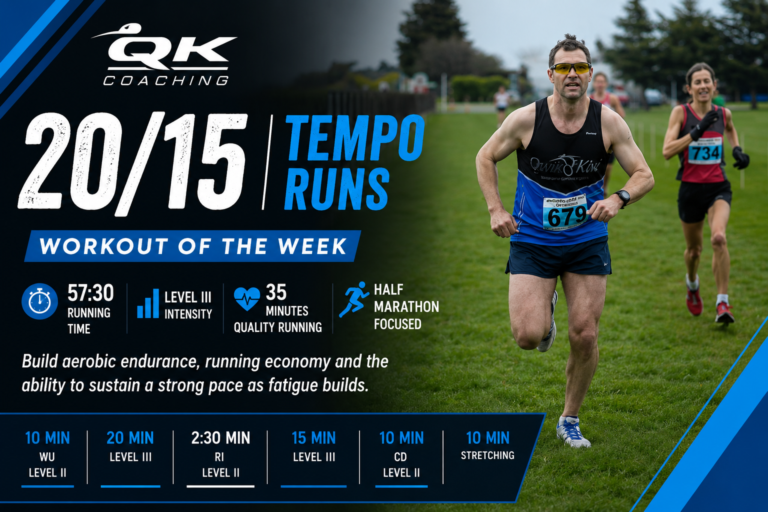
This week’s featured workout is the 20/15 Tempo Run.
It’s a beautifully simple session:
After warming up, you complete a sustained 20-minute Level III tempo effort, recover, and then follow it with another 15 minutes at Level III.
Simple doesn’t necessarily mean easy.
The challenge is maintaining a controlled, sustainable effort throughout both blocks rather than allowing the workout to become progressively harder simply because you’re feeling good.
Tempo Doesn’t Mean Racing
One of the easiest mistakes to make during a tempo session is running too hard.
Level III is moderate/tempo intensity.
You’re working harder than during your normal Level II aerobic running, but you’re still well below the intensity we’d target during threshold or VO₂ max training.
That’s deliberate.
The purpose isn’t to see how quickly you can cover 20 minutes.
We’re trying to accumulate a substantial period of quality aerobic running while remaining controlled.
That distinction becomes particularly important during the first block.
If you turn the opening 20 minutes into a threshold effort, the final 15 minutes can become a battle for survival.
Instead, aim to finish the first block knowing you’ve worked but also knowing you have another quality effort available.
Why Tempo Running Matters for the Half Marathon
The half marathon rewards the ability to sustain a strong aerobic effort for a long time.
Tempo running helps bridge the gap between your comfortable aerobic running and the harder threshold work you’ll perform elsewhere in your programme.
It develops your ability to run efficiently at a moderately demanding intensity without producing the recovery cost of a much harder workout.
That makes it particularly useful as we progress towards more race-specific half marathon training.
👉 Read the full workout:
https://www.halfmarathontraining.co.nz/workout-20-15-tempo-runs/
🎚️ Understanding Running Intensity: My Level I–V System
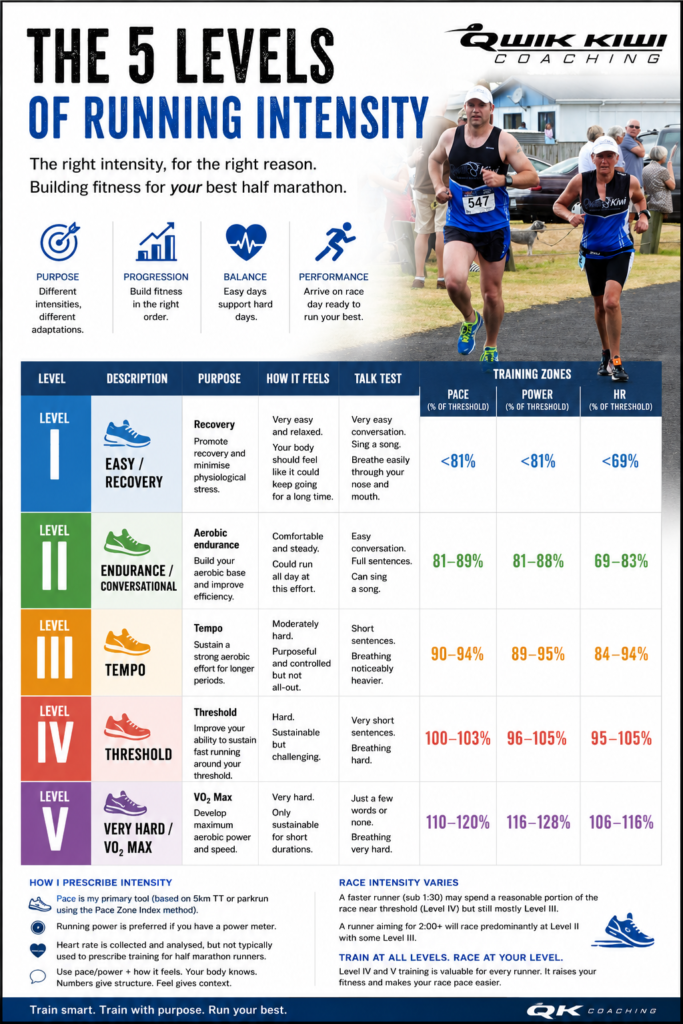
That leads nicely into a subject that underpins virtually every workout I prescribe: running intensity.
You’ll regularly see me describe training using Level I, Level II, Level III, Level IV and Level V.
Those levels aren’t arbitrary labels.
Each represents a different training intensity and, importantly, a different purpose.
Level I — Recovery
Level I is very easy running.
This is about recovery, circulation and movement rather than creating another substantial training stimulus.
There should be absolutely no ego involved here.
Easy means easy.
Level II — Aerobic Endurance
Level II forms the backbone of most half marathon training.
It’s comfortable, conversational running that allows us to develop aerobic endurance while keeping the recovery cost manageable.
Your long runs and much of your regular aerobic running will sit here.
And that’s important because one of the biggest mistakes runners make is turning their easy running into moderate running.
Level III — Moderate/Tempo
Level III is where this week’s 20/15 Tempo Run sits.
You’re now working noticeably harder, but the effort remains controlled.
Tempo training helps improve your ability to sustain a stronger aerobic effort and forms an important bridge between comfortable endurance running and harder quality work.
Level IV — Threshold
Level IV takes us into comfortably hard territory.
Conversation becomes difficult, breathing is significantly elevated, and we’re deliberately working close to your threshold.
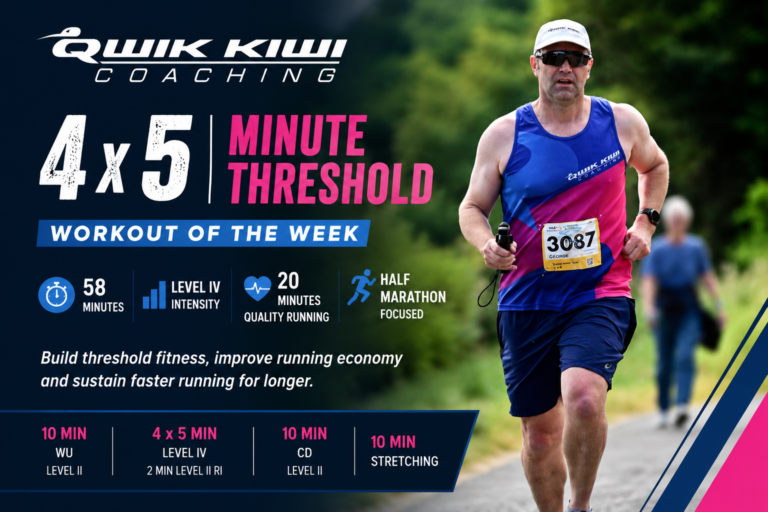
This is where sessions such as the 4 × 5-minute threshold workout we’ve recently featured belong.
Level V — Very Hard/VO₂
Level V is very hard running.
These efforts are shorter because the intensity is substantially higher.
We’re targeting aerobic power and VO₂ max rather than simply accumulating more moderate running.
Why the Differences Matter
Here’s the important part:
Higher isn’t automatically better.
If your programme says Level II, running at Level III doesn’t mean you’ve improved the workout.
If it says Level IV, pushing into Level V doesn’t mean you’ve earned extra fitness.
You’ve changed the training stimulus.
Good training isn’t about running as hard as possible whenever you feel capable of doing so.
It’s about applying the right intensity to the right session at the right stage of your programme.
👉 Learn more about the Level I–V system:
https://www.halfmarathontraining.co.nz/running-intensity-levels/
🧠 Your Half Marathon Is Mental Too
We spend a lot of time preparing the body for 21.1 kilometres.
Long runs.
Tempo sessions.
Threshold work.
Easy mileage.
Strength.
Recovery.
But there’s another part of half marathon preparation that deserves attention:
What are you going to do when the race becomes difficult?
Because at some point, it probably will.
Don’t Wait Until You’re Struggling
Mental strategy shouldn’t begin at kilometre 18 when your legs are hurting.
Think about it before race day.
There will almost certainly be moments when maintaining your pace becomes uncomfortable, your confidence dips, or the finish suddenly feels much further away than you’d like.
Having a strategy gives you something productive to focus on when that happens.
Break 21.1km Into Smaller Pieces
Twenty-one kilometres can feel intimidating when you’re already tired.
The next kilometre is much more manageable.
Instead of constantly thinking about how far remains, break the race into smaller sections.
Get to the next kilometre marker.
Get to the next aid station.
Get to the top of the hill.
Catch the runner 50 metres ahead.
Then reset and choose the next target.
You’re still covering exactly the same 21.1 kilometres, but mentally you’re dealing with a series of smaller challenges.
Control What You Can Control
You can’t control the weather.
You can’t control what other runners do.
You can’t make a hill disappear.
And you can’t change the kilometres you’ve already run.
You can control your effort.
You can control your fuelling.
You can control your form.
And you can control how you respond when things become difficult.
Put your attention there.
Expect Difficult Moments
A difficult patch doesn’t automatically mean your race is falling apart.
Sometimes you simply need to work through it.
Instead of thinking:
“I can’t hold this for another eight kilometres.”
Bring your focus back to what you’re doing now.
Relax the shoulders.
Check your posture.
Keep your cadence going.
Take your fuel when planned.
Get through this kilometre.
Then reassess.
Mental resilience isn’t pretending the race doesn’t hurt.
It’s having a useful response when it does.
👉 Read more about half marathon mental strategy:
https://www.halfmarathontraining.co.nz/half-marathon-mental-strategy/
🏔️ 12 Weeks to Queenstown: Training Starts Next Monday
If the Queenstown Half Marathon is your goal race, your 12-week countdown begins next week.
The 2026 Queenstown Half Marathon takes place on Saturday, 14 November, covering 21.1km from Coronet Fields/Queenstown Polo to the Queenstown Recreation Ground.
Starting Monday, 24 August, all five of our dedicated Queenstown 12-week programmes will be available through Hub+:
Queenstown • Starter • 12 Weeks
Queenstown • Builder • 12 Weeks
Queenstown • Improver • 12 Weeks
Queenstown • Performance • 12 Weeks
Queenstown • Elite • 12 Weeks
Whether you’re preparing for your first half marathon, looking to improve on a previous performance or chasing a significant PB, there’s a programme designed for where you are now and what you’re aiming to achieve in Queenstown.
Twelve weeks might sound like plenty of time.
But those weeks disappear quickly.
If Queenstown is your goal, this is the week to get organised so you’re ready to begin next Monday.
🏃 16 Weeks to the Canterbury Half Marathon
Queenstown isn’t the only important training countdown beginning next week.
Our 16-week Canterbury Half Marathon programmes also start on Monday, 24 August.
The Canterbury Half Marathon takes place at Pegasus on Sunday, 13 December 2026. The event caters for runners, walkers and hybrid run/walk participants over the half marathon distance.
Again, all five Hub+ levels are available:
Canterbury • Starter • 16 Weeks
Canterbury • Builder • 16 Weeks
Canterbury • Improver • 16 Weeks
Canterbury • Performance • 16 Weeks
Canterbury • Elite • 16 Weeks
Sixteen weeks gives us an excellent opportunity to build progressively.
Rather than rushing immediately into race-specific training, we have time to establish the foundations, develop the appropriate qualities through each phase of training, and gradually become more specific as race day approaches.
If Canterbury is your December goal, your structured build starts next Monday.
➡️ Join Hub+
Hub+ gives you access to the event-specific programme that matches both your goal race and your current training level.
Starter • Builder • Improver • Performance • Elite
👉 Join Hub+:
https://www.coachraytraining.co.nz/signup/nz-half-marathon-hub
🌲 Coming Up This Weekend: Forest Run Fest
After several busy weekends around the country, the New Zealand half marathon calendar is considerably quieter this week.
The event to watch is the Forest Run Fest, taking place at Bottle Lake Forest in Christchurch on Sunday, 23 August.
The event offers four distances, with The Big One covering 21km alongside 10km, 5.5km and 2km options. The organisers welcome both runners and walkers, with the 21km scheduled to start at 8:30am.
Bottle Lake gives runners a very different challenge from a conventional road half marathon.
And that brings us back to something we’ve talked about regularly in the Hub:
Run the course you’re actually racing.
Don’t become obsessed with maintaining the same kilometre pace regardless of what’s underneath your feet or what the terrain is doing.
On trails, effort is often a much more useful guide.
If you’re racing Forest Run Fest this weekend, the fitness work is essentially done.
There’s very little meaningful fitness you can gain between now and Sunday — but there’s plenty of unnecessary fatigue you can create.
Keep the final few days controlled.
Arrive with fresh legs.
And give yourself the opportunity to race the second half rather than simply survive it.
Good luck to everyone heading to Bottle Lake Forest.
🎯 This Week’s Takeaway
If there’s one theme connecting this week’s training advice, it’s control.
Control your intensity during your tempo sessions.
Understand the difference between Level I, Level II, Level III, Level IV and Level V rather than treating every workout as another opportunity to run harder.
And when race day gets difficult, control what you can control rather than wasting mental energy on everything you can’t.
Good half marathon training isn’t built from one spectacular workout.
And a good half marathon isn’t decided by one spectacular kilometre.
It’s the accumulation of appropriate decisions made consistently over time.
📩 Don’t Miss Next Week’s Half Marathon Hub
Every Monday, the Half Marathon Hub Weekly brings together the latest New Zealand half marathon results, upcoming races, practical training advice, featured workouts and coaching insights from Coach Ray.
Rather than trying to remember to check back each week, have the next edition delivered straight to your inbox.
It’s completely free.
👉 Join the FREE Half Marathon Hub Weekly:
https://qwik-kiwi.kit.com/432466e7f7
We’ll see you in your inbox next Monday.
➡️ Coming Next Week
Next Monday we’ll be back with the results from the Forest Run Fest in Christchurch, more practical half marathon training advice, another featured workout and a look at what’s coming up around New Zealand.
It will also be Day One for runners beginning our:
🏔️ 12-week Queenstown Half Marathon programmes
and
🏃 16-week Canterbury Half Marathon programmes.
If you’re following one of those plans, the journey to race day starts next Monday.
For more half marathon training advice, workouts, race guides and the weekly New Zealand half marathon round-up, visit:
www.HalfMarathonTraining.co.nz
Until next week, train smart, stay consistent and enjoy your running.