Half Marathon Hub Weekly: World-Class Racing, Strong Finishes & Building Better Half Marathon Runners | 21 September 2026
What a weekend for half marathon running.
Around New Zealand we had racing from the roads of Cambridge, Hutt and Hatuma through to the trails around Lake Tekapo and Te Āpiti. We’ve also finally got the results from the previous weekend’s Sri Chinmoy Auckland Half Marathon.
But the biggest half marathon story this week came from Copenhagen.
The World Athletics Road Running Championships produced extraordinary performances at the front of both races. Sweden’s Andreas Almgren won the men’s world title in a European record of 58:06, while Kenya’s Agnes Jebet Ngetich won the women’s title in a women-only world record of 1:05:15. (World Athletics)
And amongst that world-class field were some very good New Zealand performances.
Let’s get into this week’s Half Marathon Hub Weekly.
World Half Marathon Championships — Copenhagen
We’ll start internationally this week because these performances deserve it.
Men
Sweden’s Andreas Almgren became world half marathon champion with a brilliant 58:06, setting a European record in the process.
The podium was:
- Andreas Almgren (Sweden) — 58:06
- Nicholas Kipkorir (Kenya) — 58:11
- Joshua Cheptegei (Uganda) — 58:26
Only 20 seconds separated the three medallists, with Cheptegei recording a personal best. (World Athletics)
The depth of this race puts the New Zealand performances into perspective.
Toby Gualter ran 1:03:25 and finished 71st. Think about that for a moment: a 63-minute half marathon was good enough for 71st at a World Championship.
New Zealand’s other men’s performances were William Little — 1:04:34, 86th; Connor Melton — 1:05:11, 91st; and Taonga Mbambo — 1:05:38, 96th. New Zealand finished 18th in the men’s team competition. (World Athletics)
Women
The women’s race produced something even more significant.
Kenya’s Agnes Jebet Ngetich won in 1:05:15, setting a women-only world record.
The podium was:
- Agnes Jebet Ngetich (Kenya) — 1:05:15
- Veronica Loleo (Kenya) — 1:06:05
- Florence Niyonkuru (Rwanda) — 1:06:08
Niyonkuru’s bronze-medal performance was also a Rwandan national record. (World Athletics)
There was an excellent New Zealand performance from Georgie Grgec, who ran 1:09:18 to finish 23rd in the world. (World Athletics)
That’s an impressive result in a race where the standard at the front was exceptional.
Around New Zealand
Cambridge Half Marathon
There was some fast running at the Cambridge Half Marathon, with Samuel Bremer taking a convincing men’s victory.
Men
- Samuel Bremer — 1:13:00
- Joel Stansloski — 1:19:14
- Jake Wilkinson — 1:20:34
Women
- Hannah Bodle — 1:27:10
- Angela Hancock — 1:28:02
- Hannah Knighton — 1:29:49
There was also some Qwik Kiwi interest in Cambridge.
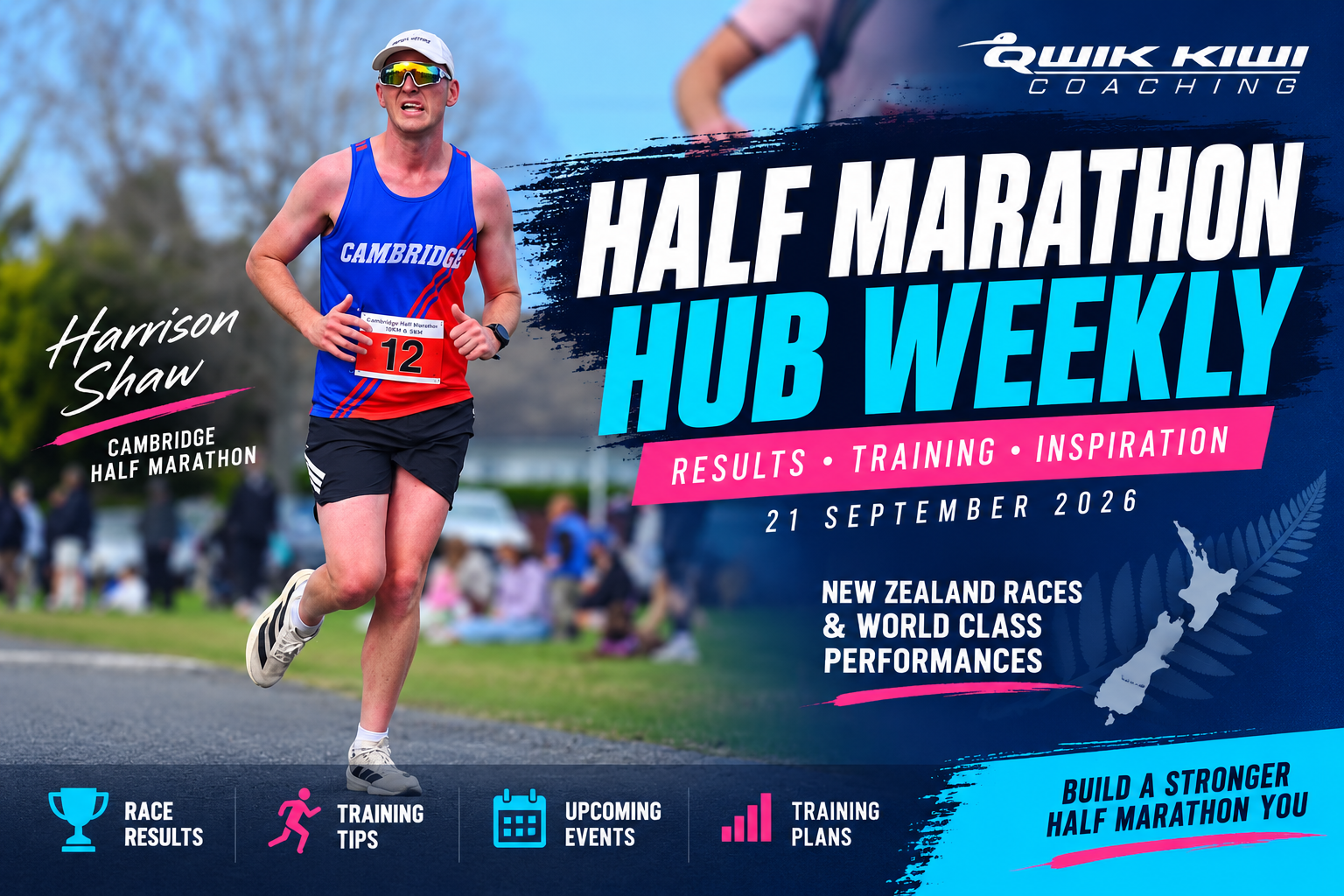
Harrison Shaw ran 1:29:45, placing 22nd male and 24th overall.
Well done, Harrison.
Hutt Half Marathon
There was quality at the front of the Hutt Half Marathon, led by a familiar name in New Zealand distance running.
Men
- Eric Speakman — 1:08:53
- Lennox Crowe — 1:09:47
- Clinton Manderson — 1:13:38
Women
- Zali Vaivars — 1:23:47
- Aimee Harmer — 1:33:19
- Jasmin Morriss — 1:34:37
On a personal note, Eric is actually a distant cousin of mine as well as being a top-class runner, so it was particularly nice to see his name at the top of the results.
Hatuma Half Marathon
We missed Hatuma when previewing last weekend’s events, but it absolutely belongs in the Hub.
The event is based near Waipukurau and takes runners around Lake Whatumā.
Men
- Joshua Stewart — 1:11:27
- Tomas Bridgeman — 1:12:18
- Elijah Waldron — 1:19:15
Only 51 seconds separated Stewart and Bridgeman at the front.
Women
- Annika Johnson — 1:33:46
- Carly Beech — 1:35:54
- Annie Creagh — 1:44:14
Merrell Race Tekapo — 21km
The 21km race at Merrell Race Tekapo provided a very different challenge from the road races.
With significant climbing and trail terrain, this isn’t a course where we should compare finishing times directly with a flat road half marathon.
Men
- Cameron Clark — 1:25:19
- Michael Sutton — 1:31:47
- Itamar Roth — 1:35:33
Women
- Zelle Logan — 1:25:45
- Ruby Morgan — 1:51:24
- Natasha Waddell — 1:56:47
One performance really jumps out.
Zelle Logan was just 26 seconds behind men’s winner Cameron Clark, effectively making her second across the entire 21km field.
That’s an outstanding run.
Te Āpiti Traverse — 20km Ruahine
The inaugural Te Āpiti Traverse wasn’t technically a half marathon, with its Ruahine race approximately 20km, but it’s close enough to our distance to warrant inclusion.
Men
- Daniel Palfreyman — 1:20:35
- Josh Shanahan — 1:32:43
- Sam Drummond — 1:33:00
Women
- Katie Pearson — 1:45:17
- Teana Whaanga — 1:51:24
- Laura Jessen — 1:57:25
Catching Up — Sri Chinmoy Auckland Race 7
We were still waiting for these results when last week’s Hub was published, so let’s catch up with the Sri Chinmoy Auckland Series Race 7 Half Marathon.
Men
- Mark Andrew — 1:31:04
- Neil Cheetham — 1:33:40
- Ben Goldsmith — 1:38:54
Women
- Kirsten Milne — 1:56:11
- Jaime Stevenson — 2:15:16
Only two women were listed in the official half marathon results.
And Jaime is another familiar name for long-time Qwik Kiwi followers. She’s also a coach and appeared on the Qwik Kiwi Coaching YouTube channel a few years ago.
Linger & Die Trail Run
We also expected results from the Linger & Die Trail Run in Alexandra, which included a 21.5km event.
Unfortunately, we haven’t been able to locate a reliable published set of 2026 results.
Rather than leave the Hub waiting—or publish results we can’t verify—we’ll leave this one out of the podium round-up. If the official results become available, we can catch up with them in a future edition.
This Week’s Training Focus
There are three new pieces of training content on www.HalfMarathonTraining.co.nz this week, and together they tell a useful story.
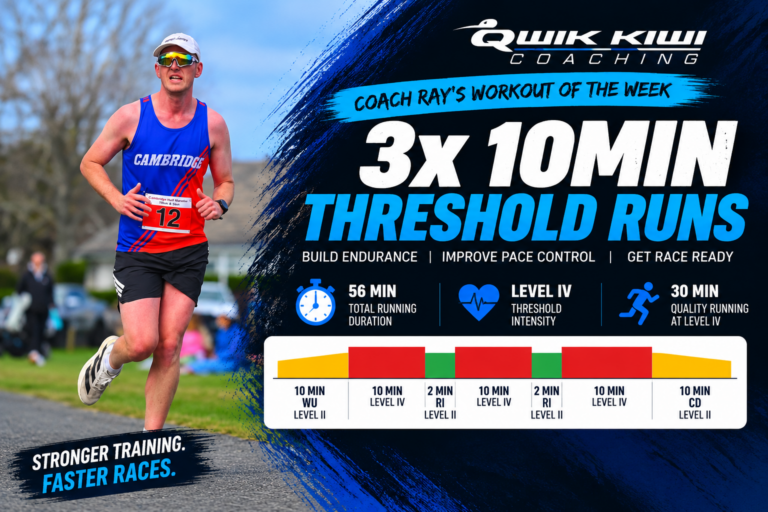
One looks at developing power and running strength with 10x 1-minute hill repetitions.
One steps right back and asks the much bigger question: How should you actually train for a half marathon?
And the third looks towards the latter stages of the race: how do you prepare yourself to keep running well when your legs are tired?
Let’s look at all three.
Workout of the Week: 10x 1-Minute Hill Reps
Short hill repetitions are a useful way of developing the strength and power that can support your running.
With 10x 1-minute hill reps, the hill provides resistance without requiring a gym machine or additional weight. You’re working against gravity while still performing the movement you ultimately want to improve: running.
But the objective isn’t simply to charge up the hill as hard as possible.
Good hill training still requires good running.
Think about posture, arm drive, cadence and maintaining your technique as the repetitions accumulate. The first repetition shouldn’t be so aggressive that your running deteriorates later in the workout.
Ten one-minute repetitions also give us enough volume for fatigue to become relevant.
That’s where control matters.
You’re not trying to win rep number one.
You’re trying to execute all ten well.
Read the workout:
How to Train for a Half Marathon
This week’s major guide on www.HalfMarathonTraining.co.nz tackles a much bigger subject.
How do you actually prepare for 21.1km?
The first point is important:
Half marathon training is about much more than gradually making your Sunday run longer.
You need aerobic fitness, durability, appropriate quality training, recovery, strength, fuelling, pacing and enough time for those elements to develop.
But that doesn’t mean doing as much training as you can possibly tolerate.
My philosophy when designing training is:
Don’t maximise the amount of training an athlete can complete. Minimise the amount required to achieve their goal.
That’s a significant distinction.
The programme needs to match the runner you are today, rather than the runner you hope to become.
Someone preparing for their first half marathon doesn’t require the same programme as someone trying to break 90 minutes.
For most of my structured half marathon programmes, I like an athlete to be capable of running continuously for around 30 minutes before beginning specific half marathon preparation. If you can’t do that yet, that’s not a reason to abandon the goal. It simply means we’ve identified the first step.
Build the runner first. Then train the runner for the half marathon. (Half Marathon Training NZ)
How Long Do You Need?
You’ll commonly see 12-, 16-, 20- and 24-week half marathon programmes.
I use all four.
There isn’t a magical duration that suits everybody.
Generally, though, having more time is useful because we can progress more gradually, develop aerobic fitness without rushing and absorb the inevitable disruptions caused by work, family, illness and life.
One missed week is much less threatening when you’ve allowed yourself six months to prepare than when you’ve tried to cram everything into a short build. (Half Marathon Training NZ)
How Often Should You Run?
I consider three runs per week the minimum for dedicated half marathon preparation, while four or five will often suit runners who can tolerate and recover from the additional training.
But more isn’t automatically better.
As we add running days, we don’t simply keep adding hard workouts.
Most of the additional running should be aerobic.
My general approach is approximately 80% at Level II and around 20% involving quality work, although the precise balance will vary between athletes.
Most of your training shouldn’t feel hard. (Half Marathon Training NZ)
And as race day approaches, the training evolves.
The objective isn’t simply to become fitter.
It’s to arrive on race day healthy, appropriately trained and ready to perform. (Half Marathon Training NZ)
Read the complete guide:
How to Train for a Half Marathon: The Complete Guide
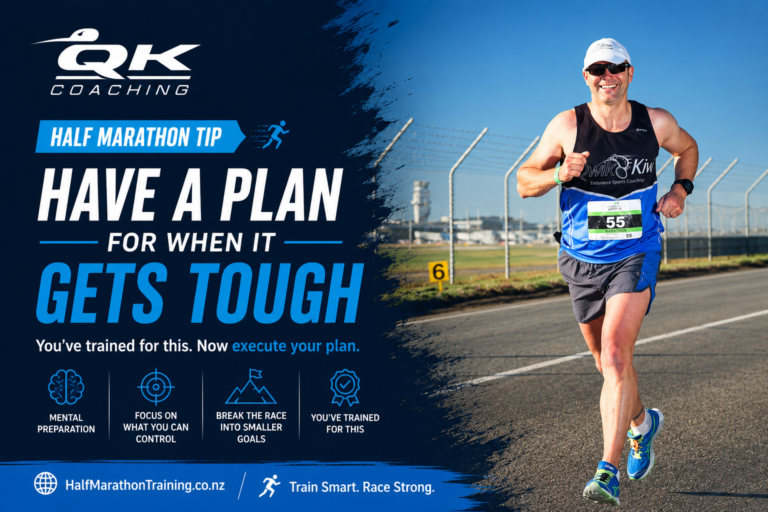
Train Your Legs to Run Strong When They’re Tired
The first few kilometres of a half marathon usually aren’t where the real challenge lies.
You’re fresh.
Your breathing is controlled.
Your legs are responsive.
The race becomes considerably more interesting when those same legs have already carried you for 15 or 16 kilometres.
That’s why some of your training should prepare you to run well when you’re already tired.
This does not mean deliberately starting workouts exhausted.
It doesn’t mean making every long run hard.
And it certainly doesn’t mean compromising your sleep or recovery so you can practise being tired.
Instead, we create controlled fatigue within selected workouts.
A long run might begin with predominantly Level II running before introducing a stronger planned section later.
You haven’t artificially manufactured fatigue.
The earlier running has naturally created it.
Now you’re practising maintaining your posture, cadence, technique, concentration and appropriate pace when your legs aren’t fresh anymore. (Half Marathon Training NZ)
The Final 5km Matters
Think about your goal half marathon pace.
Running it shortly after your warm-up is one challenge.
Running the same pace after 60, 75 or 90 minutes is another.
That’s much closer to what the race will eventually demand.
Selected long runs and race-specific workouts can therefore teach you how to respond when the effort required to maintain pace starts increasing.
But the objective isn’t exhaustion.
More fatigue isn’t automatically better training.
You still need genuinely easy running. You still need recovery. And most long runs can remain predominantly Level II.
Tired-leg training is a tool, not something that needs to appear in every session. (Half Marathon Training NZ)
Don’t Confuse Tired With Under-Fuelled
There’s another important distinction.
Running on tired legs because you’ve completed the planned earlier part of a workout isn’t the same thing as running poorly because you’ve deliberately failed to fuel.
Longer sessions can actually be excellent opportunities to practise your half marathon fuelling strategy.
Fuel the workout.
Practise drinking.
Then learn how to keep executing the session as fatigue accumulates.
The goal is to prepare yourself to perform late in a half marathon—not manufacture an energy crisis in training. (Half Marathon Training NZ)
Ideally, when you reach the difficult final kilometres on race day, the sensation won’t be completely unfamiliar.
You’ll be able to tell yourself:
I’ve been here before.
Read the full article:
Train Your Legs to Run Strong When They’re Tired
Training Plans Starting Monday 28 September
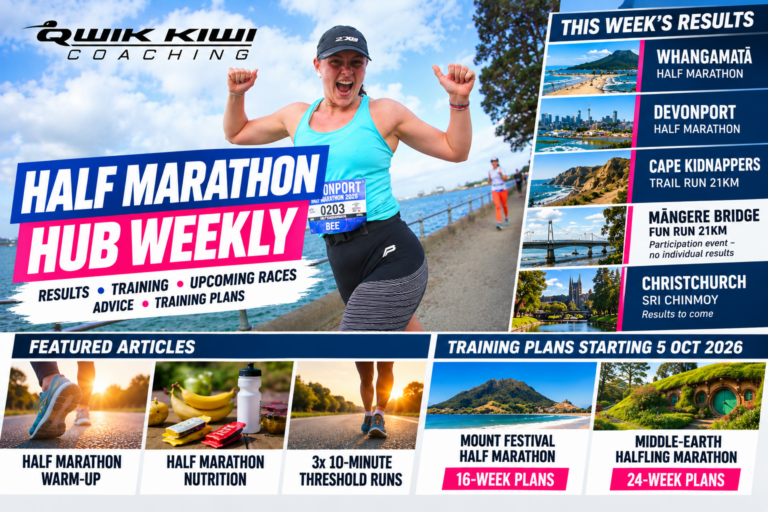
Next Monday, 28 September 2026, two new blocks of event-specific training begin through NZ Half Marathon Hub+.

Buller Gorge Half Marathon — 20 Weeks
The 20-week Buller Gorge Half Marathon training plans begin next Monday.
Twenty weeks gives us plenty of time to progressively build aerobic fitness and durability before the programme becomes increasingly specific to the demands of the half marathon.
Hamilton Half Marathon — 24 Weeks
We’re starting even further out for the Hamilton Half Marathon, with the 24-week training plans beginning on Monday.
Having 24 weeks isn’t an invitation to train harder from day one.
It’s an opportunity to avoid rushing.
We can build the runner first, progressively develop fitness, and introduce more specific work at the appropriate point.
That ties directly into this week’s complete training guide: more preparation time gives us room to progress rather than trying to cram fitness into the final few weeks.
If you’d like structured training leading into either event, you can join NZ Half Marathon Hub+ here:
Coming Up This Weekend — 26–27 September
We’ve got five half marathon or half-marathon-distance events around New Zealand this weekend.
Saturday 26 September
Cape Kidnappers Trail Run
The Cape Kidnappers Trail Run offers a 21.1km option through some spectacular Hawke’s Bay terrain.
With substantial climbing and trail conditions, pacing this one by road-running pace isn’t going to be particularly useful.
Effort management becomes much more important.
Whangamatā Half Marathon
Also on Saturday is the Whangamatā Half Marathon, giving runners a very different 21km challenge on the Coromandel Peninsula.
Sunday 27 September
Devonport Half Marathon
The Devonport Half Marathon brings another half marathon to Auckland’s North Shore, alongside its shorter-distance events.
Māngere Bridge Fun Run
The Māngere Bridge Fun Run also includes a 21km option, giving Auckland runners two half-marathon-distance opportunities on Sunday.
Sri Chinmoy Spring Half Marathon
And in Christchurch, runners will line up for the Sri Chinmoy Spring Half Marathon at North Hagley Park.
That gives us plenty of racing to follow for next Monday’s Hub.
This Week’s Takeaway: Prepare for the Runner You’ll Need to Be Late in the Race
There’s a common thread running through this week’s training.
Hill repetitions help develop the physical qualities that support stronger running.
A properly structured training programme develops your fitness progressively rather than simply throwing more training at you.
And tired-leg training recognises that being capable of running well when you’re fresh isn’t enough.
Eventually your half marathon is going to become difficult.
Your legs will get heavier.
Maintaining your pace will require more concentration.
Your technique may need conscious attention.
That’s not necessarily a sign that something has gone wrong.
That’s part of racing 21.1km.
The objective of training isn’t to guarantee that race day feels easy.
It’s to prepare you for what race day will ask you to do.
Build the runner. Train the runner. Then prepare that runner to keep performing when the race gets hard.
Get the Half Marathon Hub Weekly in Your Inbox
If you’re enjoying the Half Marathon Hub Weekly, you can have each new edition delivered directly to your inbox.
You’ll get the latest New Zealand half marathon results, upcoming races, workouts and practical training advice to help you prepare for your next 21.1km.
Sign up for the FREE Half Marathon Hub Weekly
Coming Next Week
Next Monday we’ll be looking for results from:
Cape Kidnappers Trail Run, Whangamatā Half Marathon, Devonport Half Marathon, Māngere Bridge Fun Run and the Sri Chinmoy Spring Half Marathon.
We’ll also have another week of practical half marathon training content from www.HalfMarathonTraining.co.nz.
Until then, train consistently, recover properly, and remember that the goal isn’t simply to become good at running when everything feels easy.
It’s to still be running well when your half marathon gets hard.
Coach Ray
Qwik Kiwi Coaching
www.HalfMarathonTraining.co.nz