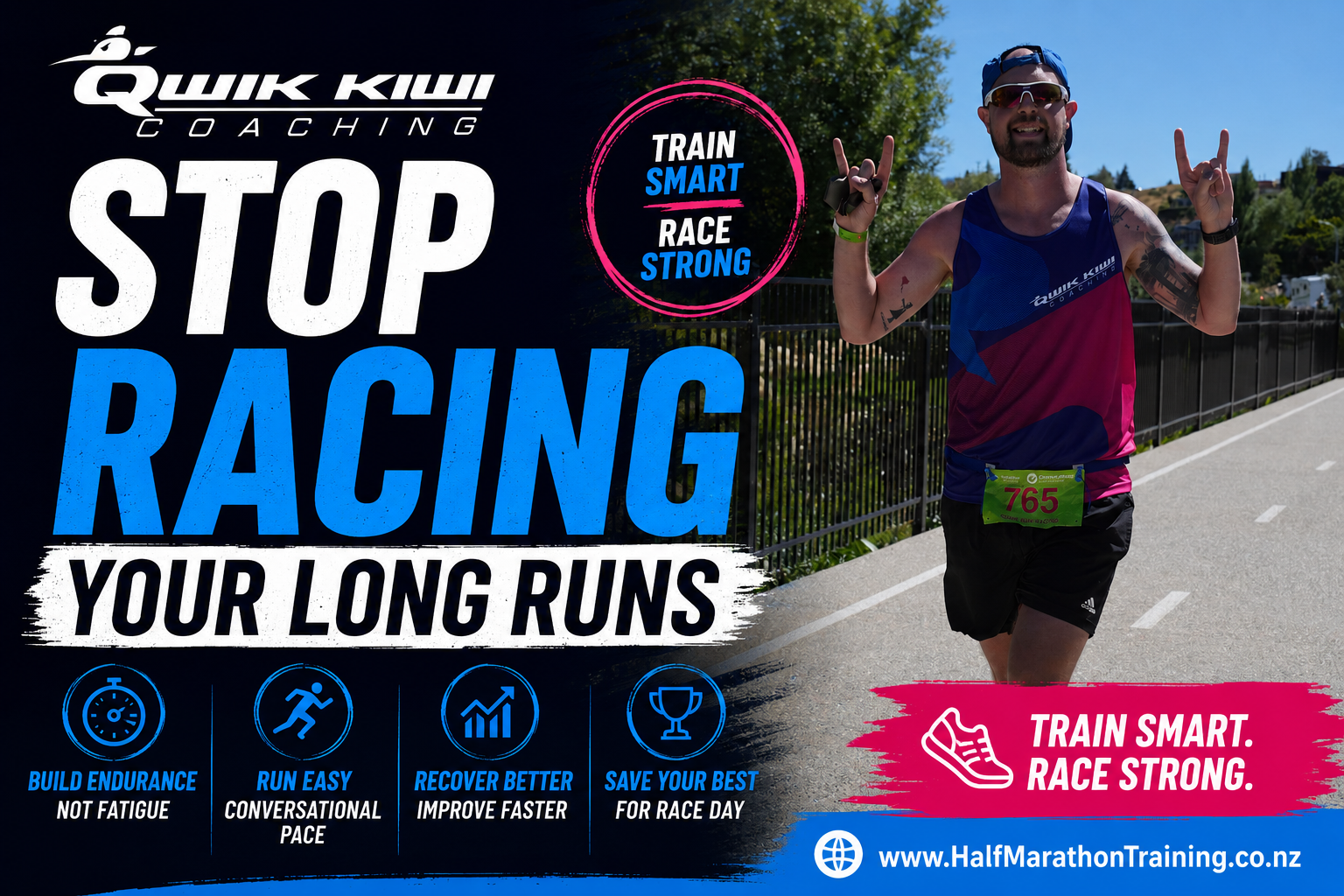
Stop Racing Your Long Runs
Your long run is one of the most important sessions in your half marathon training.
It’s also one of the easiest to get wrong.
You head out feeling good. The first few kilometres are comfortable. You glance at your watch and notice you’re moving faster than planned.
So you keep going.
Before long, what was supposed to be a controlled endurance run has turned into an unofficial race against yourself.
It might feel satisfying when you finish, but your long run is training—not a weekly test of your half marathon fitness.
What Is the Purpose of Your Long Run?
The primary purpose of most long runs is to develop the endurance required to run strongly for 21.1 kilometres.
You’re gradually teaching your body to tolerate longer periods of running while developing the aerobic fitness and muscular endurance you’ll need on race day.
You don’t need to race your long run to achieve that.
In fact, most long runs should be completed at a controlled, conversational effort. Current half marathon guidance similarly emphasises easy, conversational long running as a foundation for developing endurance.
The goal isn’t to finish exhausted.
It’s to provide enough training stimulus to improve—and then recover so you can continue training.
Stop Trying to Prove You’re Ready
As race day gets closer, it’s natural to want reassurance.
You might start thinking:
“If I can run 18km close to my goal pace today, I’ll know I can race 21.1km at that pace.”
The problem is that training isn’t supposed to provide proof every weekend.
You’re building fitness through the combined effect of weeks and months of training.
Your long run is only one part of that process.
If you turn it into a race every week, you’re adding fatigue that can compromise the training sessions that follow.
You don’t need to prove you’re ready.
You need to become ready.
Your Long Run Should Usually Feel Controlled
For most of your standard long runs, you should be able to hold a conversation.
That doesn’t mean the entire session will necessarily feel effortless. As the duration increases, you’ll naturally become more fatigued.
But there’s a big difference between becoming tired because you’ve been running for a long time and becoming tired because you’ve been pushing the pace.
Your breathing should remain controlled and your running should feel sustainable.
When you finish, I generally want you feeling as though you could have kept going if you needed to.
That’s very different from staggering through the final kilometre because you’ve spent the previous hour trying to beat last Sunday’s average pace.
But Aren’t Some Long Runs Supposed to Be Fast?
Yes.
This is where the distinction between racing your long run and completing a structured long-run workout becomes important.
Depending on where you are in your half marathon programme, I might deliberately prescribe sections at a faster intensity.
For example, you might complete the majority of the run easily before including a controlled section at half marathon race pace later in the session.
Or you might progressively increase your effort towards the end.
Those sessions can be valuable because they teach you to maintain pace when some fatigue has already accumulated. Long runs incorporating deliberate race-pace or tempo sections are a recognised way of adding specificity when appropriate.
But there’s an important difference:
The faster running is there because the training plan calls for it—not because you felt good and decided to race your watch.
Don’t Race Your Training Partners Either
Your watch isn’t the only thing that can turn an easy long run into a race.
Training partners can do it too.
Someone increases the pace slightly.
You go with them.
They push again.
Nobody says anything, but suddenly Sunday’s relaxed long run has become the final kilometres of an Olympic qualifying race.
If you’re running with others, make sure their intended effort matches yours.
Sometimes the smartest thing you can do is let somebody run away from you.
You aren’t racing them today.
Save Your Best Running for the Sessions That Need It
Half marathon training works best when different sessions have different purposes.
Your easy running develops aerobic fitness and supports recovery.
Your long runs develop endurance.
Your tempo and threshold sessions develop your ability to sustain faster running.
Other quality sessions can target speed, running economy or race-specific demands.
If you make the long run hard every week, you start blurring those purposes together.
You can end up too tired to execute your harder workouts properly while also losing the benefits of genuinely controlled aerobic running.
Hard sessions should be hard for a reason. Easy and controlled sessions should be controlled for a reason.
Don’t Judge the Run by Your Average Pace
One habit I’d encourage you to break is finishing a long run and immediately deciding whether it was successful based on the average pace on your watch.
Instead, ask yourself:
Did I run at the intended intensity?
Did I maintain good technique?
Did I practise my fuelling?
Did I complete the planned duration?
Did I finish feeling controlled?
And importantly:
Can I recover from this and complete my next important training session properly?
If the answers are yes, you’ve probably had a very productive long run—even if Strava doesn’t think it looks particularly impressive.
Final Thoughts
Your long run isn’t race day.
Stop treating it like it is.
Most of the time, run it at a controlled, conversational effort and allow the duration—not unnecessary speed—to provide the training stimulus.
When your programme deliberately includes faster sections, execute those sections with purpose.
But don’t turn every Sunday into a test of your fitness.
Half marathon improvement doesn’t come from winning your long runs.
It comes from consistently completing the right training, recovering from it, and arriving on race day ready to race.
Save your racing for when there’s a finish line.
Want to Make Every Run Count?
If you’re unsure how hard your long runs should be—or how to balance long runs, easy running and quality sessions as you prepare for 21.1km—there’s plenty more practical advice at www.HalfMarathonTraining.co.nz.
And if you’d like some individual help, book a free, no-obligation 40-minute coaching consultation with me. We can look at your current training, your target half marathon and how your weekly sessions should fit together so you’re building fitness rather than simply accumulating fatigue.
Book your free 40-minute coaching consultation: