Half Marathon Hub Weekly: Fast Racing, Race-Day Preparation & Smarter Training | 28 September 2026
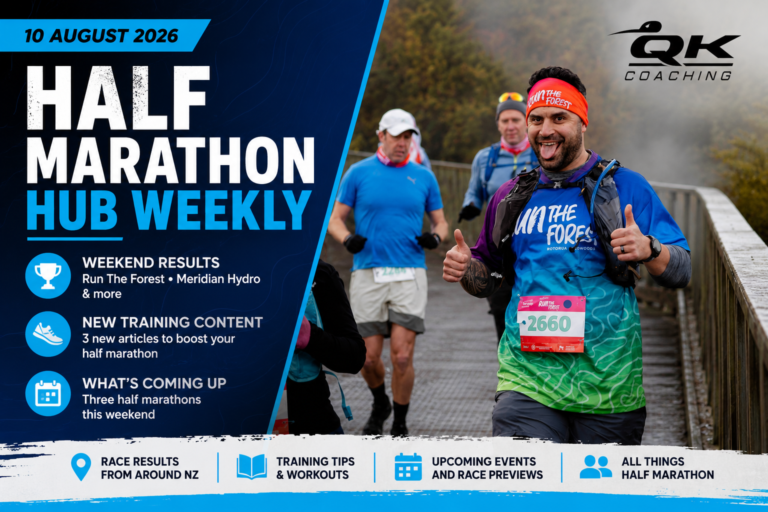
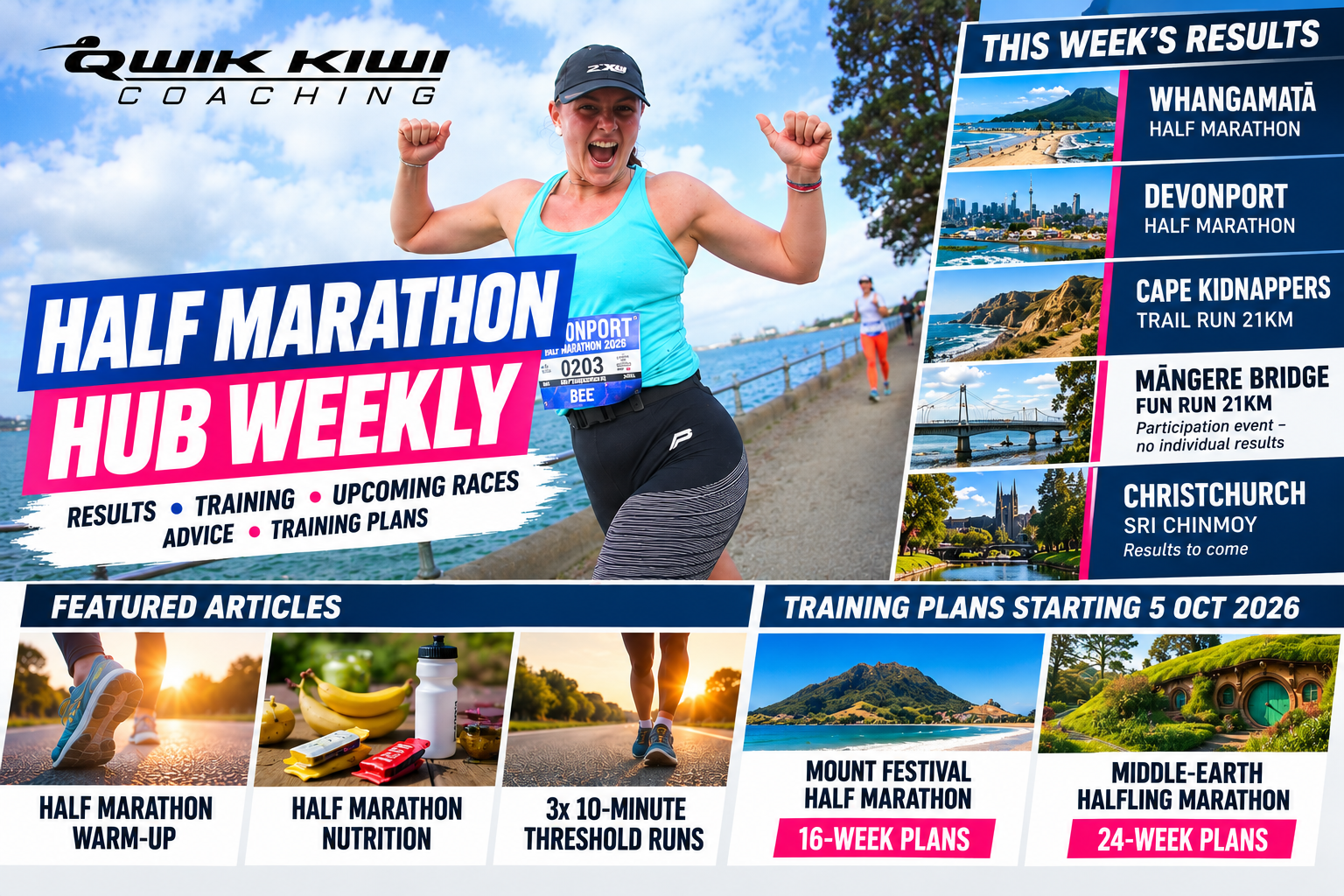
Another busy weekend of half marathon running is behind us, with racing from the roads of Whangamatā and Devonport to the trails of Cape Kidnappers.
We also had the Māngere Bridge Fun Run, where the emphasis is on community participation rather than official individual race timing, while we’re still waiting for results from the Sri Chinmoy Spring Half Marathon in Christchurch.
On the training side this week, we’re shifting some of the attention towards race-day preparation. We’ll look at whether you actually need to warm up before a half marathon, how to approach your race-day nutrition, and a substantial threshold workout featuring 3x 10 minutes at Level IV.
And if you’re looking further ahead, two new blocks of event-specific training begin next Monday: 16 weeks towards the Mount Festival Half Marathon and 24 weeks towards the Middle-earth Halfling Marathon.
Let’s get into this week’s Half Marathon Hub Weekly.
Whangamatā Half Marathon
There was some excellent racing at the Whangamatā Half Marathon on Saturday, with a particularly close battle for the remaining podium places in the men’s race.
Men
- Dion Wallwork — 1:12:13
- Kasper Lenoir — 1:13:11
- Matthew Hallam — 1:13:15
Only four seconds separated second and third.
Women
- Amelia Burton — 1:28:26
- Isla Joyce — 1:29:48
- Sheree Sheehan — 1:30:09
The women’s podium was also competitive, with less than two minutes covering the first three.
The Whangamatā Half Marathon is based at Williamson Park and forms part of a weekend that also includes 10km and 5km events.
Devonport Half Marathon
Sunday’s Devonport Half Marathon took runners around one of Auckland’s more scenic urban courses, starting and finishing at Devonport Domain and incorporating Cheltenham, Narrow Neck and the village.
Men
- Charlie Glass — 1:16:34
- Jacob Crossley — 1:18:18
- Robert Lee — 1:19:33
Women
- Ady McKenzie — 1:29:01
- Tracy McCartney — 1:31:45
- Brigid Du Burgess — 1:35:20
Congratulations to Ady McKenzie on taking the women’s victory.
There’s a fairly tenuous Qwik Kiwi connection here, but one that goes back a long way. Ady and I were both part of the youth development squad for triathlon back in the mid-1990s.
That was well before Qwik Kiwi Coaching existed, so it was nice to see a familiar name from those days appearing at the top of a half marathon results sheet more than 30 years later.
Cape Kidnappers Trail Run — 21km
The Cape Kidnappers Trail Run offered a very different half marathon challenge.
This is exactly the sort of event where finishing times need to be viewed in the context of the terrain rather than compared directly with a road half marathon.
Men
- Sean Story — 1:40:54
- Greger Rough — 1:48:10
- Oscar Moorhead — 1:49:54
Women
- Leandra Dunn — 2:06:12
- Meghan Sandle — 2:07:44
- Emily Heslop — 2:13:22
Congratulations to all six podium finishers.
Māngere Bridge Fun Run
The Māngere Bridge Fun Run also included a 21km option on Sunday, but there’s an important distinction between this event and the other races we’re covering.
It’s structured as a non-competitive community participation event rather than an individually timed race.
Consequently, there aren’t official individual finishing times or men’s and women’s podium results for us to report.
And that’s absolutely fine.
Not every 21km event needs to be about placings, PBs or racing the clock. For plenty of people, covering the distance, being active and sharing the experience with the local community is the achievement.
Sri Chinmoy Spring Half Marathon — Results to Come
The Sri Chinmoy Spring Half Marathon was held in North Hagley Park, Christchurch, on Sunday.
At the time of preparing this week’s Hub, however, the official results haven’t yet been published.
That’s not unusual for the Sri Chinmoy events. Their own event information notes that results and photographs are uploaded during the week following the race.
Rather than delay this week’s Hub, we’ll move on.
I’ll check again when preparing next week’s results and, if they’re available, we’ll catch up with the Christchurch podium then.
This Week’s Training Focus
Let’s move from racing to training.
This week we’re looking at three areas that become increasingly important as your goal race gets closer:
How should you warm up before a half marathon?
What should you eat and drink before and during the race?
And:
How can longer threshold intervals help prepare you for sustained faster running?
These might appear to be three separate topics, but there’s a common theme.
Good half marathon racing starts before the gun goes off.
You can build excellent fitness over several months and still make race day considerably harder than it needs to be through poor preparation.
Do You Need to Warm Up Before a Half Marathon?
One of the most common pieces of pre-race advice is:
Make sure you warm up properly.
But that raises another question.
What does “properly” actually mean for a half marathon?
And the answer depends partly on how you’re going to race it.
A runner trying to race a fast half marathon has a different requirement from someone whose objective is simply to comfortably complete 21.1km.
That’s important because warming up has a cost.
Every kilometre you run before the start is additional running.
Every aggressive stride or drill uses some energy.
For a 5km race, investing more in the warm-up makes sense because you’re expected to be ready to run hard almost immediately.
A half marathon is different.
You’ve got plenty of running ahead of you.
If You’re Racing the Half Marathon
If you’re planning to race hard from the start, some warm-up can certainly be useful.
You don’t necessarily want the first kilometre of the race to be the first time that morning that you’ve moved faster than a walk.
A short period of easy running can gradually increase your heart rate, raise muscle temperature and allow you to settle into the movements of running before you line up.
You can then include a small amount of more purposeful running to prepare yourself for race intensity.
But the key word is enough.
You don’t need to finish the warm-up feeling as though you’ve already completed a workout.
The objective is to arrive at the start line prepared, not fatigued.
Read the complete article:
Half Marathon Warm-Up: What Should You Do Before You Race?
https://www.halfmarathontraining.co.nz/half-marathon-warm-up/
What If You’re Running the Half Marathon at Level II?
This is where the answer changes.
If your goal is simply to complete the half marathon comfortably and you’re going to start at Level II, then the opening part of the race itself can effectively become part of your warm-up.
You don’t necessarily need to add a significant amount of running beforehand.
Instead, make sure you’ve given yourself enough time to get organised.
Walk around.
Stay mobile.
Avoid standing still getting cold for an unnecessarily long period.
And when the race starts, resist the temptation to charge off because everybody around you is excited.
Let your body gradually settle into the event.
For these runners, conserving energy may be considerably more valuable than completing an elaborate warm-up routine.
The Biggest Warm-Up Mistake May Be Starting Too Fast
There’s another reason the warm-up discussion matters.
No pre-race routine can rescue poor pacing.
You can execute the perfect warm-up and then destroy your race by running the first few kilometres considerably faster than your sustainable pace.
The adrenaline of race morning makes this remarkably easy to do.
So think beyond the exercises you perform before the start.
Your warm-up also includes how intelligently you approach those opening kilometres.
Start controlled.
Allow your body to settle.
Then let the race develop.
Half Marathon Nutrition: Don’t Leave It Until Race Day
The second major topic this week is nutrition.
And if there’s one principle I want runners to remember, it’s this:
Nothing new on race day.
Your half marathon nutrition strategy shouldn’t be something you invent at breakfast on race morning.
It should be something you’ve already practised during training.
That includes:
- what you eat beforehand;
- when you eat it;
- how much fluid you consume;
- what carbohydrate you use during the race;
- how frequently you take it;
- and whether your stomach actually tolerates it while you’re running.
Race day is the final execution of a strategy you’ve already rehearsed.
Read the complete guide:
Half Marathon Nutrition: What to Eat Before & During Your Race
https://www.halfmarathontraining.co.nz/half-marathon-nutrition/
Your Pre-Race Meal Should Be Familiar
Athletes sometimes think race morning requires a special breakfast.
It doesn’t.
It requires a breakfast that supports your race and that you already know works for you.
Race morning isn’t the time to suddenly decide that because another runner swears by a particular breakfast, you should copy them.
Your digestive system doesn’t care what works for someone else.
You need to know what works for you.
That’s why your longer training sessions are useful for more than developing endurance.
They’re also rehearsals.
If your half marathon begins at 8:00am, you can occasionally organise a long run for a similar time and practise the breakfast you intend to use.
How much do you need?
How long before running do you prefer to eat?
Does it sit comfortably?
Do you feel hungry again too quickly?
These are questions you want answered before race morning.
Practise Your Race Fuelling
The same principle applies to fuelling during the half marathon.
Don’t buy a new gel at the race expo because the packaging looks good and decide that’s what you’ll use tomorrow.
Use training to determine:
Which product works?
How frequently will you take it?
Do you need water with it?
Can you open it while running?
Can your stomach tolerate it at race intensity?
These might sound like small details.
They’re not small when you’re 16 kilometres into your goal race.
Practising your fuelling reduces uncertainty.
And reducing uncertainty makes race day simpler.
Don’t Deliberately Under-Fuel Training
This also links back to something we discussed in last week’s Hub about running on tired legs.
There’s a difference between learning to run well while naturally fatigued and deliberately running out of fuel.
They’re not the same training stimulus.
For appropriate longer sessions, practise fuelling.
Learn to keep running after consuming carbohydrate.
Learn to drink while moving.
Learn how your stomach responds.
You’re preparing the entire race-day system — not just your legs.
Workout of the Week: 3x 10-Minute Threshold Runs
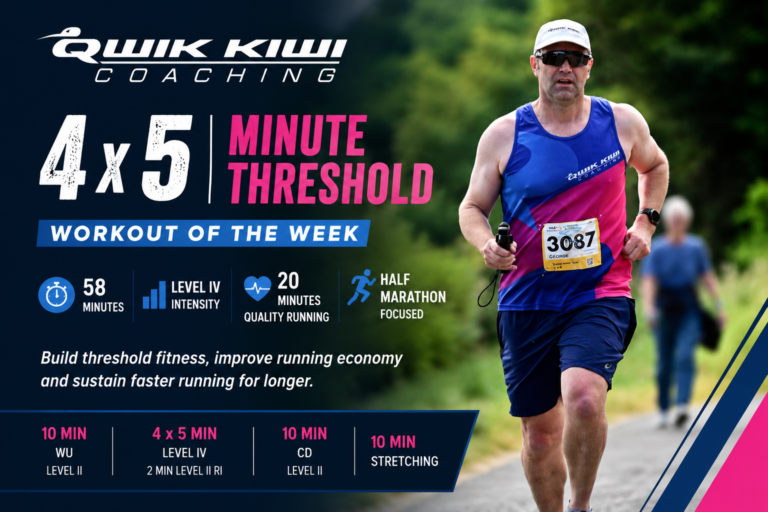
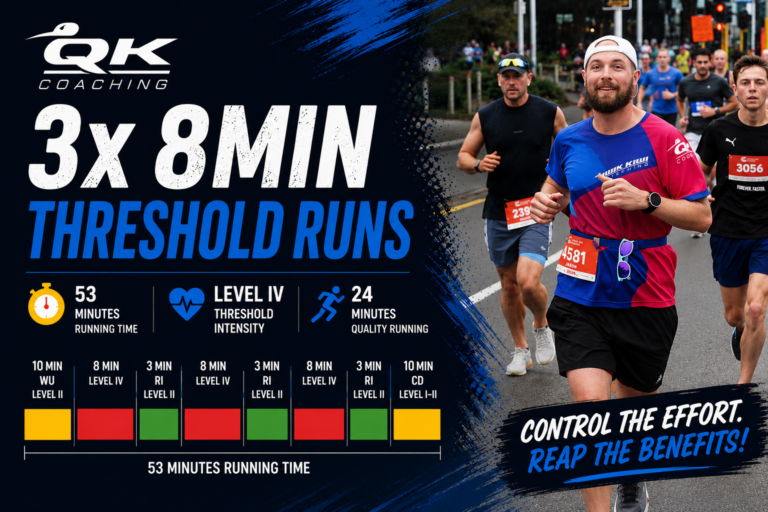
Our workout this week is a substantial threshold session:
3x 10 minutes at Level IV.
This isn’t a workout where the individual intervals are particularly short.
You’re accumulating 30 minutes of Level IV running, so pacing becomes very important.
The complete running portion of the session is 56 minutes, with the three ten-minute Level IV repetitions separated by two-minute Level II recoveries.
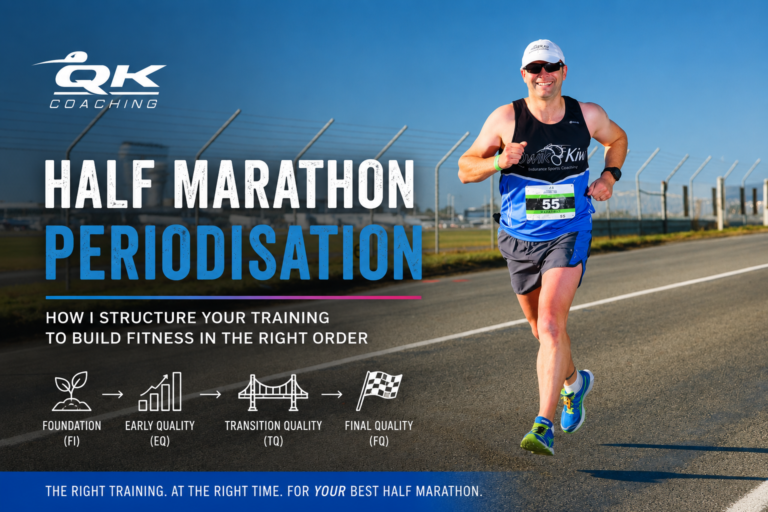
It’s primarily suited to the Transition Quality — TQ — phase of half marathon preparation.
Read the full workout:
3x 10-Minute Threshold Runs
https://www.halfmarathontraining.co.nz/workout-3x-10min-threshold-runs/
Why Ten-Minute Threshold Repetitions?
Threshold running occupies an important place in half marathon preparation.
You’re teaching yourself to sustain a strong intensity for meaningful periods without turning the workout into a series of short, maximal efforts.
And that’s where ten-minute repetitions become useful.
Ten minutes is long enough that you can’t bluff your way through it.
If you start too hard, you’ll know about it.
And because you’ve got three repetitions, poor pacing in the first rep doesn’t just affect those ten minutes.
It affects the rest of the session.
Level IV Means Level IV
This is another workout where discipline matters.
If the programme says Level IV, running at Level V because you feel good doesn’t make the workout better.
It changes the workout.
You’re trying to accumulate controlled quality at the prescribed intensity.
Think about producing three strong, repeatable efforts.
Ideally, the final repetition should still look like good running.
Your technique should remain controlled.
Your pace shouldn’t collapse.
And you shouldn’t have turned the first ten minutes into a time trial.
Why the Level II Recoveries Matter
The two-minute Level II recoveries aren’t simply dead time between the “important” parts of the workout.
They’re part of the session.
You’re continuing to run while allowing the intensity to reduce before returning to Level IV.
That creates a different demand from completely stopping between repetitions.
And for a half marathon runner, there’s obvious relevance in learning to recover while continuing to move.
Training Plans Starting Monday 5 October
Next Monday, 5 October 2026, we have two new event-specific training blocks beginning through NZ Half Marathon Hub+.
And they couldn’t be much more different.
Mount Festival Half Marathon — 12 Weeks
The 12-week Mount Festival Half Marathon training plans begin next Monday.
The Waitoa Mount Festival Half Marathon will be held on 23 January 2027, with the 21.1km event forming part of the wider Mount Festival in Tauranga. The organisers describe it as a scenic coastal course.
With 12 weeks to prepare, we’re getting into a much more focused half marathon build.
The foundations should already be there.
Now the emphasis progressively moves towards developing the fitness and specificity required for race day.
If Mount Festival is your January goal, now is the time to begin structured preparation.
Middle-earth Halfling Marathon — 24 Weeks
At the other end of the spectrum, our 24-week Middle-earth Halfling Marathon training plans also begin next Monday.
The Middle-earth Halfling Marathon will be held at Hobbiton Movie Set near Matamata on Saturday 20 March 2027.
And this definitely isn’t a conventional flat road half marathon.
The 21.1km event takes runners and walkers through Hobbiton and the surrounding Waikato farmland, with off-road terrain and rolling hills forming part of the challenge.
Having 24 weeks gives us the opportunity to develop the runner progressively before becoming increasingly specific to the demands of the event.
And because this is an off-road half marathon, that specificity matters.
Strength.
Hills.
Running economy.
Aerobic endurance.
And becoming comfortable maintaining effort when the terrain means your pace naturally changes.
The 2027 event is currently sold out, although the organisers say cancelled registrations will be re-released on 4 February 2027.
So if you’ve already secured your place, next Monday marks the beginning of your 24-week build.
And if you’re hoping to pick up one of the cancelled entries in February, beginning to develop your running now certainly won’t be wasted.
If you’d like structured training for either event:
Coming Up This Weekend — 3–4 October
We’ve got three half marathon events around New Zealand this coming weekend.
Wharf to Wharf — Great Barrier Island
On Saturday, runners head to Aotea / Great Barrier Island for Wharf to Wharf.
The event includes a half marathon alongside its other distances and provides a very different experience from a conventional city road race.
4 Paws Marathon — Christchurch
On Sunday, Christchurch hosts the 4 Paws Marathon at Bottle Lake Forest.
Despite the event name, there’s also a 21.1km half marathon, along with other distance options.
It’s another off-road event, giving us a very different set of conditions from last weekend’s road racing at Devonport and Whangamatā.
Sri Chinmoy Auckland Series — Race 8
Also on Sunday is Race 8 of the Sri Chinmoy Auckland Series, which includes a half marathon.
This Week’s Takeaway: Practise Race Day Before Race Day
If there’s one idea connecting this week’s training content, it’s this:
Race day shouldn’t be an experiment.
You should already know what you’re going to eat.
You should already know what fuelling works for you.
You should have practised drinking while running.
You should know whether you need a substantial warm-up or whether a more conservative approach suits the way you’re going to run your half marathon.
And your training should have prepared you for the intensity you’re going to experience.
That includes workouts such as 3x 10 minutes at Level IV, where patience, pacing and discipline matter.
The more of those decisions you’ve already made and practised, the fewer decisions you need to make on race morning.
You can’t control everything that happens during a half marathon.
The weather might change.
The wind might get up.
You might encounter an unexpected hill.
Another runner might surge.
But you can arrive knowing:
I’ve practised my breakfast.
I’ve practised my fuelling.
I know how I’m warming up.
I know how the opening kilometres should feel.
And I’ve completed the training.
That’s confidence built from preparation rather than hope.
Get the Half Marathon Hub Weekly in Your Inbox
If you’re enjoying the Half Marathon Hub Weekly, you can have each new edition delivered directly to your inbox.
Every week we’ll bring together New Zealand half marathon results, upcoming races, workouts and practical coaching advice to help you prepare for your next 21.1km.
Sign up for the FREE Half Marathon Hub Weekly:
Coming Next Week
Next Monday we’ll be looking for results from:
Wharf to Wharf – Great Barrier Island
4 Paws Marathon
and
Sri Chinmoy Auckland Series Race 8
We’ll also check again for the outstanding Sri Chinmoy Spring Half Marathon results from Christchurch and include them as a catch-up if they’ve been published.
And, as always, there’ll be more practical half marathon training advice from www.HalfMarathonTraining.co.nz.
Until then, remember:
Don’t wait until race day to discover what works. Practise it in training, build confidence through preparation, and make race day the execution of a plan you’ve already rehearsed.
Coach Ray
Qwik Kiwi Coaching
www.HalfMarathonTraining.co.nz