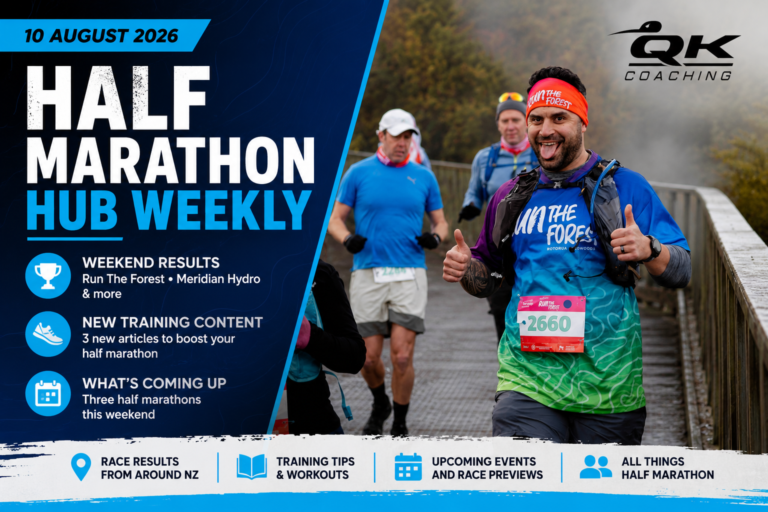
Half Marathon Hub Weekly: Fast Racing, First-Marathon Success & Building Stronger Runners | 14 September 2026
Another busy weekend of half marathon racing is behind us, with some genuinely impressive performances from Dunedin to Auckland.
This week we’ve got a particularly quick battle at the front of the Dunedin Half Marathon, a woman taking the overall victory at Run Auckland’s Millwater Half Marathon, and a fantastic marathon debut from one of our own Qwik Kiwi athletes.
On the training side, we’re looking at three areas that can make a substantial difference to your half marathon performance: tempo running, strength training and training your gut.
And there’s plenty happening next weekend too. There are five half marathons spread throughout the country.
Let’s get into this week’s Half Marathon Hub Weekly.
Dunedin Half Marathon — Just 20 Seconds Separates the First Two
There was some fast racing at the Emerson’s Dunedin Half Marathon, particularly at the front of the men’s field.
Men
🥇 Jason van Kempen — 1:09:27
🥈 Thomas Newsom — 1:09:47
🥉 Robbie van Deursen — 1:13:36
Only 20 seconds separated Jason van Kempen and Thomas Newsom, with both men breaking 70 minutes.
Women
🥇 Mel Aitken — 1:21:38
🥈 Juliet Downs — 1:26:06
🥉 Tahlia Roome — 1:27:33
Mel Aitken produced an impressive performance to take the women’s victory comfortably, while Juliet Downs and Tahlia Roome completed the podium.
Tahlia is also a familiar name from this season. She won the Otago Ale Trail Half Marathon last month in 1:29:42, so her 1:27:33 in Dunedin continues a strong period of half marathon racing.
That is exactly the sort of continuity I want us to start following through the Weekly Hub: not simply who won each weekend, but how runners are progressing and performing across different events.
Qwik Kiwi Highlight — What a Marathon Debut for Jessica Bray
Although this is the Half Marathon Hub, I’m making an exception for a performance in the full marathon.
And for very good reason.
Qwik Kiwi athlete Jessica Bray completed her first-ever marathon in Dunedin in 3:04:18, finishing fourth woman.
Running 3:04 in your first marathon is an outstanding debut.
The marathon has a habit of exposing even small mistakes in pacing, fuelling and preparation. You can feel wonderful at halfway and still have a very long way to go.
So to put together that sort of performance on a first attempt is something Jessica can be extremely proud of.
Congratulations, Jessica.
Run Auckland Millwater — Dalia Gamboa Wins the Entire Half Marathon
There was another standout performance at Race 6 of the Run Auckland Series at Millwater Estuary.
This time, however, the first runner across the line wasn’t the men’s winner.
It was Dalia Gamboa.
Women
🥇 Dalia Gamboa — 1:15:16 — 1st overall
🥈 Angela Marie Dela Cruz — 1:24:16
🥉 Billie-Lee Haresnape — 1:25:45
Men
🥇 Brent Kelly — 1:17:00
🥈 Daniel Finlayson — 1:18:24
🥉 Isaac Kirkpatrick — 1:20:01
Dalia’s 1:15:16 gave her the women’s victory and made her the fastest half marathon runner across the entire field, finishing 1 minute 44 seconds ahead of men’s winner Brent Kelly.
That’s an exceptional performance and one of the standout results we’ve covered in the Half Marathon Hub this year.
Run Auckland confirms that Millwater was Race 6 of its 2026 series. (Run Auckland Series & Half Marathon)
Sri Chinmoy Auckland Series — Results Still Pending
The Sri Chinmoy Auckland Series Race 7 was also held at Auckland Domain on Sunday.
The half marathon takes place over multiple laps of the Domain circuit, which is predominantly flat with a couple of slight uphill sections.
However, the results were still being compiled and finalised when I prepared this week’s Hub.
Rather than publish provisional or incomplete results, we’ll wait for the official results and pick those up in a future edition.
Training Focus: Three Different Pieces of the Half Marathon Puzzle
This week’s new training content on www.HalfMarathonTraining.co.nz covers three subjects that might initially seem quite separate.
We’ve got tempo training.
We’ve got strength training.
And we’ve got gut training.
But all three illustrate something important about preparing for a half marathon:
Running performance isn’t developed by one type of workout alone.
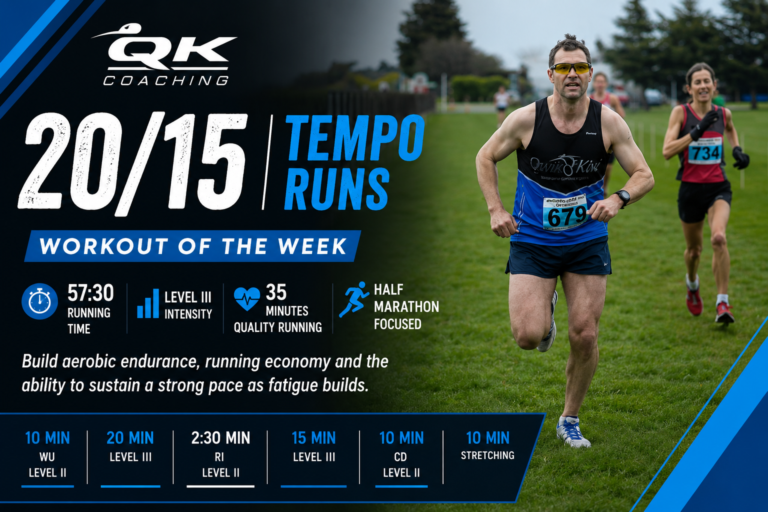
Workout of the Week: 20-15-10 Tempo Runs
This week’s workout is the 20-15-10 Tempo Runs session.
One of the challenges with tempo running is learning to sustain a strong effort without turning every quality workout into a race.
This workout gives you three substantial blocks of quality running, but progressively reduces the duration:
20 minutes → 15 minutes → 10 minutes.
That structure is useful psychologically as well as physiologically.
The first repetition requires patience. Twenty minutes is long enough that starting too aggressively can make the remainder of the session unnecessarily difficult.
Then the duration drops.
When you reach the final 10-minute effort, you’ve already accumulated fatigue, but you also know the remaining work is shorter.
That gives you an opportunity to maintain good quality without needing to turn the session into an all-out effort.
Tempo work helps develop the ability to sustain a strong aerobic pace, builds endurance and teaches pace control — all qualities that transfer directly into half marathon racing.
The lesson is similar to something we’ve talked about repeatedly in recent Weekly Hubs:
Don’t win the beginning of the workout and lose the end.
Run with control, accumulate quality work and finish knowing you’ve completed the session that was prescribed.
Strength Training for Half Marathon Runners
Running more isn’t the only way to become a better runner.
Strength training can play an important role in developing a more robust and efficient runner.
When you’re preparing for a half marathon, you’re asking your body to repeat essentially the same movement thousands of times.
Early in the race, maintaining good running form usually isn’t particularly difficult.
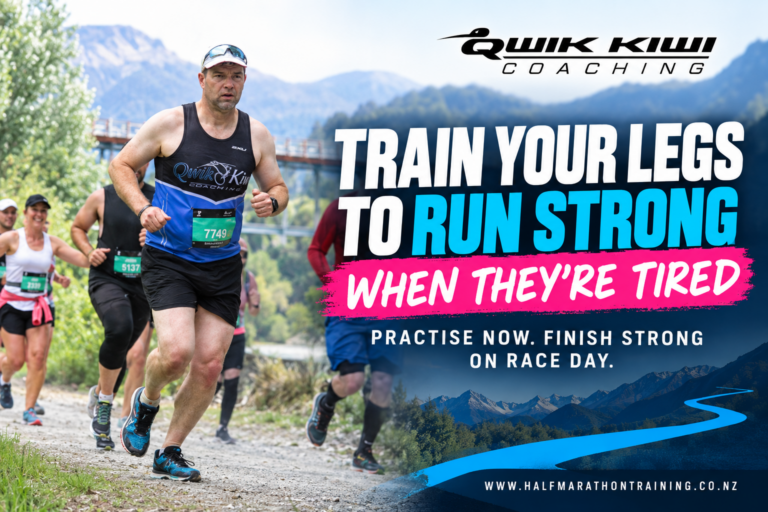
The challenge comes as fatigue accumulates.
Your hips, calves, hamstrings and other supporting muscles still need to control your movement and help you maintain an efficient stride when you’re 15, 18 or 20 kilometres into the race.
That’s one reason strength work matters.
We’re not trying to turn a half marathon runner into a bodybuilder.
We’re trying to build a body capable of supporting the running we want it to perform.
Appropriate strength training can help develop running-specific force production, resilience and economy while supporting the athlete’s ability to tolerate their running programme.
It also needs to fit sensibly around the running.
If your strength session leaves you so fatigued that you can’t complete the key running session that follows, we’ve created a new problem.
Like everything else in a structured programme, strength work needs to have a purpose and an appropriate place within the week.
The aim isn’t to collect workouts.
The aim is to build the runner.
You Train Your Legs — But Have You Trained Your Gut?
The third piece of this week’s training discussion is one that runners sometimes overlook completely.
We practise running at race pace.
We practise long runs.
We practise threshold running.
But then some athletes arrive at race morning and use a fuelling strategy they’ve barely practised.
Your digestive system needs preparation too.
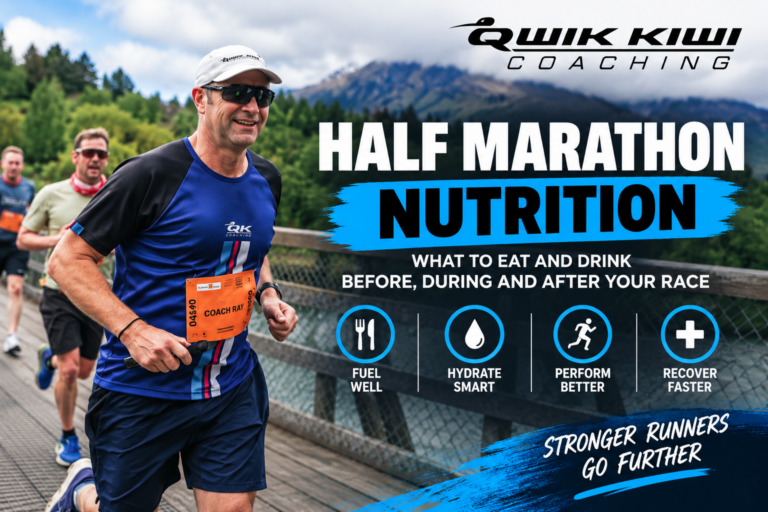
Taking carbohydrate and fluid while running isn’t necessarily the same as consuming them while sitting at home.
Blood flow is being directed towards the working muscles. Your body is bouncing with every stride. Race intensity is higher. Race-day nerves may also affect your stomach.
So your long runs and appropriate race-specific sessions aren’t only opportunities to train your legs.
They’re opportunities to practise fuelling.
That means experimenting well before race day with the products you intend to use, the amount you can comfortably tolerate, when you take them and how much fluid you need alongside them.
If something doesn’t work, training is where you want to discover that.
Not at kilometre 14 of your goal half marathon.
Over time, regularly practising carbohydrate intake during appropriate training can improve your ability to tolerate and use fuel while exercising.
So when we talk about race preparation, don’t simply ask:
“Are my legs ready?”
Ask:
“Is my fuelling strategy ready as well?”
Training Plans Starting Monday 21 September
Two new groups of structured training plans begin next Monday through NZ Half Marathon Hub+.
Canterbury Half Marathon — 12 Weeks
With 12 weeks to go, our Canterbury Half Marathon plans begin on Monday.
At this point we’re close enough to the event that training can become progressively more specific.
There’s still fitness to develop, but every week now has a clear purpose as we work towards race day.
Rotorua Off Road Half Marathon — 24 Weeks
At the other end of the preparation spectrum, our 24-week Rotorua Off Road Half Marathon plans also begin next Monday.
Twenty-four weeks gives us something extremely valuable:
time.
We don’t need to rush immediately into highly specific half marathon training.
We can develop the athlete first, establish consistency, build aerobic endurance and running strength, and progressively prepare the body for the more specific training that comes later.
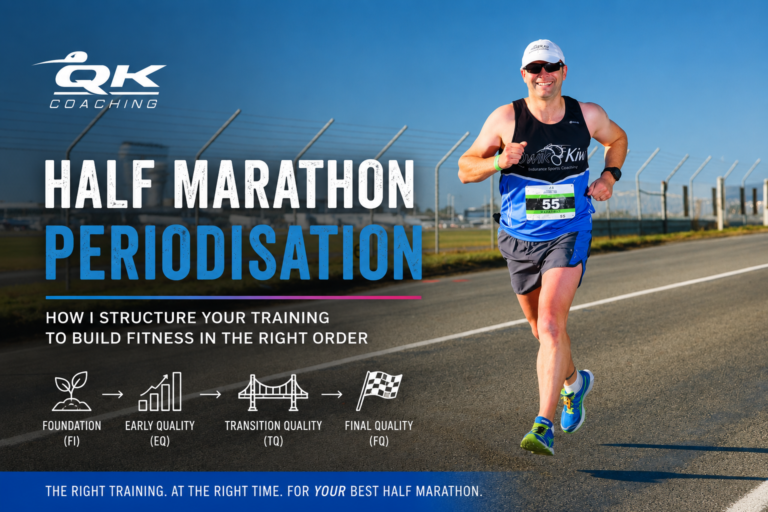
That’s the benefit of periodisation.
We’re not simply asking, “What workout should I do today?”
We’re asking:
“What does this athlete need now so they’re ready for what we’re going to ask them to do later?”
If you’d like structured training leading into your event, you can join NZ Half Marathon Hub+ here:
Coming Up This Weekend — Five Half Marathon-Distance Events
We’ve got another busy weekend ahead.
Saturday 19 September
Linger and Die Trail Run — Alexandra
This is certainly not your conventional road half marathon. The 21.5km course takes runners through Matangi Bike Park and incorporates purpose-built trails, historic gold-mining terrain, punchy climbs and descents.
Merrell Race Tekapo — Lake Tekapo/Takapō
Another challenging trail option, the 21km Race Tekapo course has approximately 550 metres of elevation, starting and finishing on the Tekapo lakefront. (Race Tekapo)
Te Āpiti Traverse — Woodville
One clarification from the calendars: this isn’t technically a certified half marathon. The inaugural event offers a 20km Ruahine course, alongside 10km, 14km and 42km options. The 20km course travels through rolling hills and valleys, so we’ll include it as a half marathon-distance event rather than calling it a 21.1km half marathon.
Sunday 20 September
Cambridge Half Marathon — Cambridge
Cambridge provides a very different challenge. The half marathon uses a predominantly flat, two-lap course and this year’s race doubles as the 2026 Waikato Bay of Plenty Half Marathon Championship. Importantly, the course has now been officially measured and certified, with adjustments made after the 2025 version was found to be slightly short. (Cambridge News)
That should make Cambridge particularly interesting to watch for some quick performances.
There’ll be some extra Qwik Kiwi interest at Cambridge this weekend, with Qwik Kiwi athlete Harrison Shaw lining up for the Cambridge Half Marathon. I’ll be looking forward to seeing how Harrison goes on the fast, predominantly flat course. Good luck, Harrison — run smart, settle into your rhythm and have a great race!
Hutt Half Marathon — Lower Hutt
The Hutt Half Marathon is also changing this year. Work associated with the Te Awa Kairangi project means the event is using new courses for 2026, while the full marathon has been removed from this year’s programme. The half remains a flat, scenic out-and-back event. (Hutt Half Marathon)
Good luck to everyone racing around the country this weekend.
This Week’s Takeaway: Prepare the Whole Runner
There’s a nice theme running through this week’s Hub.
A good half marathon runner isn’t simply someone who can run a lot.
Your tempo sessions develop the ability to sustain quality running.
Your strength training helps develop a body capable of supporting that running.
Your fuelling practice teaches your digestive system to handle what you’re going to ask of it on race day.
Your periodised programme puts those pieces together in the right order.
And then race day gives you the opportunity to use everything you’ve built.
Train the legs. Build the body. Practise the fuelling. Prepare the whole runner.
📩 Get the Half Marathon Hub Weekly in Your Inbox
Want NZ half marathon results, training advice, upcoming races and new workouts delivered directly to you each week?
The Half Marathon Hub Weekly is free.
Join the FREE Half Marathon Hub Weekly
And if you’d like structured training rather than trying to piece everything together yourself, NZ Half Marathon Hub+ gives you access to structured half marathon training plans designed to guide you towards your event.
Coming Next Week
Next Monday we’ll look for results from Linger and Die, Race Tekapo, Te Āpiti Traverse, Cambridge and Hutt, along with the finalised Sri Chinmoy Auckland results if they’re available.
We’ll also continue following the runners whose names keep appearing across the New Zealand half marathon scene and bring you another week of practical half marathon training advice.
Until then, train with purpose — and remember that successful half marathon preparation isn’t just about accumulating kilometres.
It’s about preparing the whole runner.
Coach Ray
Qwik Kiwi Coaching
www.HalfMarathonTraining.co.nz